 |
Volume 11, Issue 5 — March 11, 2013
|
 | |  |
| | |

Digital Signage: More than a Posterboard
By Scott Tiner  Last week’s Digital Signage Expo in Las Vegas was the Expo’s 10th anniversary. It amazes me that a segment of our industry has grown to this level in just ten years. I find digital signage to be so interesting, because for what seems to be a fairly straightforward technology, there are so many applications.
Digital signage can serve a lot of needs and be a lot of things, but unfortunately cheap is not one of them. The cost of setting up a single sign can be anywhere from $3,000 to $10,000, depending on your design and vendor. Once you network that equipment, the cost goes up even higher. Education has struggled on this front, as it has been hard for us to find the Return on Investment (ROI) for a system that costs in the tens of thousands of dollars. We don’t have the same monetary incentive that retailers have to use this technology to generate income.
We have been working with digital signs for about six years ago. It began with a request from our Dean of Faculty’s office for a way to post information about upcoming events, or celebrate academic achievements of our faculty and students. The first sign was a success and every year they would ask us to put up another sign in a new location. From the start we used Tightrope Media System because we knew it could grow with us, and we did not need a massive investment up front.
Slowly, one sign became four, then five and now we have a total of 14 digital signs on our campus. This includes one in every academic building, our two athletic buildings, our dining hall, our student center, our admissions office and our theater.
We have learned some things over the years which have made the digital signage system add value to our community. This first step in this project, like any successful project is to define who does what. As the IT/AV people, we spec, design, install and support the digital signs, but we do not create content. To that end, we are at a point where we do not even provide training for our users. Our communications office has taken on the role of creating all the templates, and training all the users. Each sign has its own local admin who can create content, edit content and approve content. This gives us the ability to keep the signs fresh and updated. No one person is responsible for the content, and most importantly, we (my group) are not responsible for the content. This should be a familiar concept between the IT/AV and Communications groups at institutions. We went through this years ago when IT got out of the business of updating content on web pages. In fact, the model we use for our digital signs is almost an exact duplicate of what we do with our web pages.
In addition to the standard task of advertising events, we have found several additional uses for our digital signs. One task is to stream live video to the signs. We have used this for major campus events such as commencement and convocation. We also use it for remote monitoring. For example, a digital sign outside our concert hall serves as a audio and video monitor of the event happening inside the hall. As people show up late they can see what is going on inside without walking in and interrupting the performance. When they see a break, they can sneak in. During our athletics contests we stream video to the monitors outside of the gymnasium, so people who go to grab a snack or a bit of fresh air can still see what is happening. This proved very useful during a swim meet for our local high school teams. All of the families could not fit in the pool area, so they watched the monitor outside and would rotate in and out as their own child’s event came and went. The beauty of all this is that it is automatically programmed to switch the content. So, right before an event starts, the video feed turns on. Once the event ends, the content goes back to the regularly scheduled content.
A wonderful feature of a networked digital signage system is the ability to make a global announcement. With a networked system a user can log into a web page and set an alert to all the monitors on your campus, or to subsets of the signs. This may pass important information to customers, like closings due to weather. Obviously, we all hope that we never need to use this system in a time of violence or danger on campus, but we also need to be aware of the possibility. I recommend you put a policy in place on how you would handle this situation. In our case, our security office does not directly use the Tightrope System. It is such a rare event that they need to use it, when the time comes they will have forgotten how. Instead, we have identified a couple of everyday users who they would contact in an emergency and those people would set the alert message.
One thing that I will caution against is trying to develop your own custom built digital signage system. I know of a couple cases where this was attempted and neither of them ended very well. In both cases the technology manager got into a position where he was the only person who could support these systems. So, while it looked like a lot of money was being saved up front, one has to question how much money was spent in support of these devices and how much time was lost waiting for this single point of support. When the first request for a digital sign came to our department, there was some discussion of putting a Mac Mini behind a monitor and running a slide show. While this would have been less expensive up front, it was not scalable and would have required a great deal of training and support. If we have taken this approach we would be a real pinch right now trying to support 14 signs.
Integrators and designers can help technology managers on this front, by showing them all the various options for digital signage and more importantly, the various things it allows you to do. Show us these features and tell us how other educational institutions are using them. Budgets are tight, and we may have pressure from above to use an inexpensive “Mac Mini” type solution. You can arm us with the right information to educate our customers. Also, give us some options as to how we can grow. Many schools can not afford a $100,000 investment up front.
In a recent blog on rAVe I wrote about convergence — this is another example of where convergence is simply a part of life. You will eventually, if not immediately, need a server that links all your digital sign boxes. Each device will need to be on the network, and it is desirable to have the system connected into your authentication system so the accounts link to accounts your users already have (LDAP, active directory, etc.). All of this will require strong partnership with your  networking folks. Many systems now branch in other systems. For example, they can read and display RSS feeds and they can tie into your campus scheduling system and show events from it based on criteria you define. The Tightrope system, for example, gives you Web pages that display your digital signage content. Maybe it is time to take your network administrator out to lunch.
Have you started using digital signage in your institution? Was it a success? How did you setup your team and what equipment did you use? I’m looking forward to hearing from you!
Scott is very active in the field, having presented at both regional and national conferences. In 2011, he was appointed as chair of the Technology Managers Council of InfoComm. Scott can be contacted via LinkedIn, on Twitter at http://www.twitter.com/stiner or via email at [email protected]
Leave a Comment  
Share Article
Back to Top 
|
Click above to learn more |
HEVC is Coming – What Will It Change?
By Paul Gray
Director of European TV Research, Display Search  High Efficiency Video Coding (HEVC) is a video compression standard, a successor to H.264/MPEG-4 AVC, which will enable improved video quality, double the data compression ratio, and support 8K UHD (resolutions up to 8192×4320). The ratification of the first draft specification of ITU’s HEVC has been hailed as the dawn of 4Kx2K television. However it is perhaps useful to consider other generations of compression and their effect to evaluate its true significance. MPEG-2 brought the first mass-market digital video formats (MPEG-1 only ever got brief traction in VCD in Asia), enabling DVD and the first digital broadcasts. However its low compression efficiency also made HD broadcast difficult and only a few countries adopted MPEG-2 HD (Australia, Korea, Japan and the U.S.). Probably its biggest effect was to perfect the VCD concept as DVD. MPEG-4’s initial breakthrough was celebrated as bringing economic HD broadcasting – in particular to spectrum-challenged Europe, but since then to all new digital broadcast deployments. However, its greatest impact (viewed with a few years’ hindsight) is not broadcast at all, but Internet video: Netflix, catch-up services and YouTube. MPEG-4 had unlocked video from the TV screen. So what might HEVC bring? It is tempting to imagine that it will unlock a new era of 4Kx2K broadcasting. It is also likely that governments will seize the opportunity to sell some more radio spectrum by migrating terrestrial TV to HEVC. In fact this has already been proposed in France; with budget deficit reduction a political priority the idea is likely to be attractive politically in several countries. However, like MPEG-4 and MPEG-2 before it, its greatest effect may be in perfecting the bleeding edge of the previous codec’s application. Furthermore, with the current ‘pixel war’ in tablet and smartphone screens, Internet video consumption devices are now HD-capable. HEVC’s main effect therefore will likely be ubiquitous HD, not 4Kx2K. The days of your entire HD video library in your pocket are not far away… Paul Gray is director of European TV research for DisplaySearch. He also covers digital broadcast, signal processing and semiconductor technology. He is heavily involved in analysis and forecasting of connected TV and 3D. Paul has worked his entire career in the TV supply chain, and has more than 15 years of experience in market intelligence, marketing and product management. His work includes forecasting, product strategy and investment and R&D decisions. Before joining DisplaySearch, Paul worked at NXP Semiconductors as a market intelligence manager and also as product manager for TV semiconductors. Before NXP, he held positions of increasing responsibility at Philips Display Components (later LG.Philips Displays), including Director and International Account Manager in both Asia and Europe. Paul started his career as a production shift leader in a CRT factory. Paul has a bachelor’s degree in electrical engineering and a management diploma in industrial studies.
Leave a Comment
Share Article Back to Top
|
 Click above to learn more |
InfoComm: Creating Project Managers the Right Way
By Bradley A. Malone, PMP  Many organizations that are beginning to mature their business management practices go through a process of determining who to select as their project managers and how to nurture their competence and capabilities. As a certified Project Management Professional and practicing project manager for 25 years, and as someone who’s taught more than 15,000 students in project management worldwide for the Project Management Institute, InfoComm, and my own organizational excellence consulting company, I have seen many of these selection cycles across many different business markets. I’ve see it at information technology and AV integration companies, construction companies (especially smaller firms), as well as at financial services organizations and many others attempting to improve how they manage projects by using their own internal resources to manage and staff those projects.
Typically, companies start by unconsciously growing their future project managers through a “trial-by-fire” approach to crisis management. They give intelligent, highly motivated technical or functional employees a “challenge” or “opportunity” to fix a problem in a very limited time and with very limited resources. This opportunity is viewed as an emergency, and the company (or manager) is depending on these individuals to “Give 110 percent,” “Pull out all the stops,” “Do whatever it takes,” etc. to get the crisis contained. To paraphrase an oft-quoted phrase, “A crisis is the instantaneous end of a delusion.”
The thing is, attempting to transform a company’s star problem solver into a project manager can be challenging. Many of these problem solvers are what we call technical specialists and they have a general tendency to look within themselves in order to arrive at the desired solution. In fact, let’s list the traits of a typical technical specialist and an optimal project manager and discuss each.
Technical Specialists
Technical specialists — the ones putting out the company’s fires while being groomed for a project management role:
Seek optimal solutions. There is a best answer to the problem and technical specialists usually make every effort to attain it. They often get demoralized when they’re unable to realize the optimal end.
Strive for precision (exactness). Technical specialists look for exactness, and when they can’t give an exact answer, they tend to feel as if their competence or knowledge is being judged. Their estimates tend to be presented as very exact and are often based on optimistic (perfect-world) conditions. Their confidence is directly related to the amount of certainty.
Deal with things. Machines, speakers, equipment, wiring, racks, etc. If technical specialists can understand the inner workings of something like an AV system, they can fix it or make it work. Things can’t talk back or have an opinion that may cause conflict (a condition to be avoided or minimized).
Focus on processes. Technical specialists feel there is a prescribed way of getting things done, in an often systematic and very linear process, and spend time creating their own way of doing things—which they rarely share. Following the developed steps will lead them to the optimal solution.
Practice reactionary problem solving. Putting out fires is a challenge — an opportunity to show one’s expertise and knowledge. The bigger the crisis, the more indispensable the person. Technical specialists only escalate a problem when it has grown insurmountable.
Work with immutable laws. To technical specialists, there are certain laws of nature — physics, electrical, mechanical, etc. — that make sense and must be applied to a problem in order to solve it. They believe there is a “right way” to do things.
Specialize to improve. They get better at their job by becoming more and more knowledgeable about specific areas of interest. Being the expert in a field—the go-to person in a crisis — is the highest compliment.
Succeed individually. Technical specialists focus mainly on diving into a challenge or opportunity individually, removing themselves from their surroundings and focusing all their effort on the specific problem. Communicating often gets in the way of solving the crisis.
A technical specialist is answer-based.
In short, technical specialists see their value and worth measured by how well, quickly and precisely they can answer a question. And if they ever had to ask a question themselves, it would only show others that they didn’t know or couldn’t determine the answer.
Project Managers
While technical specialists are critical to an AV integration firm’s successful operation, they aren’t always the best choice for project management roles. Mature project managers look outside themselves for resources, understand interdependencies and ask probing questions of others (client, design consultant, general contractor, users, technicians, manufacturers, etc,) to achieve the desired outcome. The people you want managing your AV projects:
Seek pragmatic solutions. They defines what is probable and realistic, given the circumstances, assumptions and constraints, and communicate realism, not optimism.
Strive for accuracy (predictability). Project managers know that an accurate estimate always has a confidence range, or a probability factor. They know a precise estimate is typically exact but completely inaccurate and they are comfortable with the unknowns and variances of projects. They remain confident when there is uncertainty.
Deal with people. Most projects impact a range of different people, all of whom have opinions, needs, wants and expectations — many of which are often in conflict. Project managers learn to address conflict early and understand that proactive conflict management is an essential part of a successful project. Early diagnosis and resolution reduce the probability of a dramatic crisis.
Focus on outcomes. They are able to envision the desired result and look at multiple ways to achieve it. They are more focused on deliverables than on following their own rigid processes.
Practice proactive planning. Project managers strive to minimize risk and “fires” through proactive planning. When problems do occur, they will notify others as the problems are worked on and escalate issues early, with viable and well-constructed options.
Work with situational rules. They understand that the world is not perfect and are willing to adapt to the current situation. They’ll make changes based on fluctuating conditions and communicate what is happening versus what was hoped for or expected.
Generalize to improve. They attempt to understand the bigger picture, the interrelationships between the various pieces, and the people involved and affected by a project. Project managers focus on the integration of different specialties and the hand-offs between them. They can picture the spider-web of interdependencies and orchestrate their connections.
Succeed through others. Project managers rely on the expertise of others rather than trying to know all of the answers. They understand that projects are successful because of the combined efforts of many talented people working together.
A project manager is question-based.
In short, project managers understand the value of asking questions, especially those that may seem too simple to ask. They involve many different stakeholders and are willing not to know the answers in order to find the correct solution.
Both of these types of people — technical specialists and project managers — are incredibly important to the successful completion of a project and the continued satisfaction of a client. The challenge is in determining which of your resources is predisposed to growing as a technical specialist and which is more inclined to become a project manager.
Organizations have to separate project management from the technical specialist career path. Not all employees should or can play both roles. Such a practice often diminishes the strengths of our technical specialists and ultimately reduces their value, and their morale.
This column was reprinted with permission from InfoComm International and originally appeared here.
Leave a Comment
Share Article Back to Top
Hospitals Get Smart with Latest Interactive Patient Care Solutions
By Warren Kressinger-Dunn
Vice President of Strategic Marketing, Point of Care for Barco Healthcare Today’s hospitals are facing a virtual tidal wave of demand for healthcare services based on several factors: an aging baby boomer population that requires more intensive care and more of it, new healthcare legislation that is extending eligibility to thousands of newly-insured patients and emerging treatment modalities offering the potential to extend lifetimes to the longest in history.
Complicating matters is an anticipated global healthcare provider shortage, which is threatening the ability of healthcare delivery organizations (HDOs) to meet the growing need for services. As a result, HDOs are aggressively seeking ways to re-tool their operations to provide care more efficiently and cost-effectively to an increasing number of patients, without compromising quality or their own financial bottom lines.
High-Tech Improves Coordination of Care
Fortunately, one of the latest trends in Healthcare IT may provide a partial answer to the crisis in the form of new Interactive Patient Care (IPC) solutions that promise to improve clinical workflow and staff efficiency, while enhancing the patient experience. New and re-purposed technologies are converging to equip the hospital enterprise with a user-friendly IT platform that streamlines numerous processes while empowering patients with tools to personalize their stay and optimize their recovery.
Hospitals are rapidly adopting Radio Frequency Identification (RFID) and Real Time Locating Systems (RTLS) technologies throughout their facilities to automatically identify clinicians and patients and deliver a wealth of patient data to caregivers at the point of care. Featuring built-in security parameters, RFID and RTLS capabilities ensure access to specific patient information only by authorized individuals, so that sensitive data is always protected.

These technologies are now providing value far beyond simple inventory tracking and equipment monitoring in facilities, creating opportunities for a more streamlined, coordinated approach to patient care on behalf of the entire healthcare team. Today’s IPC solutions are designed to increase clinician productivity and enhance both patient safety and comfort. Having a patient’s up-to-date medical history and current medications at your fingertips is the key to safely and effectively delivering optimum care while reducing the administrative burden.
A Portal in the Storm of Information
By combining these automated identification capabilities with new networked, smart terminals located at the point of care, these fully integrated solutions provide a convenient portal to information, services and a diverse array of capabilities for clinicians, staff and patients alike.
Today’s bedside smart terminals come in all shapes and sizes to provide the utmost comfort, control and convenience for both patients and clinicians within the confines of the hospital room. Typically comprising a medical grade all-in-one computer, these consoles are available in wall-, ceiling-mounted or tabletop options for easy viewing and mobility. User-friendly graphic interfaces, similar to smartphone menus, make applications easily accessible via an anti-bacterial touchscreen. Patients can select from a wide array of functions to make their stay more personalized, from ordering their evening meal to checking their daily schedule or simply adjusting the room lighting.
The best-performing solutions offer a turnkey approach to interactive patient care systems, bundling proprietary software with the terminals to ensure seamless operation and smooth connectivity. Many also feature sound ergonomics and sleek styling, in addition to energy-saving LED backlights for a truly “green” approach to bedside computing.
Clinician Collaboration Goes Mobile
 One of the greatest benefits to physicians and other caregivers is the ability to instantly access, update and communicate a patient’s medical data conveniently at the bedside. Using smart cards or RFID cards, doctors and nurses can also securely access the Hospital Information System (HIS) in addition to complete Electronic Medical Records (EMR) for patients. Healthcare providers can view a patient’s chart to prescribe medication, examine x-rays, update records with lab test results – all conveniently at the bedside, so information is available to the entire healthcare team at any moment, from any networked workstation. Moreover, by entering patient data only once at the point of care instead of transcribing notes or logging into multiple workstations, providers can significantly reduce the potential for error and deliver improved efficiencies and clinical workflow.
Clinicians can also use bedside smart terminals to build a rapport with patients, employing these user-friendly tools as an interactive “whiteboard” to communicate more clearly and completely about a patient’s course of treatment. While a patient rests comfortably in bed, the doctor can pull up their latest MRI scan, show a video depicting the upcoming surgical procedure, and provide post-operative instructions to illustrate the continuum of care in a meaningful, understandable way.
Staying Connected for Better Outcomes
In addition to learning more about their condition and course of treatment, patients can utilize smart terminals to access a diverse palette of entertainment and communication apps, allowing them to stay connected, both inside and outside the hospital, during their stay. Armed with a fully-optimized, ergonomic monitor, patients can quickly and easily access television, movies, radio, Internet, email, games, video conferencing and more to make their recuperation more enjoyable.
Hospitalized patients can also use the terminal to communicate with hospital workers, control their room environment, request special meals and view their daily schedule to feel more in control of their experience. It goes without saying that the patient “self-service” aspects of bedside smart terminals can also free up medical staff to attend to more critical tasks and provide better care in a more timely manner.
 Education Promotes Long-Lasting Recovery
Another key benefit, is that patients and their families can view educational brochures and videos about their specific medical condition, including follow-up care, to learn ways to enhance their opportunities for a full recovery. It’s no surprise that a well-informed patient is likely to have a more successful recuperation and return to good health more quickly. We are seeing that patients actively engaged throughout their hospitalization typically experience greater overall satisfaction, which can also positively influence their clinical outcome.
Hospitals Re-tool for Efficiency
Patients who have taken an active role in their care and treatment are often more likely to continue healthy habits upon their return to home. For an HDO, successful patient outcomes can result in fewer re-admissions due to potential complications or relapses. With fewer re-admissions, hospitals can benefit from faster bed turnarounds to accommodate new, incoming patients.
In addition to their clinical advantages, IPC solutions can also aid healthcare administrators in significantly improving operational efficiency throughout the hospital enterprise. Anything that empowers clinicians and staff to increase their productivity and throughput is going to benefit an institution’s bottom line.
Hospitals can leverage the networked communications and information-sharing capabilities of IPC solutions to reduce the administrative burden on providers and staff, primarily by eliminating repetitive data entry and automating many routine tasks. Also, by integrating these solutions into the hospital’s nurse call systems, hospitals can enable caregivers to prioritize and more fully respond to requests while allowing patients to obtain exactly the type of assistance needed. For the hospital, these types of modifications can enable a smarter approach to staffing and clinician coverage, which in turn, improves utilization of resources across the enterprise.
Creating New Revenue Streams
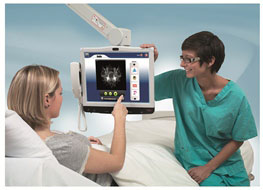 The flexibility of the platform also enables hospitals to package and upsell premium patient entertainment packages to create a new source of revenue stream, complete with integrated billing systems for true self-service entertainment. This may also be a benefit that prompts patients to rate their hospital highly when it comes to satisfaction surveys. The bedside smart terminal makes this easy! Hospitals can offer online patient satisfaction surveys right on the device, potentially using positive results to secure higher reimbursements from many healthcare insurers. Patients can take surveys anytime during, and at the conclusion at their stay, providing feedback on numerous parameters which can be used by healthcare administrators to continue improving the delivery of care.
From a cost-containment perspective, hospitals typically benefit from the bundling benefit of IPC solutions, i.e., sole-sourcing TV/telephone/Internet platform and services, which typically results in a lower total cost of ownership for these items when not combined.
Paving a New Path to Quality Care
IPC solutions can play a vital role in ensuring the continuity and quality of patient care, closing the resource gap with innovative, self-service tools that benefit patients, clinicians and the entire hospital enterprise. By adopting these bedside smart terminals in their facilities, healthcare delivery organizations can continue their mission of safely and cost-effectively delivering high-quality patient care in a new era of growing demand for services.
Warren Kressinger-Dunn is vice president of strategic marketing, Point of Care for Barco Healthcare. In his current role, he leads the corporate strategic direction and product development for Barco’s Point of Care solutions. Bringing more than 25 years of experience in the electronics industry, Kressinger-Dunn joined Barco during its acquisition of JaoTech where he formerly served as the company’s chief executive officer.
Leave a Comment
Share Article Back to Top
|
 Click above to learn more |
Sharp Samsung Alliance – An Alliance of Mutual Benefits
By David Hsieh
DisplaySearch  According to news reports, Sharp is in talks with Samsung on concluding a capital and business alliance. The two sides are believed to be in final negotiations, with Sharp likely to receive around 10 billion yen ($107M) in investment from Samsung, in exchange for a 3 percent stake of Sharp. We believe Samsung’s main purpose is to secure panel supply from Sharp, especially 32” produced on the Gen 8 line (Kaymeyama-II fab) and 40” and 60” from Gen 10 (Sakai fab). Sharp also produces mobile device panels with high resolution using CGS (a form of LTPS) and oxide TFT technology, so it is also likely that Samsung, with huge demand for mobile panels, will also purchase the high resolution mobile panels from Sharp. We believe this decision can be attributed to several causes:
- Samsung and Sharp have long been rivals, but Sharp has apparently determined that forming an alliance with its rival in flat-screen TVs and mobile phone handsets is required to improve its performance and financial standing. Sharp has been struggling with its financial position and has been seeking investment, including Foxconn (which invested in 50 percent of its Sakai Gen 10 fab) and Qualcomm (which invested in $120M and has more than a 5 percent stake). Sharp is also in talks with Intel and Dell. The near-term financial need for Sharp is a loan payment of 200 billion yen in Q3’13.
- Samsung’s purpose is mainly to secure TV panels, especially 32”, 40” and 60”. According to the Quarterly LCD TV Value Chain Report, Sharp has been a key supplier of 40” to Samsung, with more than 400K per quarter, and 60” with more than 200K per quarter in Q3’12. Due to the reduced orders for displays for Apple’s iPad, Sharp has been shifting Gen 8 capacity, which was originally making 9.7” tablet PC panels, to produce 32” LCD TV panels for Samsung. With the Taiwanese retreating from supplying 32” panels, Samsung is eager to secure a new source. Sharp started to ship 32” to Samsung at the beginning of 2013. In total, Samsung will be buying more than one million panels from Sharp, so it may make sense for Samsung to invest to secure the source.
- Given that Sharp is a leader in oxide TFT technology, especially at Gen 8, it’s possible that Samsung can utilize the oxide TFT backplanes from Sharp for its AMOLED TV.
- This may indicate that Samsung wants to continue to source a certain percentage of panels externally. There are indications that Samsung Display is reducing the scale of its own TFT LCD fab investment in China. It’s possible that the Samsung group intends to curb new TFT LCD capacity expansion and focus more on AMOLED TV.
- Foxconn has been intending to make additional investments in Sharp to access more high resolution displays for mobile devices. But Sharp has been reluctant to give Foxconn additional control. The investments from Qualcomm, possibly Intel, and now Samsung indicate that Sharp’s strategy is to balance multiple investors rather than rely on one. Foxconn might not be happy with this because of its poor business relationship with Samsung. However, as Foxconn is seeking to grow its OEM/ODM business and Apple’s growth is limited, it’s also possible that Foxconn will start to talk with Samsung about an OEM/ODM relationship on LCD TV and other mobile devices.
In the business world, there are no permanent enemies or friends. Sharp and Samsung disliked each other in the past, but the present realities may lead them to work together. Sharp is becoming a big ship, with investments from many companies. All of these investors will see different benefits and conflicts in this big Sharp ship.
This column was reprinted with permission from DisplaySearch and originally appeared here.
Leave a Comment
Share Article Back to Top
|
 Click above to learn more |

Recently from rAVe's BlogSquad Back to Top 
Almo Announces New Distribution Agreement with Elo Touch Solutions  Almo Professional A/V announced this week a new distribution agreement with Elo Touch Solutions, a global supplier of touch-enabled Interactive Digital Signage (IDS) technology. Almo Pro A/V reseller partners now have access to Elo’s touch interactive experiences in screen sizes ranging from 7 inches to 70 inches. “The Elo team is excited to engage with the Almo digital signage thought leaders and certified Pro A/V technology experts,” said Craig Witsoe, CEO, Elo Touch Solutions. “Together we will help resellers and end-users realize the possibilities for digital signage to help education, government, hospitality, healthcare, and retail organizations enhance their audience experience and optimize communications efficiency.” “Our resellers are experiencing increasing demand for large format touch-enabled displays,” explained Sam Taylor, executive vice president and COO for Almo Professional A/V. “We’re partnering with Elo Touch Solutions because they provide a broad portfolio of screen sizes and touch technologies our resellers can incorporate into their projects with the service and support to back Elo’s innovative products.” Almo will show Elo Touch Solutions products in its booth (#1251) at the Digital Signage Expo in Las Vegas this week. Learn more about Almo Pro A/V here: http://www.almoproav.com/ Learn about Elo Touch Solutions here: http://www.elotouch.com Leave a Comment
Share Article Back to Top
|
 Click above to learn more |
NSCA's BLC Was Huge Success  More than 250 systems integration professionals gathered in Phoenix, AZ, last week to discuss strategies to create a profitable business despite a number of transformations affecting their business. NSCA’s 15th Annual Business & Leadership Conference, commonly referred to as “the best ever,” witnessed record-breaking numbers for the fourth year in a row, in addition to welcoming more than 55 first time-attendees from the integrator community.
The industry-specific business conference delivered information to innovate integration professionals that will improve their business life cycles, create leadership among their employees and management teams, utilize economic factors to administer logical business decisions and were inspired to be more by one of the most dynamic speakers the conference has hosted.
“The 2013 BLC deliverable exceeded its billing,” said Advanced AV Vice President of Sales & Marketing John Greene. “The event was business altering. It included a wonderful agenda with informative, challenging and pertinent speakers who delivered business solution on industry issues ranging from economic to marketing, strategic and motivational. This year was even better than 2012, which was remarkable, and the primary reason I attended this year’s event. I will not miss next year and if you are involved in the communication industry you need to consider this conference if you want to stay relevant. The peer networking alone was worth any expense.”
Several integration companies have been bringing their entire management staff, from accountants, technology managers to CEOs, and using this conference to kick-off their strategic planning meetings. They incorporate the thought processes and content to build their business plan and check in on their current processes and procedures.
“It was refreshing to have successful speakers finally say ‘it’s time to pull up your bootstraps,’” said Andy Musci, Altel Systems, Inc. president/CEO and a member of the BLC planning committee. “To receive that message and then be inspired to make it happen – I’m looking forward to building off of this momentum.”
“I am overwhelmed by the response from our attendees, sponsors, and speakers this year,” said Chuck Wilson, NSCA executive director. “Our speakers were thrilled to have such an engaged audience. Their messages resonated with the pain points of our members, the concepts and theories that will improve profits, meet customer expectations and so much more. We truly heard how this was the best event yet and hearing from a couple of our Excellence in Business panelists that they incorporated strategies learned from this conference and improved profits by 50 percent — it is exciting to realize the impact this conference has on our integrators success.”
“Attending BLC was exactly what I needed to focus my efforts in growing my company, said Gregory Meyet, BAE Technology Inc.; vice president of business development and first-time attendee. “I had decided to attend so that I could meet with other successful integrators, share ideas and develop strong relationships. Growth is my immediate focus for BAE Technology and the BLC provided some strong information to help me achieve that goal!”
Despite arriving to snow in Phoenix, more than 60 golfers participated in the NSCA Education Foundation Golf Tournament which led to three days filled with networking, inspiration, and motivation to build a better business.
“We get asked to sponsor events every day, but Listen Technologies has chosen the BLC due to the incredible networking opportunities,” said co-founder and Vice President of Sales Worldwide for Listen Technologies Corporation Cory Schaeffer. “We have found the caliber of the attendees to be outstanding and with quality time to actually network. I have left each BLC feeling enriched and inspired unlike any other industry event I’ve attended. NSCA has the secret ingredient to pull off the most amazing topics with dynamic speakers.”
NSCA announced the 2014 Business & Leadership Conference at the conclusion of the conference and received nearly 70 registrations on-site. Additionally, the NSCA Education Foundation will offer twice as many Randy Vaughan Founders Awards, 20 in total, for the 2014 event. Award winners will receive complimentary admission to the Business & Leadership Conference, of which Randy Vaughan founded in 1998. The 2014 Business & Leadership Conference will be held February 27 – March 1, in Dallas, TX, at the Four Seasons Las Colinas. Registration is now open by visiting http://www.nsca.org/blc
Leave a Comment
Share Article Back to Top
ClearOne Buys Back $10 Million Worth of Own Stock  On May 16, 2012 the Board of Directors of ClearOne authorized a stock buy-back program to acquire up to $2,000,000 in the Company’s common stock during the next twelve months. On July 30, 2012 the Board authorized to increase the amount available for the stock buy-back program from $2,000,000 to $3,000,000.
Yesterday, the Board authorized to increase the amount available for the stock buy-back program from $3,000,000 to $10,000,000.
Generally, this is a good sign that the company believes it's in a good financial position and wants more control from the shareholders. We'll continue to monitor ClearOne's 8-K fillings and report them as we see them.
ClearOne is here: http://www.clearone.com
Leave a Comment
Share Article Back to Top
|
 Click above to learn more |

|
 Click above to learn more |

Extron Announces New EDID Emulator for HDMI  Extron introduced the EDID 101H, an EDID Emulator for HDMI signal sources. It features EDID Minder, an Extron exclusive technology that automatically manages EDID communication between connected devices. Pre-stored EDID is communicated to the source based on a user-selected resolution and refresh rate. Alternatively, the EDID 101H can be set to capture and store EDID information when connected to a display. A unique HPD (Hot Plug Detect) port provides control for remote cameras and other signal sources that require a periodic HPD trigger.
The EDID 101H joins the EDID 101 Series of EDID emulators, which includes the EDID 101D for DVI and the EDID 101V for VGA signals. The EDID 101H is housed in a compact 1" high, quarter rack width metal enclosure for convenient, discreet installation. An energy-efficient external universal power supply is included.
Here are all the specs: http://www.extron.com/product/product.aspx?id=edid101h&s=5
Leave a Comment
Share Article Back to Top
RP Visual Solutions Releases Matrix Flex Mount for Flat Panel Arrays  RP Visual Solutions has launched what it is calling an "economical" matrix flex mount for flat panel arrays. Dubbed the RPMM-Matrix Flex Mount, it's CNC-laser-cut from formed 3/16” black powder-coat welded steel. This mount can extend out from the wall up to 30 inches, allowing an installer, service person or end-user to physically get behind the mount for cable connecting and trouble shooting. Additionally, the mount articulates left and right to enhance the viewing experience and for ease of installation or service.
The RPV RPMM Matrix Flex Mount enables a large flat panel matrix to be firmly held in position and mounted on a load bearing wall. If the wall is not able to hold the flat panel weight, custom H-Frames (steel slab-slab posts), floor stands or overhead support structures are available as installation options. This mount is ideal for two high 46”, 55”, and 60” flat panels. It can go up to four wide.
The RPMM-Matrix Flex Mount is shipping now. Here are the details: http://www.rpvisuals.com/
Leave a Comment
Share Article Back to Top
Extron Now Shipping Select DMP 128 Audio DSP Models with Dante  Extron is shipping the DMP 128 AT and DMP 128 C AT audio digital signal processors with Dante network connectivity from Audinate. Both DMP 128 models are 12×8 audio mixers featuring Extron ProDSP, automixing and I/O expansion capabilities. The DMP 128 C AT version also features AEC — acoustic echo cancellation. DMP 128 AT models feature a 56 input by 24 output expansion matrix, providing efficient scalability for creating larger audio matrices over a local area network using standard Internet Protocols. A built-in four-port Gigabit switch provides direct interconnection of multiple DMP 128 AT units. The award-winning DMP 128 Series offers a configuration approach to DSP that simplifies mixing, routing, conferencing and room optimization. Quick and intuitive configuration using the DSP Configurator Software allows the DMP 128 to be installed in very little time, with easy-to-learn adjustments that can be heard in real-time.
DMP 128 AT models provide scalable audio transport over a local area network using standard Internet protocols. Each processor sends out 24 channels of 24-bit/48 kHz digital audio and can receive 56 channels over the network. A built-in four-port Gigabit switch also provides direct interconnection of multiple DMP 128 AT units to create larger, cost-effective audio matrixes. Dante technology distributes a virtually unlimited 512×512 audio channels at 24-bit/48 kHz over a single Gigabit Ethernet link, or 48×48 audio channels at 24-bit/48 kHz over a single 100 Mbps Ethernet link, plus integrated control data with extremely low latency. Both Dante and the DMP 128 AT processor's four-port switch are AVB – Audio Video Bridging ready.
The DMP 128 features Extron ProDSP, engineered from the ground up using a powerful 64-bit floating point DSP engine and studio grade 24-bit converters with 48 kHz sampling. ProDSP is managed by the intuitive DSP Configurator Software, featuring an easy-to-use GUI that allows for complete audio system visualization within a single window. All DMP 128 models include an automixer with gated and gain sharing modes for managing up to eight groups of microphone signals. Select DMP 128 processors feature Extron AEC with eight independent channels of high performance, fast echo cancellation for optimal intelligibility in conferencing applications.
Here are the specs: http://www.extron.com/company/article.aspx?id=dmp128ad&s=sl01
Leave a Comment
Share Article Back to Top
Extron Expands HDMI Distribution Amplifier Lineup  Extron has introduced two new, larger HDMI distribution amplifiers as part of its HDMI DA Series product line. The HDMI DA4 with four outputs, and HDMI DA6 with six outputs, are HDCP compliant and support HDMI specification features including data rates up to 6.75 Gbps, 12-bit Deep Color, 3D, Lip Sync and HD lossless audio formats. They also support HDTV 1080p/60 and PC resolutions up to 1920×1200. For ease of integration and reliable operation, the HDMI DA Series features two Extron technologies: EDID Minder, which maintains continuous EDID communication between connected devices, and Key Minder, which continuously authenticates HDMI encryption between all devices, ensuring the simultaneous distribution of source content to connected displays.
To enhance and simplify integration, the HDMI DA Series offers features including automatic input cable equalization, automatic color bit depth management and selectable output muting, as well as indicators for monitoring and troubleshooting. Input cable equalization restores and reshapes incoming HDMI signals, reducing the need for additional signal conditioning equipment by compensating for weak source signals or signal loss from a long input cable. The HDMI DA Series automatically adjusts color bit depth based on the display EDID, preventing color compatibility conflicts between source and display. Outputs can be muted independently via RS-232, allowing content to be previewed on a local monitor. Additionally, the distribution amplifiers provide immediate visual confirmation of EDID status, HDCP authentication, and signal presence confirmation for each port via front panel LED indicators.
Here are all the stats: http://www.extron.com/product/product.aspx?id=hdmidaseries&s=5
Leave a Comment
Share Article Back to Top
Savant Expands SmartView Video Tiling Technology  Savant Systems has expanded the capabilities of its SmartView Tiling technology to deliver up to nine high definition (HD) windows of content or media on a single display. SmartView Tiling, initially unveiled with a six-tile capacity, is a versatile technology featuring broadcast quality video processing and scaling that is appropriate for both residential and commercial applications. Savant SmartView Tiling will accept video input resolutions up to 1080p while delivering HD video to the display via HDMI. Source inputs can broadly range from Blu-ray players, cable boxes, security cameras or other video devices. Most importantly, users will be able to easily arrange their tiling, change content programming and save "favorite" configurations all via Savant's intuitive iPad interface. The nine-tile version is available now with Savant's multi-window video processing modules, the VOM-SV02 and the SVT-009T platform.
Leave a Comment
Share Article Back to Top
Extron Ships Six-Input, HDCP-Compliant Scaling Presentation Switcher  Extron Electronics is shipping the IN1606, a six-input, HDCP-compliant video scaler that includes four HDMI inputs, two universal analog video inputs and two simultaneous HDMI outputs. The IN1606 accepts a wide variety of video formats including HDMI, HDTV, RGB and standard definition video. Its video scaling engine features 1080i deinterlacing, Deep Color processing and seamless switching with support for up to 1920×1200 and 2K output resolutions. Enhanced audio features include six stereo inputs, fixed and variable stereo outputs, two mic/line inputs with ducking and 48 V phantom power, plus HDMI audio embedding and de-embedding. The IN1606 also offers a complete AV switching system with flexible control options including Ethernet, RS-232, and USB.
To enhance and simplify integration, the IN1606 features SpeedSwitch Technology, which Extron says provides exceptional switching speed for HDCP-encrypted content. EDID Minder and Key Minder automatically manage EDID communication and HDCP key negotiation between input and output devices to ensure reliable operation. The IN1606 also provides immediate visual confirmation and real-time HDCP status verification.
With HDMI audio embedding and de-embedding, the IN1606 can insert analog input audio signals onto the HDMI output or extract embedded HDMI audio signals. Audio breakaway allows the analog audio channels to be separated from corresponding video signals so that the audio channels can operate as an independent switcher. The IN1606 also provides control of advanced audio configuration settings, such as audio gain, attenuation, mixing and ducking.
For more information, click here: http://www.extron.com/in1606pr.
Leave a Comment
Share Article Back to Top
Savant Calls Ube's Bluff with Wi-Fi Thermostat  Savant Systems has announced the availability of the Savant Wireless Thermostat, SST-W100. The SST-W100 is a Wi-Fi enabled digital thermostat designed to control Heating, Ventilation and Air Conditioning (HVAC) systems within any residential or commercial setting and integrate seamlessly into a Savant-controlled environment. The SST-W100 is a versatile thermostat for one and two stage control of forced air, radiant, heat pump and HVAC systems.
The Savant SST-W100, requiring only standard thermostat wiring at its mounting location, is ideal for retrofit installations thanks to its wireless communication to Savant's SmartSystem controllers. The SST-W100 provides access to temperature adjustments from anywhere in the home or from a remote location using any Savant interface. Multiple Savant thermostats may be networked over an existing Wi-Fi network, enabling temperature and humidity adjustment from any SST-W100 in the home. Energy conservation is achieved by programming the HVAC system (using the HVAC Scheduler within the Savant TrueControl iPad app) to automatically respond based upon outside temperature, season or time of day.
Up to two optional remote temperature sensors (sold separately) can be connected to the SST-W100 for enhanced flexibility and optimized performance when required. Climate can be regulated according to the average of multiple sensors or the built-in sensors within the thermostat can be disabled entirely to allow the SST-W1000 to be installed out of sight.
Key features include:
- Wi-Fi (802.11) enabled thermostat
- Supports standard or heat pump HVAC systems
- Includes 128 x 64 backlit graphical display
- Local temperature displays on backlit LCD
- Set point display and control
- System mode (off, auto, heat, and cool)
- Fan display and control (auto, manual, and on)
- Six buttons with on-screen labels
- Fahrenheit or Celsius modes
- Optional remote sensors
- Optional flush mount accessory
- Integrates easily with TrueControl
- Automatically sends changes, so there is no polling
Here are all the stats: http://www.savantsystems.com/product-details/savant_wireless_thermostat.aspx
Leave a Comment
Share Article Back to Top 
BenQ Debuts New 4K Lumen HD Projector 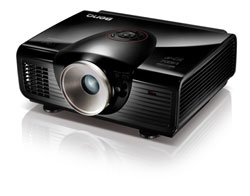 BenQ's new SH940 is a native 1920x1080p resolution DLP projector that's specified at 4,000 lumens and a contrast ratio of 50,000:1. Included with horizontal and vertical lens shift, 2D keystone correction and throw ratios of up to 2.43, the SH940 is aimed at both home theater applications since it includes an HDMI ports and a VGA port in addition to a set of five BNC (RGBHV) for connecting systems the old-fashioned way.
For IT managers maintaining facility-wide installations, features such as scheduling, monitoring, email alerts and control of multiple A/V gear are all provided through an intuitive user interface to make maintenance easier. With a LAN control feature, the SH940 also provides support for Crestron, SNMP, PJLink, and AMX systems, enabling remote management and control in addition to projector maintenance from workstations.
To reduce energy costs, power-saving features such as an "Eco Blank Mode" allow presenters to blank out the projection screen whenever the projector is not in use, while a standby mode will lower power consumption to less than 0.5W while the SH940 is inactive. Lamp replacement has also been made extra easy with access from the side or top of the projector while a filter-free optical system and BenQ's no color decay further reduces the TCO of the device.
The SH940 is shipping now and lists for $3,999. You can see all the specs at: http://www.BenQ.us
Leave a Comment
Share Article Back to Top
Delta Displays Introduces Innovative WX21 and WX31 Megapixel Displays  Delta Products is launching the WX21 and WX31 WideXtreme (WX) megapixel displays that Delta claims can be assembled in under an hour and calibrated in seconds using Mersive's auto-calibrating Sol software. In addition to integrating Mersive's Sol software, the WX series displays are also the first displays to ship with Mersive's Solstice software, a new application that allows multiple users to access and share the display simultaneously using laptops and mobile devices over an existing IP network. Delta’s WX displays effectively solve two of the most common problems found in nearly all conference rooms today: the lack of cost effective beyond HD display systems, and collaborative software to connect, control, and share. Here are all the stats: http://www.delta-americas.com/displaysolutions/products/WX-Series-Displays/
Leave a Comment
Share Article Back to Top
Panasonic Ships New Solid Shine Series of LED/Laser Projectors  Panasonic told rAVe today that its new SOLID SHINE Series of lamp-free projectors with DIGITAL LINK technology are already shipping. The LED/laser light source in the SOLID SHINE Series of one-chip DLP projectors is specified with a 20,000 hours light-source life span. All models in the series are spec'd to deliver 3,500 lumens of brightness. Integrated with a DIGITAL LINK terminal, and by combining an optional interface box with its HDMI and other input terminals, a user can transmit uncompressed HD digital video, audio and control signals (Ethernet, RS-232C) for up to 100 meters (328 feet) through a single CAT5e cable.
DIGITAL LINK is an original function added to technology based on the transmission standards used in Crestron’s DigitalMedia 8G+ and Extron’s XTP Systems, as well as others. Signals from the ET-YFB100G Digital Interface Box can also be relayed to a non-DIGITAL LINK-ready projector by using another manufacturer’s equipment based on the same technology.
The PT-RZ470/RZ370 Series projectors offer installation flexibility, with a 2x zoom, wide lens shift capability, HDMI/DVI digital inputs and Crestron RoomView compatibility. The PT-RZ470 Series offers additional flexibility with portrait mode projection capability, as well as edge blending, color matching and 3D.
The PT-RZ370 Series, which includes the PT-RZ370U (1920×1080) and PT-RW330U (1280×800), are available immediately and list for $5,899 and $4,599, respectively. The PT-RZ470 Series, which includes the PT-RZ470UK/UW (1920×1080) and PT-RW430UK/UW (1280×800) will be available in March and will list for $6,799 and $5,499, respectively.
Here are all the specs: http://panasonic.com/business/projectors/
Leave a Comment
Share Article Back to Top
BenQ Launches New Entry-Line of Projectors  BenQ's new entry-level M6 Series MS616ST, MX618ST, MX662 and MW663 models are spec'd at contrast ratios of 13,000:1 and up to 3,500 ANSI lumens of brightness. They also include BenQ's SmartEco technology to cut energy consumption by up to 70 percent. Designed for corporate, classroom and personal spaces, the MS616ST (SVGA) and MX618ST (XGA) are short-throw projectors offering wireless connectivity for "Bring Your Own Device" (BYOD) scenarios. The higher brightness versions are the MX662 (XGA projector spec'd at 3,500 ANSI lumens) and the MW663 (a WXGA wide-screen projector spec'd at 3,000 ANSI lumens).
One interesting feature is that the BenQ M6 Series features wireless display options for cable-free connection to content sources. When paired with BenQ's Qpresenter app for the iPhone and iPad, users can transfer files from their handheld iOS devices directly to the projection screen. What makes them green is that BenQ's SmartEco technology allows users the same brightness, features and performance at a lower total cost of ownership (TCO). For instance, in "Smart Eco" mode, projectors automatically adjust lamp power by up to 70 percent in order to use just the right amount of brightness needed. The result is an 6,500 hours of lamp life without any compromise to picture quality, according to BenQ. To further reduce power consumption, an "Eco Blank" mode allows teachers or presenters to blank out the screen whenever projection isn't needed while a "No Source Detected" mode automatically lowers brightness to 30 percent when no display has been detected for more than three minutes. An audio pass through function also preserves lamp life by enabling only sound when projectors are on standby.
Available now, the BenQ MS616ST, MX618ST, MX662 and MW663 retail at $699, $899, $799, and $799 respectively. Here they are: http://www.benq.us/products/product_line.cfm?plid=8
Leave a Comment
Share Article Back to Top 
Planar UltraRes Displays Bring 4K Clarity to Professional Applications  At DSE, Planar Systems, Inc. announced its 84-inch Planar UltraResTM display product line, designed for ultra-high resolution commercial applications.
The new Planar UltraRes 4K displays provide native ultra–high definition resolution (3840×2160), outstanding image quality and a range of configurations. Planar UltraRes displays are ideal for professionals in a wide variety of commercial industries who require a large viewing area, very high pixel density and enterprise-level features that allow teams to collaborate around more immersive and detailed visual information.
Making the Most of High-Resolution Information
Planar UltraRes 84-inch displays are designed for applications including energy, geospatial, engineering and design, architecture, aerospace, control room, collaborative conference room, medical imaging, science and digital signage, among others.
Features include:
- LED-lit LCD technology, selectable dynamic contrast and local dimming for enhanced contrast
- 60Hz refresh rate and 10-bit color
- A slim metal bezel
- Failover power supply for 24×7 environments
- Planar Profile Mounting System, which allows for an extremely slim profile when wall-mounted (about three inches) and provides a front service access mode
- Advanced energy-efficient design that utilizes edge-lit LED technology and passive cooling
- Ability to switch to standby mode when no source is detected
- Consumption of less than 0.5 watt of standby power
- Modular for easy repair
Planar UltraRes displays come in three base models:
- UR8450-LX: 2D landscape display ideal for conference and control rooms
- UR8450-MX: 2D landscape and portrait, higher brightness model designed for digital
- signage and other higher ambient light environments
- UR8450-3D: 2D and 3D landscape support, ideal for decision rooms where both 2D
- and 3D images and video are viewed
Planar says the 4K displays will be available in the second quarter of this year. For more information, visit http://www.planar.com
Leave a Comment
Share Article Back to Top
NEC Display Adds 42-Inch, LED-Backlit LCD to V Series  NEC announced today the 42-inch V423 LCD display, an addition to its commercial-grade V Series that utilizes LED backlighting for improved power consumption and a slimmer cabinet depth.
NEC says the V423 offers a 46 percent decrease in power consumption while maintaining its brightness (450 cd/m² maximum brightness). The edge-lit LED backlight enables a slimmer cabinet depth and lightweight design. With a full HD panel, integrated temperature sensors and fans, the V423 large-screen display is ideal for applications that require extended use, such as retail stores, restaurants, indoor venues, training facilities and corporate boardrooms.
The V423 also features built-in, 10-watt speakers and an Open Pluggable Specification (OPS) compliant expansion slot. Video, RS-232 control and power are passed internally from the display to the computer, eliminating additional cabling.
The V423 includes the following features:
- LED backlighting technology for reduced power consumption
- Commercial-grade LCD panel and components, which enable extended run times
- 1920×1080 native resolution
- 320/450 cd/m² brightness (typical/maximum) and 1300:1 contrast ratio
- DisplayPort, HDMI, DVI-D (in/out), VGA 15 pin D-sub (Composite, Component, S-Video)
- RS-232C, Ethernet (RJ45), IR Remote, DDC/CI for external control
- Built-in, 10-watt speakers enhance the experience with superior sound
- TileMatrix, which facilitates video walls up to 10×10
- Built-in ATSC digital tuner, which allows for high-definition broadcast capabilities (V423-AVT model only)
- Bundled solution, which includes a V423 display and single board computer (OPS-PCAF-WS) for simple digital signage (V423-PC model only)
- Optional accessories, including speakers, stand, a variety of internal and external computers, digital tuner, calibration kit and wall mount
The V423 display is available at a minimum advertised price of $899. The V423-AVT and V423-PC models are priced at $1,099 and $1,699, respectively.
For more information, click here: http://www.necdisplay.com/p/large–screen-displays/v423
Leave a Comment
Share Article Back to Top
NEC Adds 46-Inch and 52-Inch to Super-Slim Line  NEC Display added two super-slim displays to its specialty X Series portfolio in the form of the 46-inch X462S and 55-inch X552S. NEC is calling these "industrial-strength." Using LED backlighting and a mere 1.8 inches deep, the X462S and X552S are not only super-slim and ultra light, but they also deliver a brightness of 700 cd/m².
In addition, these super-slim displays include the Open Pluggable Specification (OPS) slot, a standardization designed to simplify installations, use and maintenance of digital signage. Users receive full connectivity, including DisplayPort, HDMI and DVI-D, as well as remote management through the Network Control and Communication tools.
The X462S and X552S displays include the following features: - LED backlighting technology, which reduces power consumption and contributes to a lightweight design with minimal 1.8-inch depth
- Commercial-grade LCD panel and components, which enable extended run times
- 1920×1080 native resolution, which provides stunning image clarity
- 500/700 cd/m² brightness (typical/maximum) and 3,000:1 contrast ratio delivering brilliant imagery
- DisplayPort, HDMI and DVI-D (in/out), which enable connectivity to a wide range of peripherals
- RS-232C, LAN and DDC/CI for external control
- TileMatrix, which facilitates video walls up to 100 displays in 10×10 configurations
- Optional color-calibration solution, which enables color uniformity and fidelity across individual and multiple screens
- Real-time clock, which has the ability to set schedules for on/off times 24/7 and can be set to warm up 30 minutes before use for optimum color representation
- Built-in ATSC digital tuner
The X462S and X552S are available at minimum advertised prices of $1,999 and $3,099, respectively and are here: http://www.necdisplay.com/category/large-screen-displays
Leave a Comment
Share Article Back to Top 
Promethean and Epson Announce Partnership  Promethean and Epson today announced a partnership that gives educators in the United States and Canada a wider range of options for converting classrooms into collaborative and interactive learning environments.
Under the agreement announced today, customers will be able to purchase Promethean’s teaching and learning software, ActivInspire, from Epson when buying Epson’s industry-leading BrightLink interactive projectors. Each company will provide world-class customer support for their respective products, giving educators full confidence and support as they convert classrooms and learning spaces to interactive work areas.
“School districts want to select the best interactive hardware and the best interactive software tools independently that suit their needs and budgets,” said Keith Kratzberg, senior vice president of Epson America, Inc. “This partnership squarely delivers on that request from the education community and seamlessly brings together the highly acclaimed software of Promethean with Epson BrightLink, the top selling line of interactive projectors in the world1, to transform classrooms across the United States and Canada.”
Under the agreement, Epson will have licensing rights to sell Promethean ActivInspire to new and existing customers using BrightLink interactive projectors throughout the United States and Canada, providing educators more options as they transition to collaborative, interactive classrooms.
“We want to give educators the flexibility to create environments where students can experience a 21stcentury lesson with the tools and resources that make sense to them. By pairing our award-winning interactive teaching and learning software with Epson interactive projectors we provide them with options. And with over a million teachers worldwide using our software, they can have the confidence that using our software with an interactive device will motivate, engage and inspire students,” said Promethean CEO Jim Marshall.
Leave a Comment
Share Article Back to Top 
Polycom Ships SoundStation Connect with USB  Polycom's new SoundStation Connect plugs directly into any laptop or desktop USB port, letting users of soft-phone apps such as Polycom RealPresence Desktop 2.0, Microsoft Lync, Skype or IBM Sametime get HD-quality audio conferencing technology for small-group meetings in the office, at home or when traveling.
Benefits of the SoundStation Connect include:
- Clear conversations: Polycom Voice technology reduces background noise, echo, and feedback, while microphone pickup covers more than 7 feet in diameter
- Easy to deploy with broad interoperability: Plug-and-play with no software driver needed, the device runs on USB power and works with any UC soft-phone app running on computers that support USB audio
- Easy to use and transport: The ultra-simple UI with volume up, down and mute makes it easy for anyone to use
Polycom SoundStation Connect will be available in Q2 2013 and will list for $299. Here are the specs: http://www.polycom.com/products-services/voice/conferencing-solutions/conferencing-phones/soundstation-connect.html
Leave a Comment
Share Article Back to Top
LifeSize Announces Microsoft Lync Room System 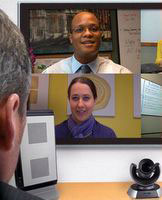 LifeSize is working with Microsoft to deliver a video and collaboration solution that brings the popular Microsoft Lync unified communication experience to the meeting room. LifeSize is one of four video collaboration vendors participating in the Microsoft Lync Room Systems program, aimed at developing a new product category designed around Lync 2013. LifeSize LRS1000 for Microsoft Lync is a meeting room collaboration solution that natively runs Microsoft Lync 2013 software optimized for meeting rooms. By including all of the components needed for more productive meetings, LifeSize LRS1000 for Microsoft Lync provides the familiar Lync user experience and group collaboration capabilities to conference rooms with the goal of more productive meetings. LifeSize says the LRS1000 for Microsoft Lync allows Lync 2013 users to collaborate more effectively across distances with customers, partners and peers anywhere. The familiar Lync user interface is supported in this meeting-room based solution, enabling an enhanced collaboration experience that includes content sharing, voice and video calling. LifeSize LRS1000 for Microsoft Lync supports voice and video calling on Lync 2013 and Lync 2010 with a touch-screen control console that showcases a user directory, calendar and presence information, an HD camera, stereo microphone and support for up to two touch-displays for digital white boarding. LifeSize LRS1000 for Microsoft Lync will be available to order in the second quarter of the 2013 calendar year. But there are rumors swirling in the VTC community that Logitech may be closing or selling the LifeSize brand.
Leave a Comment
Share Article Back to Top 
Samsung Officially Debuts Smart Signage Platform  Playing on its popular consumer line of Smart TVs, Samsung is borrowing "smart" for its new Smart Signage Platform in digital signage. Samsung is showcasing the Samsung Smart Signage Platform, which it describes as an "open-source digital signage platform" built around an embedded media player and software developer kit (SDK).
Samsung’s new SDK for signage software allows software partners to develop customized signage applications suitable for an array of business and user environments. Backed by best-in-breed software developers and solution providers, including Capital Networks, Four Winds Interactive, Scala, Signagelive and Wireless Ronin, customers will have access to signage experts to help create customized solutions.
Powered by a System on Chip (SoC) semiconductor and featuring a dual-core CPU, full codec video processor and either 4GB or 8GB of storage depending on the model, Samsung’s Smart Signage Platform includes an embedded, high-performance media player which allows users to play back content without the need for a separate PC or set-back box. By eliminating the need for external devices, the Samsung Smart Signage Platform ensures clean and simple installation and operational processes, saving both time and money. The technology also supports open pluggable standard (OPS) platforms.
The Smart Signage Platform is compatible with the 2013 lines of the following Samsung digital signage products:
ME – C Series: These ultra slim, lightweight displays provide increased energy savings of 35 percent or more over CCFL backlit displays, while a thin chassis and narrow bezel help simplify installation and provide a more impactful message.
PE – C Series: This is a line of ultra-slim large format displays ideal for high-traffic areas that require 24/7 reliability, including commercial, public and corporate environments. These displays feature LED backlighting for brighter, more colorful images and anti-glare technology that offers a sharp picture, even in brightly lit indoor environments.
MD – C Series: Ideal for high-traffic areas, including commercial, public and corporate environments, the design elements of these displays facilitate enhanced performance with the added benefit of cost-savings. At just 19 millimeter, a narrow bezel allows audiences to focus more on the content, and the slim depth of the series offers more available space for other uses.
Here are the details: http://www.samsung.com/us/business/smart-signage-platform/
Leave a Comment
Share Article Back to Top 
InfoComm Does Digital Signage in Bigger Way in 2013  InfoComm 2013 will introduce the latest advances in technology and solutions for digital signage, bringing together leading manufacturers and service providers with end-users at the annual event taking place June 8-14 at the Orange County Convention Center in Orlando, Fla.
Digital signage is one of the most rapidly expanding fields in the audiovisual industry, with applications in retail, corporate, hospitality, institutional markets and more. “Digital signage has changed the public landscape, and its presence is growing,” said InfoComm Executive Director and CEO David Labuskes, CTS, RCDD. “InfoComm 2013 exhibitors, systems integrators, software engineers and design consultants will share best practices, along with the latest content creation techniques and hardware delivery solutions, to engage audiences and communicate effectively. InfoComm 2013 is the largest digital signage marketplace for institutional buyers and technology managers in retail, government, corporate and hospitality spaces.”
Digital Signage Pavilion
The Digital Signage Pavilion located on the show floor, will bring attendees together to see innovative products from the leading manufacturers, best practices presentations and training. The Digital Signage Presentation Stage, located within pavilion, will feature case studies and strategic advice throughout the show. The Digital Signage Content Creation Zone will provide attendees the opportunity to get up close and personal with top content providers through demonstrations, as well as training.
Featured digital signage products and services include:
- Display system technologies and media players
- Digital signage software
- Content management systems
- Network infrastructure products
Beyond the Show Floor
The Digital Signage Training Sampler, offered by InfoComm University, will offer four new courses to address the opportunities and challenges of visual messaging and digital signage, including Digital Signage in Universities and Technology Trends in Digital Signage.
Before the show floor opens, DisplaySearch will be hosting the Flat Panel Display Conference at InfoComm. Held on Tuesday, June 11, this day-long conference will focus on display-based solutions for vertical professional markets. The agenda will include supply chain trends, case studies, and the effect of mobile products.
InfoComm 2013, the largest commercial audiovisual show, expects 35,000 attendees from wide-ranging market sectors, including business, government, military, education, worship, healthcare, hospitality, retail and entertainment. Along with a trade show floor that exhibits the latest from all of the industry leaders in audiovisual, staging, signage and more, the educational programming provides attendees with opportunities to develop skills and update certifications during the conference.
For more news on InfoComm 2013, click here: http://www.infocommshow.org
Leave a Comment
Share Article Back to Top 
Kramer Electronics and Sierra Video to Consolidate Manufacturing and Operations in Israel  Kramer Electronics, the parent company of Sierra Video has announced that it is transferring all Grass Valley, Calif. production and operations to its headquarter offices, located in Jerusalem, Israel.
To read the complete press release online, click here. Back to Top Snell Appoints Paul Martin as President of Snell North America  Snell this month announced the appointment of Paul Martin as president of Snell North America. Martin is taking on leadership of sales, marketing, and service functions for the North American market.
To read the complete press release online, click here. Back to Top
B-Tech Hires Andy Lee as Export Area Sales Manager  B-Tech AV Mounts has recruited a new face to add it its growing sales team. Andy Lee has joined as an export area sales manager and will be covering Europe, Middle East and Africa (EMEA).
To read the complete press release online, click here. |
Back to Top
Wyrestorm Announces Mark Dziekan as National Sales Manager for Pro A/V Business  Wyrestorm, a global manufacturer specializing in the design and development of innovative HD distribution products for custom residential and commercial applications, has hired Mark Dziekan to the company as national sales manager, dedicated to developing Wyrestorm's presence in the professional audio and video market within the U.S.
To read the complete press release online, click here. Back to Top
Delta Displays Announces New Partnership with Millar Electronics  Delta Products Corp. has announced a new partnership with Millar Electronics that will strengthen its presence in the Southeast. Millar Electronics is a manufacturer’s representative firm specializing in product sales, service and marketing for the commercial A/V industries in the southeastern United States. As Delta’s new representative covering Georgia, Alabama, Tennessee, Mississippi, North Carolina and South Carolina, Millar Electronics will be promoting Delta’s complete line of professional display solutions for commercial applications such as conference rooms, houses of worship, control rooms and public signage.
To read the complete press release online, click here. Back to Top
DPI Partners With Rep Firm Anew Communications Technology in Western U.S.  Digital Projection International (DPI) has announced another major expansion of its customer sales and support network. Effective immediately, Anew Communications Technology, Inc. (Anew C.T.) will work on behalf of DPI’s headquarters, clients, end-users and industry partners across the western U.S. This news follows DPI’s January 2013 announcement of its recent manufacturer’s rep expansion across the central and eastern regions of the country.
To read the complete press release online, click here. Back to Top 
For all you REGULAR readers of rAVe ProAV Edition out there, hopefully you enjoyed another opinion-packed issue! For those of you NEW to rAVe, you just read how we are — we are 100 percent opinionated. We not only report the news and new product stories of the ProAV industry, but we stuff the articles full of our opinions. That may include (but is not limited to) whether or not the product is even worth looking at, challenging the manufacturers on their specifications, calling a marketing-spec bluff and suggesting ways integrators market their products better. But, one thing is for sure, we are NOT a trade publication that gets paid for running editorial or product stories. Traditional trade publications get paid to run product stories — that's why you see what you see in most of the pubs out there. We are different: we run what we want to run and NO ONE is going to pay us to write anything good (or bad). Don't like us, then go away — unsubscribe! Just use the link below. To send me feedback, don't reply to this newsletter. Instead, write directly to me at [email protected] or for editorial ideas, Editor-in-Chief Sara Abrons at [email protected] A little about me: I graduated from Journalism School at the University of North Carolina at Chapel Hill (where I am adjunct faculty). I've been in the AV-industry since 1987 where I started with Extron and eventually moved to AMX. So, I guess I am an industry veteran (although I don't think I am that old). I have been an opinionated columnist for a number of industry publications and in the late 1990s I started the widely read KNews eNewsletter (the first in the AV market) and also created the model for and was co-founder of AV Avenue, which is now known as InfoComm IQ. rAVe [Publications] has been around since 2003, when we launched our original newsletter, rAVe ProAV Edition. Everything we publish is Opt-in — we spam NO ONE! rAVe ProAV Edition is our flagship ePublication with what we believe is a reach of virtually everyone in the ProAV market. rAVe HomeAV Edition, co-published with CEDIA and launched in February 2004, is, by far, the largest ePub in the HomeAV market. We added rAVe Rental [and Staging] in November 2007, rAVe ED [Education] in May 2008 and then rAVe DS [Digital Signage] in January 2009. We added rAVe GHGav [Green, Healthcare & Government AV] in August 2010 and rAVe HOW [House of Worship] in July 2012. You can subscribe to any of those publication or see ALL our archives by going to: https://www.ravepubs.com To read more about my background, our team and what we do, go to https://www.ravepubs.com Back to Top
Copyright 2013 – rAVe [Publications] – All rights reserved – All rights reserved. For reprint policies, contact rAVe [Publications], 210 Old Barn Ln. – Chapel Hill, NC 27517 – (919) 969-7501. Email: [email protected]
rAVe contains the opinions of the author only and does not necessarily reflect the opinions of other persons or companies or its sponsors.
|
|
 |
|


 Gary Kayye:
 Rants and rAVes: