Panasonic to Debut New LED-Lit LCD Digital Signage Series of Displays at InfoComm
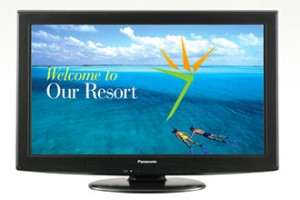 Panasonic will launch a a new line of high definition LED LCDs for hospitality and digital signage, the LRU60 Series. Available in 32”, 39”, 42”, 50” and 65”, Panasonic’s new LED line will be aimed at the hospitality, digital signage and meeting room markets. Panasonic designed the Energy Star-rated LRU60 Series with functions that reduce power consumption, including a built-in ambient light sensor feature, C.A.T.S. (Contrast Automatic Tracking System), which automatically adjusts the television’s screen brightness and contrast to suit the lighting of the room. Panasonic says that feature not only optimizes picture performance, but it also helps to keep power consumption low – which should, theoretically, lengthen brightness display life.
The LRU60 Series incorporates a new thin glossy-finish bezel that gives the guest the appearance of more screen without taking up more counter space. The 65” model is designed with an ultrathin bezel and is ideal for lobbies, lounges and luxury suites – as they are integrated with built-in invisible speakers.
Each LRU60 TV features a built-in Pro:Idiom digital tuner for Pay-Per-View and Free-to-Guest programming support, and an integrated LodgeNet b-LAN terminal adaptor, eliminating the need for additional external boxes and decreasing the number of cable connections. With its USB slot cloning feature, television settings can be copied onto a USB and easily installed into other TV units, shortening the installation time. This is ideal for setting up channel line-ups, customized ‘welcome’ screen images, hotel guides and more. Additionally, with Centralized FTG channel management, hotel management staff can distribute channel information remotely from the head-end to the guest room televisions.
The 32” TH-32LRU60, 39” TH-39LRU60, 42” TH-42LRU60 and 50” TH-42LRU60 are available now and list for $535, $730, $855 and $1,080, respectively. The 65” TH-65LRU60 will be available in July at a suggested list price of $3,850.
Here are all the specs.
Leave a Comment


Share Article
Back to Top
Sony Laser Projector Introduced
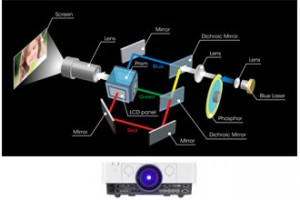
The Sony laser projector is a major announcement from the company at InfoComm 2013. The Sony VPL-FHZ55 is its first lampless projector using 3LCD imaging technology to achieve a spec of 4,000 lumens of color light output at WUXGA resolution (1920×1200).
The new projector uses blue laser as its light source, which in turn generates RGB color through a 3LCD optical system. The VPL-FHZ55 projector achieves a lower total cost of ownership and energy efficiency since it’s spec’d to be maintenance-free for up to 20,000 hours and is an HG (mercury) free projector.
The use of a laser light source also gives the projector instant “on/off” capability and “tilt-free” capability. Combined with 1.6x standard zoom lens, V:+60% H:+/-32% lens shift, built-in edge-blending and geometric correction, the projector is fully capable of advanced commercial integration.
Here’s a PDF that explains the technology.
Leave a Comment
Share Article
Back to Top
Christie’s Brio Takes On Barco’s ClickShare
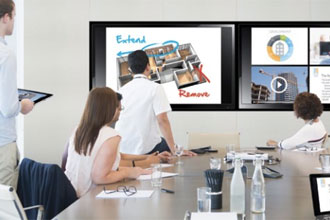 Christie’s press release says: The days of passing cables and adapters across meeting room tables, installing additional software, rebooting laptops and apologizing for delayed or bungled presentations have ended with the launch of Christie Brio, a new meeting presentation and collaboration system that takes the hassles out of single and multi-site workplace meetings.
And, they’re right. There are a handful of manufacturers here at InfoComm with wireless room systems that leverage the Network. Barco was first to market with a totally wireless presentation system called ClickShare.
Developed by Christie, Brio enables multiple attendees at meetings to run audio and video presentations from their own devices (that includes devices like tablets running Windows 8, Apple iOS and Android). Both the node control and presentation connection work the same for tablets and smartphones as they do for PCs and Macs.
Straightforward to install and use, Brio uses wired or wireless connections to automatically share multiple presentations showing simultaneously on either one or two meeting room screens. Whether participants use Macs or PCs, iPads/Android tablets or smartphones, presentations can be added to a meeting in seconds.
Brio is being unveiled this week at InfoComm 2013 and starts shipping this summer.
Using a single, low-cost hardware Brio node, any meeting room can automatically show up to five computer screens on that room’s display. Once the content is processed by the node it can also be made available to other Brio nodes via Ethernet. In this way, a variety of information, including PowerPoint and Keynote presentations, audio, digital whiteboards, and videoconferencing sessions – can be shown on any display attached to the Brio node, and shared with all the displays in the same meeting.
Brio nodes can be connected via network to multiple worksites on a corporate campus or across the country. All Brio nodes added to a meeting will see the same presentations and any Brio node user can share a presentation in the meeting. Brio makes interactive collaboration across multiple rooms and offices straightforward, seamless and immediate, plus the cost of Brio nodes is low enough to equip even remote users in home offices.
Brio also takes full advantage of interactive whiteboard technology. Users in multiple locations can work together on notes and sketches. Any Brio node connected to a meeting allows users, anywhere, to contribute to that whiteboard session.
Christie Brio nodes fit in standard 19-inch IT racks or can sit on their own, packaged to look good on meeting rooms credenzas. The system supports dual-link and single-link DVI, DisplayPort and HDMI. Brio can handle a maximum of five sources.
Christie says Brio’s playback quality is exceptional, with the option of running uncompressed 1080p video sources.
Here is the Brio Brochure.
Leave a Comment
Share Article
Back to Top
Extron Introduces New Media Presentation Switcher with DTP Extension
 Extron’s new MPS 602 is a six-input media presentation switcher for digital and analog sources. It offers digital video switching with three HDCP-compliant HDMI inputs and one DTP 230 twisted pair input, and analog video switching with two RGB inputs that are digitized for distribution to the digital outputs. In addition, the MPS 602 includes a selectable DTP 230 twisted pair or HDMI output. The DTP 230 input and output extend video, audio and bidirectional control signals to DTP 230 transmitters and receivers, each over a single CATx cable up to 230 feet (70 meters). The MPS 602 also includes several audio switching and processing features, available power amplification, plus flexible control options for complete switching and distribution with local and remote display support. The MPS 602 is available in three models: a non-amplified version with a variable preamp output, the MPS 602 SA that adds a stereo 4/8 ohm power amplifier and the MPS 602 MA with a mono 70 volt amplifier.
The DTP 230 twisted pair input on the MPS 602 can receive signals from a remote DTP 230 transmitter in areas such as a conference table, lectern, or wall for connecting a guest laptop. The DTP 230 twisted pair output can be used to transmit digital AV signals from an MPS 602 in a rack to a DTP 230 receiver behind a flat-panel display on a wall, above a ceiling-mounted projector or any other remote location. To simplify installation, bidirectional RS232 and IR signals can be inserted from a control system and transmitted over the single CATx cable together with the video and audio, enabling control of a source or display. The MPS 602 can also remotely power the DTP 230 transmitter and receiver over the same CATx cable.
The MPS 602 includes six-input analog audio switching, a mic/line input with 48-volt phantom power, HDMI audio embedding and de-embedding and several audio processing features for mixing and ducking. The Mic Talk Over feature automatically reduces program audio when it detects a microphone signal, replacing the need for a separate, standalone ducking processor. To streamline audio setup, the MPS 602 features front panel mic and program audio output volume controls that allow for independent adjustment of mic volume, program audio volume, and muting. Two MPS 602 models feature integrated power amplifiers. The MPS 602 SA delivers stereo power amplification with 50 watts rms per channel into 4 ohms and 25 watts rms per channel into 8 ohms, while the MPS 602 MA provides mono 70-volt amplification with 100 watts rms output.
To simplify integration of sources and displays, and to help ensure optimal system performance and dependability, the MPS 602 features two Extron technologies: EDID Minder and Key Minder. EDID Minder manages EDID communication between the display device and input sources to ensure that the correct video formats are displayed reliably. For HDMI signals with protected content, Key Minder authenticates and maintains continuous HDCP encryption between input and output devices to ensure quick and reliable switching.
Here are all the details.
Leave a Comment
Share Article
Back to Top
Aviom AN-16/i v.2 Analog Input Module Ships
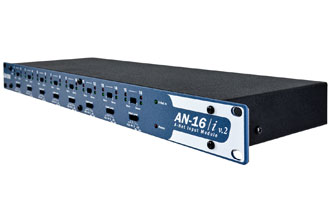 Aviom told rAVe today that its new AN-16/i v.2 Input Module, which supports the new A360 Personal Mixer, is now shipping. The AN-16/i v.2 converts 16 line-level analog audio channels to a Pro16e A-Net digital stream.
Based on an enhanced version of Aviom’s Pro16 A-Net protocol, Pro16e, the technology driving the new A360 Personal Mixer allows multiple 16-channel banks of monitoring content to be delivered over a single Cat5 cable. The AN-16/i v.2 includes an A-Net Input jack for connecting up to three additional input modules. The analog inputs of the AN-16/i v.2 are merged with this incoming A-Net stream to create the expanded Pro16e digital audio stream utilized by Aviom’s new A360 Personal Mixers. The new A360, which brings new levels of control and customization to the personal monitoring experience with a number of new features, offers the ability to choose which channels are mixed on each unit in the system. Each A360 may use the default channels, or audio channels can be selected and organized individually for each personal mixer, drawing from a network pool of up to 64 channels.
The AN-16/i v.2 features eight four-position input level/gain sensitivity switches, stereo channel link switches for every channel pair, and per-channel signal present and clip LEDs on the front panel. On the rear panel, the unit has 16 analog audio inputs with balanced ¼” TRS jacks. The audio Thru jack for each input allows the AN-16/i v.2 to be inserted seamlessly into an existing audio signal path. Also on the rear panel are one A-Net In jack and one A-Net Out jack, along with a slide switch for assigning the channel bank. The AN-16/i v.2 can be used with any line-level analog audio signal such as console direct outs, inserts or aux sends.
The new AN-16/i v.2 Input Module works with Aviom’s new A360 Personal Mixers as well as the company’s current A-16II Personal Mixers, and the two personal mixers can be combined seamlessly into the same system. In addition, the AN-16/i v.2 can be used as part of a Pro16 digital snake or audio distribution system. These systems support a range of flexible configurations, including 16×0, 32×0,48×0, 64×0, 16×16, 32×16, 32×32 and 48×16, with an unlimited number of digital splits and no loss in audio quality.
Here are the specs.
Leave a Comment
Share Article
Back to Top
Atlas Sound Intros BlueBridge DSP Accessories
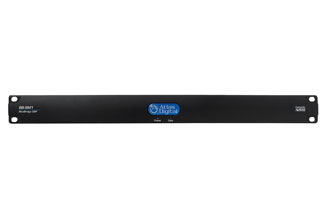 Atlas Sound’s new Atlas Sound BlueBridge DSP controllers are a set of rack and wall mount accessories for the BlueBridge platform. The BB-SM1 is a 1RU rack-mountable system manager that allows for third-party control interpretation as well as Web browser control of the BlueBridge system using a PC or mobile device (iOS or Android). The BB-SM1 also includes scheduling and system backup functionality. The BB-EB1616DT is a 1RU rack-mountable expansion box that features 16 inputs and 16 outputs including Dante. The BB-EB1616DT can be as a standalone digital snake in a Dante network. Five wall plates are also being released to support the BlueBridge platform allowing integrators the ability to offer their customers remote and preconfigured control over system settings.
BB-SM1 System Manager
The BBWP-K1B allows control of any single value change preset by the integrator including gain, threshold and frequency adjustment. The BBWP-S4K1B is a four-button controller with level control that can be used to change any four preset selections and control any single value change. The BBWP-K4B is a four-button controller with level control that can be used to change any four preset selections and control any four-value changes. The BBWP-S8B is an eight-button controller that can be used to change preset selections. Finally, the BBWP-S4B is a four-button controller that can be used to change any four preset selections. The Atlas Sound BBWP-TOUCH7 is a custom PoE 7″ Touch Screen that can be customized to control any function using the BlueBridge software. An integrator can easily turn this touch panel into a multi source or zone volume control, allow for muting capabilities of installed hardware, or create a mixer that can adjust the system on the fly. All wall plates and touch panels are additionally available in a white finish.
Here are the details.
Leave a Comment
Share Article
Back to Top
SurgeX SEQ-1U: Smart, Slim Surge Eliminator and Power Conditioner
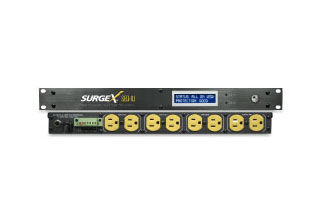 Here at InfoComm, SurgeX’s is showing the 1U Sequencer (SEQ-1U), a single rack unit power management surge protection, conditioning and sequencing solution for AV, broadcast and computer equipment. The SEQ-1U offers advanced protection for any size AV or IT installation.
Proprietary SurgeX technology in the SEQ-1U includes Advanced Series Mode surge elimination, a zero let-through technology that SurgeX says stops all surges up to 6,000 volts / 3,000 amps (unlimited surge current) without producing harmful side effects such as ground contamination or common-mode disturbances. The unit also features both common mode and normal mode Impedance Tolerant EMI/RFI filtering and COUVS (Catastrophic Over/Under Voltage Shutdown), as well as SurgeX ICE (Inrush Current Elimination) to keep connected AV and IT products protected and fed with a continuous flow of power.
Programming of the SEQ-1U is made easy through a front panel LCD display with simple commands. The display also shows unit status and AC line voltage. In addition to protecting AV and IT equipment, the nine available outlets on the SEQ-1U can be used to control other SurgeX power management products or several SEQ-1Us can be connected to operate together for management of large datacenters or audio video installations. All set-up configurations are stored in non-volatile memory.
Build materials and industrial design of the SEQ-1U were carefully considered. A magnetic shielding steel enclosure makes the unit impervious to magnetic interference while a thermal circuit breaker provides overload protection. For added convenience, the SEQ-1U accommodates any type of control unit and provides DC voltage or contact closure feedback to Crestron, AMX and other similar control interfaces.
The SEQ-1U has a load rating of 20 amps at 120 volts and meets Federal Grade A, Class 1, Mode 1 (A-1-1) guidelines for powerline surge suppressors.
The SurgeX SEQ-1U is shipping now and you can get more info here.
Leave a Comment
Share Article
Back to Top
Atlas Adds Line of BlueBridge DSP Controllers
 Atlas Sound’s new line of DSP controllers are being released under the Atlas Sound BlueBridge brand. The BlueBridge family of products feature drag and drop, open architecture software and can operate on any network. Each model utilizes high quality microphone preamps and 24 bit converters to obtain ultra-low noise floor while still maintaining a smooth sound, with the flexibility and control a system designer requires. BlueBridge models use a 40 Bit Floating Point DSP engine to prevent digital clipping and to obtain maximum speed and power to process advanced algorithms in complex system designs. Models are available in configurations ranging from 2 I/O to 16 I/O with all models using the same DSP engine. Additionally, Atlas offers four models that feature Dante inputs/outputs allowing for true digital audio transmission over the network.
BlueBridge Models Include:
- TSD-BB22 2 In/2 Out Configuration
- TSD-BB44 4 In/4 Out Configuration
- BB-88(DT) 8 In/8 Out Configuration (w/Dante)
- BB-816(DT) 8 In/16 Out Configuration (w/Dante)
- BB-168(DT) 16 In/8 Out Configuration (w/Dante)
- BB-1616(DT) 16 In/16 Out Configuration (w/Dante)
- BB-816AECDT 8 In/16 Out Configuration with Acoustic Echo Cancellation and Dante
All of them are here.
Leave a Comment
Share Article
Back to Top
Extron Introduces Speaker Innovation for Suspended Ceilings
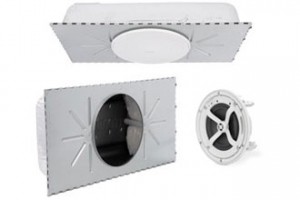 Extron’s new SpeedMount Ceiling Speaker System is a patented low-profile, plenum-rated, two-piece ceiling tile speaker system for division-of-labor installations. The CS 1226T SpeedMount speaker system features the newest speaker design from Extron, which greatly simplifies ceiling speaker installation and delivers significant time and cost savings. The two-piece system consists of the CS 120P plenum rated enclosure and a CS 26T two-way speaker cartridge. A low-voltage contractor places the CS 120P enclosure directly on the ceiling grid without the need for a tile bridge, C-ring or tile rails. Signal wiring is then routed to the enclosure. This dramatically cuts installation time and costs during the rough-in phase. Later, an AV technician can quickly complete installation by connecting the CS 26T speaker cartridge to the wiring and securing it into the enclosure.
The CS 1226T is available as a complete assembly of a pair of CS 120P enclosures and a pair of CS 26T speaker cartridges. The enclosures and speaker cartridge can also be purchased in pairs separately, so they can be delivered to low-voltage and AV system contractors.
The CS 120P plenum enclosure installs quickly into 2′x2′ (61×61-centimeter) or metric 600×600-millimeter suspended ceiling grids. It features a shallow 5″ (12.7-centimeter) profile, which simplifies installation into congested ceiling spaces around piping and ducts. The integrated tile bridge of the enclosure rests on the ceiling tile above the grid, evenly distributing the weight of the CS 120P and the CS 26T speaker cartridge. This avoids the need to assemble V-rails and C-rings, greatly reducing the number of installation steps and the chance of losing installation hardware.
The CS 26T speaker cartridge features a 6.5″ (16.5-centimeter) woofer and a 3/4″ (1.9-centimeter) tweeter in a coaxial design, and can be used in 70/100 volt or 8-ohm operation. It installs quickly and easily into the CS 120P enclosure. The CS 26T delivers high performance, full-range audio reproduction with a frequency response of 70 Hz to 20 kHz, and is optimized for a wide range of audio presentation applications for music, program, and voice. It features a power rating of 30 watts continuous pink noise and 60 watts continuous program capacity, and offers both direct 8-ohm or 70/100-volt operation with a behind-the-grille, six position power selector switch. The CS 26T features a magnetically attached grille and a thin-edged bezel for a refined appearance on the ceiling.
Here are the details.
Leave a Comment
Share Article
Back to Top
rAVe Scoop: Da-Lite’s New ViewShare is a Screen with an Embedded Videoconferencing Camera
 The show hasn’t even opened and we already have yet another scoop for you. Da-Lite’s going to launch a new product here at InfoComm called ViewShare. ViewShare is an electric tensioned screen that actually has a 1080p USB compatible screen integrated right into the screen frame. It’s designed for UC applications for rooms where videoconferencing is needed on-the-fly and you don’t need a heavy-duty VTC system and prefer to use a desktop videoconferencing system.
ViewShare pricing depends on the size of the screen and will be available this summer. And, here’s a video rAVe founder, Gary Kayye, shot of it in Da-Lite’s booth:
Leave a Comment
Share Article
Back to Top
Christie Launches iPhone App: Christie InControl
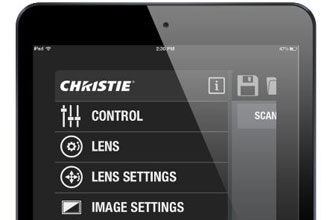 Christie announced the Christie InControl projector iOS App at InfoComm. Christie InControl is aimed at rental and staging customers using Christie 3-chip DLP M Series and J Series projectors in various applications including trade shows, live events and projection mapping. Fixed installation applications such as classrooms and boardrooms, houses of worship, government facilities and museums will benefit.
The Christie InControl App provides a responsive user interface to commonly used projector functionality such as; power on/off, shutter control, test pattern selection, and lens zoom and focus, in addition to more advanced projector functionality like 2D keystone and color management.
Features of the Christie InControl Projector App include:
- All key projector information is grouped into a single area.
- Scan for available projectors on the local Wi-Fi network to add them to a group, or manually type in the IP address of the desired projector.
- Main Control interface groups all key commands on one page, allowing for fast changes when needed.
- Ability to adjust zoom, focus or lens position from anywhere within Wi-Fi range, providing easier setup in large staging environments.
- Dedicated user interface for complete control over zoom, focus and lens offset. Position can be adjusted via joystick type interface or by entering specific x/y values.
- Easy group access and ability to create and save projector groups for multi projector control.
- Adjust color temperature and color drive level with immediate results on screen.
- Enable single or dual lamp mode where applicable and adjust lamp power level as needed.
- Four Corner 2D keystone control.
- Adjust image size, vertical stretch, horizontal/vertical position, pixel tack/phase and blanking.
- Provides simple slider based interface to adjust key image settings at the touch of a finger.
- Adjust power settings easily to meet requirements of a specific venue or permanent installation.
- Christie InControl is supported on iOS version 5.1 (and higher) enabled devices including iPad, iPhone or iPod.
Get it here.
Leave a Comment
Share Article
Back to Top
Vaddio Intros Controller That Can Transform Any Vaddio High Definition PTZ Camera into a USB or IP Camera
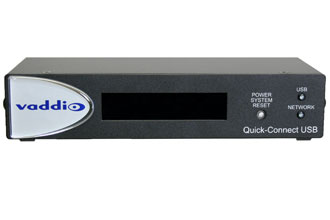 Vaddio’s new Quick-Connect technology that allows any Vaddio camera that supports a Quick-Connect Short-Range (SR) to output USB or Ethernet. Based on Vaddio’s Quick-Connect technology, that allows cameras to be extended up to 150 feet over Cat. 5 cabling, now USB cameras can be deployed in system designs where distance was an issue.
Vaddio’s Quick-Connect USB is based on UVC (Universal Video Class Device) USB 2.0 standards that require no third-party drivers. An Ethernet network port is included for IP streaming supporting RTSP or HLS. Cameras are controlled through an Embedded Web Server that provides browser-based robotic camera control, and CCU image and color control. Additional outputs include HDMI and HD Analog component. An R-J45 provides an RS-232 interface for third-party control systems. An integrated LCD blue backlit display shows both the IP and the MAC addresses.
Here are all the specs.
Leave a Comment
Share Article
Back to Top
DPA Microphones Launches New Podium Microphones
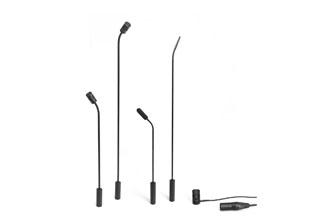 DPA Microphones is launching two new Podium Microphones at InfoComm 2013 this week in Orlando. These are based on the company’s d:dicate Recording Microphones (formerly known as Reference Standard) and its 4060 Miniature/d:vote 4099 Instrument Microphones, both solutions give AV installers and conference organizers the clear, transparent and precise sound they demand.
DPA is offering podium microphones that incorporate the modular capsules from its d:dicate Recording Microphones. These new podium microphones combine the d:dicate capsules with any of the company’s newly introduced modular active booms and modular active cables. With several capsules to choose from, DPA customers can access the exact microphone and boom or cable combination to meet their needs.
In addition to the d:dicate solution, DPA has also developed a cost-effective, directional podium microphone based on two of its miniature microphones, the 4060 and the d:vote 4099 Instrument Microphone. DPA Microphones adapted its existing miniature capsule to give an off-axis frequency response that negated room reverberation while preserving the on-axis sensitivity for voice level. The company positioned the capsule on a delicate gooseneck stand, but it can also be used in a wireless configuration by employing an adapter from DPA.
Both Podium Microphones will be available to the installation market beginning August 2013. Click here for more info.
Leave a Comment
Share Article
Back to Top
VDO360 Pro USB PTZ HD Camera under $1,400
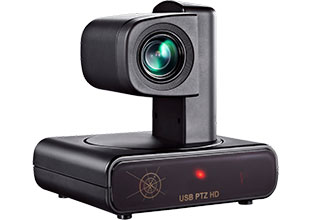 At InfoComm, VDO360 said that its new VTC camera, the PTZHD-01 — a 720p PTZ camera, is the first professional grade USB PTZ HD camera under $1,400.
While the idea of a USB HD PTZ camera isn’t exclusive to VDO360, this price point is. While the rest of the VTC industry has been pushing its way to the next great codec, the next great telepresence product, VDO360 says it has decided to focus on getting the price lower.
Camera features include:
- Sensor size: 1/2.7 ” CMOS
- Effective pixels: up to 1280X720 Pixels
- Zoom: 12x optical zoom lens
- Focal length: 4.0 ~ 48.0 mm
- View angle: maximum 53°, the minimum 5°
- Video frame rate: 30fps @ 720P
- Pan: 300° left and right
- Tilt: 180° up and down
- Dimensions: W90 x L110 x H105
- Supports Linux, Windows XP,Vista,Windows 7 32 and 64bit as well as Mac OS
Cart System highlights includes:
- PTZHD-01 Camera
- Sturdy metal base and casters
- Cherry laminate cabinet
- Small Form Factor PC
- Intel i7 Ivy Bridge processor (3.8Ghz)
- Blu-ray player
- PCi expandable for future-proofing
- Wireless keyboard/mouse
- Jabra Speak 410 (echo and noise cancelation)
- 47” LCD monitor
Here are the details.
Leave a Comment
Share Article
Back to Top
Extron Ships Eight-Input Scaling Presentation Switchers with DTP Extension
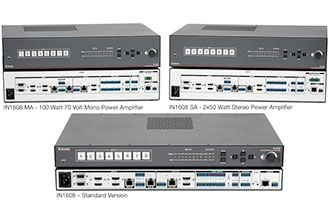 Extron is now shipping the IN1608, an eight-input, HDCP-compliant scaling presentation switcher with four HDMI inputs, two universal analog video inputs and dual HDMI outputs. It also features two Extron DTP 230 twisted pair inputs and a DTP 230 output for extending HDMI, audio and bidirectional control signals to DTP 230 transmitters and receivers, each over a single CATx cable up to 230 feet (70 meters). The IN1608 provides the convenience of supporting local and remote displays with fast and reliable input switching, and a high performance scaling engine that converts all HDMI and analog sources to the optimal resolution. Selectable output resolutions are available up to 1920×1200, including 1080p and 2K. The IN1608 also includes a host of audio switching and processing features. It is available as a standard model with two stereo audio outputs, the IN1608 SA that adds a stereo 4/8 ohm power amplifier, and the IN1608 MA with a mono 70 volt amplifier.
The two DTP 230 twisted pair inputs can receive signals from remote DTP 230 transmitters in areas such as a conference table, lectern or wall for connecting a guest laptop. The DTP 230 twisted pair output can be used to transmit from an IN1608 in a rack to a DTP 230 receiver behind a flat-panel display on a wall, above a ceiling-mounted projector, or any other remote location. To simplify installation, bidirectional RS232 and IR signals can be inserted from a control system and transmitted over the single CATx cable together with the video and audio, enabling control of a source or display. The IN1608 can also remotely power each of the DTP 230 transmitters and receiver over the same CATx cable, streamlining system design and installation.
In addition to video switching and processing, the IN1608 can serve as the central component for audio system integration. It includes eight-input audio switching, two mic/line inputs, HDMI audio embedding and de-embedding, and several audio processing features for mixing, ducking, tone adjustments and more. Audio configuration features and options can easily be accessed through the internal Web pages, with a GUI that provides access to all available adjustments and settings. Two IN1608 models feature integrated power amplifiers. The IN1608 SA delivers stereo power amplification with 50 watts rms per channel into 4 ohms and 25 watts rms per channel into 8 ohms, while the IN1608 MA provides mono 70 volt amplification with 100 watts rms output.
The IN1608 features an advanced scaling engine that can scale HDMI, RGB, component and standard definition video signals to a common high resolution output. It provides high performance 1080i deinterlacing and Deep Color processing to deliver optimal image quality.
Here are all the details.
Leave a Comment
Share Article
Back to Top
Vaddio Introduces Complete UC Meeting Room Solutions for Laptops and Tablets: the GroupSTATION and HuddleSTATION
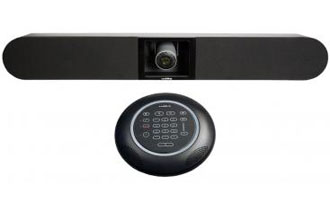 Vaddio has introduced two new unified communications room solutions designed for mobile laptop or tablet users to enable its computer applications for group collaboration and presentation meetings. By just connecting a laptop or tablet directly into the GroupSTATION or HuddleSTATION dock users can add HD video, wideband audio microphones and a loudspeaker system to their collaboration and presentation software.
GroupSTATION consists of two main components: a table-based MicPOD dock and a wall-mounted sound bar that incorporates an HD camera in its center.
The MicPOD Dock functions as a microphone, speakerphone, user interface and Laptop/Tablet dock for easy connection. Four microphones, each with its own independent acoustic echo canceller, provide a 360-degree pickup pattern. Vaddio’s SmartMIC technology ensures that crystal clear audio is maintained for far-end participants with hands-free operation. PC or tablet connections include HDMI or VGA to locally extend the PC’s display output to the room display.
The sound bar incorporates two audiophile-quality dual two-way loudspeaker systems with independent acoustically tuned enclosures. Two separate 30-watt Class-D amplifiers independently power each loudspeaker system and provide plenty of power for even the largest room applications. The integrated broadcast-quality HD camera features a 19x optical zoom lens and a Quick-Set manual Pan/Tilt adjustment for easy camera set up. System power, Ethernet network, HDMI and MicPOD dock connectors are all located on the back of the sound bar. A unique wall mounting system with an integrated cable tray provides for an easy, clean installation.
Vaddio’s HuddleSTATION is identical to the GroupSTATION, but is tailored for smaller meeting rooms typically designed to accommodate 4 to 6 people. As a result, HuddleSTATION has a very wide-angle (82-degree) camera lens specifically designed for the challenges of getting everyone in the camera shot. Also, the MicPOD dock microphone audio system has been tuned to eliminate the echo and increased room noise that occurs in smaller spaces.
Here are all the details.
Leave a Comment
Share Article
Back to Top
Aviom Partners with Yamaha, Intros D800-Dante A-Net Distributor
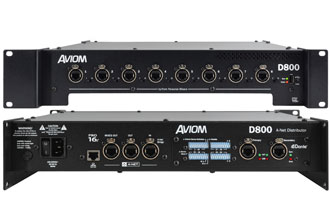 Aviom has introduced the D800-Dante A-Net Distributor, a product designed in collaboration with Yamaha Commercial Audio Systems at InfoComm 2013. The new D800-Dante A-Net Distributor offers Dante connectivity for integration of Aviom Personal Mixing Systems with Yamaha CL Series consoles and Rio Series I/O racks.
With a D800-Dante A-Net Distributor connected to the Dante network, up to eight Aviom personal mixers can be connected in parallel in an Aviom personal mixing system, eliminating the need for any A-Net cards in the Yamaha console. The D800-Dante distributes power and up to 64 channels of audio to each A360 Personal Mixer in the system and is also compatible with Aviom’s A-16II Personal Mixers.
The new distributor also introduces two new features to personal mixing systems using A360 Personal Mixers. The new Network Mix Back allows the digital stereo mix from each A360 Personal Mixer connected to the D800 to be sent to an AN-16/o v.4 Output Module for use with wireless transmitters. With Network Mix Back, wireless in-ears can easily be set up off stage and cabling for the personal mixers on stage is simplified. In addition, the D800-Dante serves as a communications hub for iOS devices connected via an Ethernet Wi-Fi router. iOS support for the A360 is scheduled for release in 2014.
For more information, click here.
Leave a Comment
Share Article
Back to Top
Revolabs Announces Updated Executive Elite Wireless Conferencing Solution
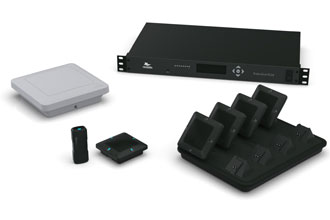 Revolabs Inc. announced at InfoComm 2013 its next-generation Executive Elite four- and eight-channel wireless microphone systems, the company’s new flagship product and latest addition to its family of unified communications solutions for boardrooms and conference rooms. The system’s features include a new distributed architecture, increased density, enhanced integration with room control systems and cloud-based management capabilities. The solution also includes Revolabs’ secure AES-256 encryption featuring dynamic key updates every 60 seconds, in addition to flexible AVB, analog and USB audio output options.
Using a new distributed architecture, Executive Elite separates the remote antenna receiver unit from the Executive Elite base digital signal processing (DSP) unit. The remote antenna receiver (whether wall or ceiling mounted) and base DSP units connect via a standard Cat6 cable with power over Ethernet (PoE) support. This means the Executive Elite’s remote antenna receiver unit can be placed in the same room as wireless microphones.
The system also introduces Revolabs’ redesigned Executive Elite microphones. For longer talk times, the new microphones — which include omnidirectional, directional, gooseneck (6-inch and 12-inch options), wearable microphones, as well as XLR and mini-XLR adapters — allow for up to 12 hours of continued usage, even in high RF settings with receivers up to 300 feet away, according to Revolabs. The microphones also conserve power when not in use, enabling stand-by times of up to 72 hours with a remaining talk time of at least one hour.
The Executive Elite receiver also uses Revolabs OTA™ technology, which enables proximate remote antenna receivers to synchronize their signal automatically. Depending on the region, this allows the system to utilize up to 60 (Americas) or 120 (rest of world) high-definition channels for its wireless microphones in any given deployment. When switching to high-density mode, the receivers can tap into even more channels, increasing the number of supported microphones even further. By calibrating radio settings, the Revolabs remote antenna receivers can also reach any number of microphones.
Revolabs Executive Elite is also providing new local and remote cloud-based system management. Administrators will be able to obtain real-time information on microphone status, audio and radio signal strength, and overall system performance directly from the unit’s display or via the local Web-based interface by connecting a laptop or tablet through a USB port.
The Revolabs Executive Elite four- and eight-channel wireless microphone systems will be available in Q3 2013. More information is available at http://www.revolabs.com.
Leave a Comment
Share Article
Back to Top
PrimeView Intros 84″ 4K Display with HDBaseT
 Primeview this week is unveiling its new 84” 4K HDBaseT-enabled display, a solution to the 4K distance problem that plagues commercial projects. HDBaseT can deliver 4K video up to 100 meters over a single Ethernet cable, making the installation process much simpler and more cost effective compared to all other cabling options for professional installers and systems integrators.
HDBaseT technology, powered by Valens chipset, enables all-in-one connectivity between HD video sources and remote displays through a single 100m/328ft CAT5e/6 cable, delivering uncompressed high definition video, audio, Internet, control signals and up to 100 watts of power.
For more information on HDBaseT, click here, and for more information on the new Primeview’s HDBaseT displays, click here.
Leave a Comment
Share Article
Back to Top
Crimson AV Debuts ADA Compliant Ultra Flat Articulating AV Mounts Aimed at Healthcare, Hospitality and ProAV
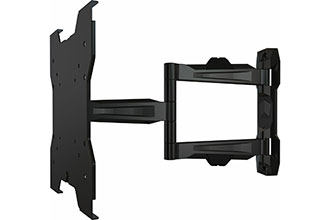 Crimson AV’s new AU42 and AU65 ultra-thin articulating AV mounts aimed at the ProAV and Healthcare markets. Securely holding flat panel displays a mere 1.09” from the wall when retracted and a full 21″ when fully extended, the flagship AU65 model claims to be the world’s lowest profile swing arm mount.
Two models are included in the AU line: the AU42 is compatible with 13-42”+ flat panel displays, lists for $199 and comes with a 100×100 through 200×200-millimeter interface and is expandable to 400×400 millimeters when the optional AD400 VESA Adapter is used. The AU65 is compatible with 13-65”+ flat panel displays, lists for only $249 and features a universal mount with a hole pattern through 600×400 millimeters. Both models can hold displays weighing up to 80 pounds, and feature smooth tilt adjustments of +15° forward and 3° side-to-side roll, facilitating perfect screen positioning for a variety of viewing angles. Three attachment points for wood studs or concrete walls provide additional installation safety and security, while an integrated cable management system preserves design and décor aesthetics.
Full specs are here.
Leave a Comment
Share Article
Back to Top
IED Adds New Power Amplifiers
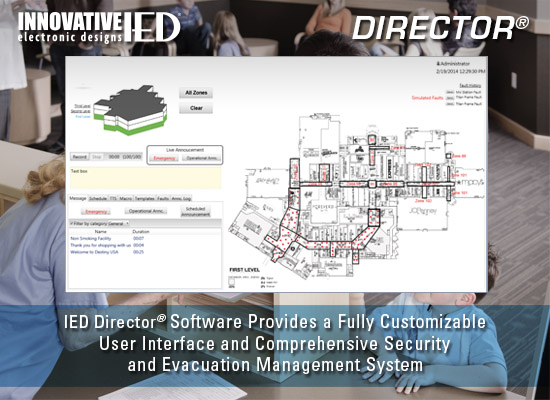
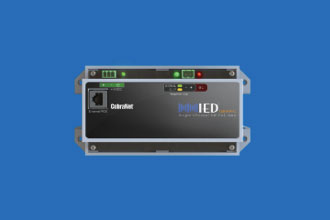 Innovative Electronic Designs’ (IED) new IED1581NA-C/IED1581NA-D and IED1542NA-C/IED1542NA-D are single and dual channel power amplifiers designed for use in smaller applications that require full-bandwidth audio and where low power and low cost are considerations.
The IED1581 amplifiers have a single channel output that offers 8 watts of power at either 4Ω or 8Ω. Model IED1581C incorporates CobraNet digital audio inputs while the IED1581D features Dante digital audio inputs. The IED1542 amplifiers feature two-channel output at either 4Ω or 8Ω with total output power of 4 watts per channel. Model IED1542C incorporates CobraNet digital audio inputs while the IED1542D features Dante digital audio inputs. All models are powered by either an external 48VDC power supply or IEEE 802.3af PoE switch and have remote monitoring output available. Each model has a small footprint enclosure that can be either DIN rail or wall mounted for convenience.
Here are all the details.
Leave a Comment
Share Article
Back to Top
Ricoh Enters Projection Market
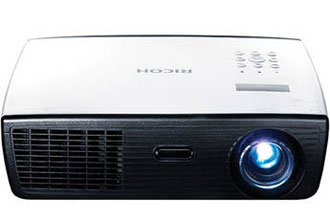 Ricoh Americas Corporation has become the third major copier company to enter the projection market in the past five years. Debuting a number of LCD projectors at InfoComm, the RICOH PJ X3340, PJ WX3340, PJ X3340N and PJ WX3340N Desk Edge projectors join about 12 other models in the Ricoh line of XGA and WXGA projectors.
To be perfectly honest, there aren’t any ground-breaking features any of these have, but they do include integrated eBeam technology and an interesting multi-screen mode that enables guests in up to four different rooms with four different projectors, to view the same presentation.
The four models here at InfoComm are:
- PJ X3340 – XGA – $1,040
- PJ WX3340 – WXGA – $1,200
- PJ X3340N – Wired/wireless network capable – XGA – $1,375
- PJ WX3340N – Wired/wireless network capable – WXGA – $1,500
These units can project images from as close to the wall or screen as 27 inches and as far away as 24 feet. High-definition images range from 30 inches diagonal to 240 inches, depending on the proximity and model.
The RICOH Desk Edge Series can be operated via one-touch keys or remote control. Ricoh says the projectors automatically self-balance to maximize focus and minimize distortion even when projecting in tight spaces or at sharp angles. Two of the systems, the RICOH PJ X3340N and PJ WX3340N, automatically focus for a sharper image when the projector is first turned on or moved. When projecting onto color surfaces, Wall Color Mode offers subtle color enhancements automatically to improve image clarity.
Here are the details.
Leave a Comment
Share Article
Back to Top
Tightrope Introduces New Compact, Multiformat HD Video Server for Small-Scale Broadcast Operations at $14,995
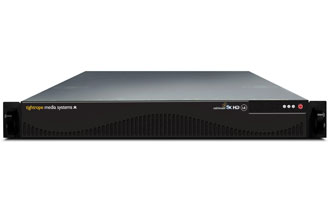 Tightrope Media Systems announced at InfoComm the Cablecast SXHD LE video server, a new multi-format HD and SD video server that joins Tightrope’s Cablecast family of all-in-one broadcast automation systems. SXHD LE is a single-box, 1 RU solution for video playout that includes 4 TB of storage and built-in branding functions. It’s meant for small-scale broadcast operations such as public, educational, and government-access TV stations; campus television; local origination cable channels; hospitals; and cruise ships.
The Cablecast SXHD LE video server plays all common video formats, including MPEG-2, WMV, H.264, AVI, DVCPRO HD and ProRes, with no transcoding required, and it encodes MPEG-2, DV, DVCAM, DVCPRO, DVCPRO HD and ProRes formats up to 220 Mbps in the full 4:2:2 profile. Besides having built-in support for all of those formats, the SXHD LE plays video files back-to-back on the same output. Channel branding is made easier with video overlay features such as a station bug, bug text and crawls with both foreground and background images, possibly eliminating the need for a downstream key. The server also automatically downconverts HD files to SD for playout on an SD channel, and upconverts SD to HD for playout on an HD channel.
As with all Cablecast video servers, the SXHD LE comes with Cablecast station automation and scheduling software, which allows users to “write once, publish everywhere.” They simply enter the program information into the system one time and then drag programs onto the schedule, and Cablecast automatically publishes the schedule to the channel, the website, TV Guide’s format, and station programming reports. Cablecast also automates file conversion for Web-based video on demand.
The SXHD LE is a lower-cost alternative to Tightrope’s Cablecast SX2HD server in a smaller footprint. It is capable of standing alone, or it can control a Tightrope Carousel player through built-in software. The Carousel player automatically shows the program schedule and promotes upcoming shows throughout the day, and also serves as a community bulletin board for campus, shipboard, and community announcements.
The Cablecast SXHD LE video server will be available in Q3 for $14,995.
Go here for more information.
Leave a Comment
Share Article
Back to Top
Panasonic Debuts Five New Short Throw Projectors
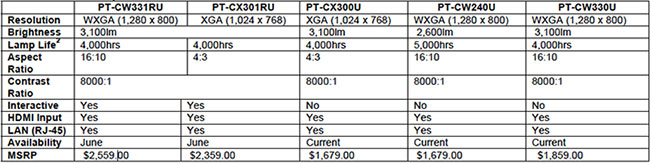
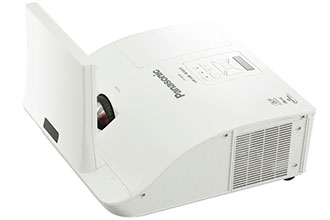 Panasonic’s new PT-CW330 Series of ultra short-throw projectors includes the PT-CW330U, PT-CW240U, PT-CX300U as well as two interactive models that have dual pen capabilities, the PT-CW331RU and PT-CX301RU. All of these projectors are well suited for a host of applications where space is limited and high image quality is critical, including classroom lectures, corporate presentations, digital signage and small rooms.
With up to 3100 lumens and a contrast ratio of 8000:1, the PT-CW330U, PT-CW240U and PT-CW331RU are able to generate an 80” diagonal image from less than 2 feet away and the PT-CW331RU and PT-CX301RU have built-in interactive features enables two users to simultaneously write on the image using IR pens without requiring a dedicated interactive whiteboard.
PT-CW330 Series projectors include a built in 10 Watt speaker, up to 5,000 hour lamp replacement cycle and Crestron RoomView compatibility. The projectors are also 3D capable and all of them have HDMI inputs:
All of them are here.
Leave a Comment
Share Article
Back to Top
Christie Debuts Plethora of Products at InfoComm
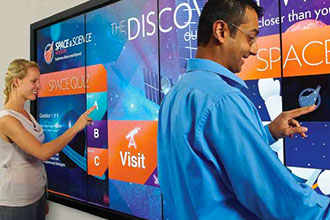 Christie’s new Jumpstart, the Christie FHD551-XG with Corning Gorilla Glass, and the company’s first turnkey multi-touch video wall solution highlighted its InfoComm booth. With the industry’s smallest image-to-image gap of any bonded LCD panel, the Christie Multi-touch Video Wall Solution comprises a 4×1 wall of portrait-mounted 55-inch LCD panels with bonded Corning Gorilla Glass, Christie Interactivity Kit, Christie Jumpstart and the mounting hardware for a wall-mounted or freestanding display.
Christie Jumpstart now provides additional flexibility with six outputs (compared with four previously) and a 50 percent increase in resolution capability — now 15 megapixels. The content management system allows you to display multiple, high-bandwidth video files, graphics, Microsoft Windows applications, Blu-ray and DVD movies, and text effortlessly on a large-format video wall. It is compatible with any digital display, including Christie MicroTiles and rear-projection or flat-panel display solutions.
Christie JumpStart features a 3.6 GHz processor, 16 GB memory and 64-bit server for even faster performance and a more powerful workstation. Users can also send serial over IP commands to external devices by scheduling them at any point along the scenario timeline. More info on Jumpstart can be found here.
The first 55-inch super-narrow bezel LCD display for tiled video walls with bonded Corning Gorilla Glass, the Christie FHD551-XG is designed for touch screens including broadcast sets and high-traffic public spaces including hotels, restaurants, museums, airports and railway stations. It’s a native 1920x1080p LCD that’s LED-backlit, is spec’d at 700 nits (cd/m2), a 3000:1 contrast ratio and it has DisplayPort, HDMI and DVI ports. Specs are here.
The Christie Multi-touch Video Wall Solution brings a turnkey, interactive digital experience to multiple users. Quad Full-HD resolution, high pixel density and LED backlighting combine to provide a visually stunning display with the smallest bezels of any bonded video wall. Here are all the details.
Christie Jumpstart, Christie FHD551-XG with Corning Gorilla Glass and Christie Multi-touch Video Wall Solution begin shipping in July 2013 and all of them are on Christie’s website.
Leave a Comment
Share Article
Back to Top
Extron VNS 104 Multi-Stream Decoding Software Ships
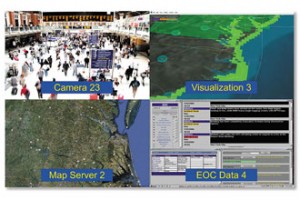 Extron is shipping its new VNS 104 Multi-Stream Decoding Software that decodes and presents one or four video sources and one associated stereo audio source streamed from VN-Matrix 225 or 200 Series Encoders, or a VN-Matrix Recorder. VNS 104 multi-stream decoding software includes text overlay and status messaging features, which are valuable for distinguishing between AV sources during operation and system commissioning.
VNS 104 multi-stream decoding software operates on Windows PCs and is managed as a part of a system by a VN-Matrix Enterprise Controller. It offers aspect ratio management for VN-Matrix streams, including FILL, FOLLOW and a 1:1 mode, which can be applied independently to each decoded source. VNS 104 provides an effective method for monitoring multiple streaming sources in a variety of environments including command and control, after action review, training and simulation and medical or geological visualization.
Go here for all the specs.
Leave a Comment
Share Article
Back to Top
Atlas Debuts Ceiling Tile Speaker Adapter
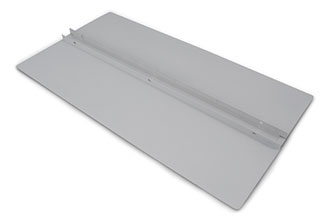 The new Atlas Sound DT12-2X2ADP is a ceiling tile adapter for use with the Atlas Sound DT12 1′ x 2′ drop in speaker system. The DT12-2X2ADP is an adapter plate that turns the Atlas Sound DT12 1′ x 2′ lay-in speaker package into an easy-to-install 2′ x 2′ speaker package that can replace an entire 2′ x 2′ acoustical tile.
The kit includes two adapter plates and an additional T-bar support. Atlas says the DT12-2X2ADP is manufactured at the same factory as the DT12 to insure both products match in appearance. Customers can order both the DT12 and the DT12-2X2ADP to create an entire 2′x2′ speaker package.
More information is here.
Leave a Comment
Share Article
Back to Top
Panasonic Debuts Brightest Single-Chip DLP WUXGA Projector Ever
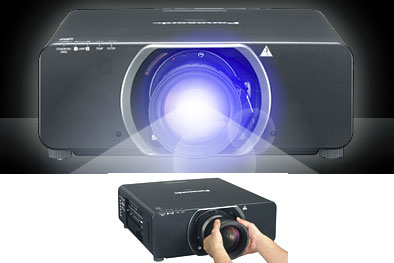 Panasonic’s newest single-chip DLPs are all part of the PT-DZ870U Series. The line includes the 8,500-lumen PT-DZ870UK, spec’d to be the industry’s brightest WUXGA (1920×1200) 1-Chip DLP projector; the 8500-lumen, WXGA (1280×768) resolution PT-DW830U; and the 10,000-lumen, XGA (1024×768) resolution PT-DX100U. The entire PT-DZ870 Series uses a new 420-watt, dual-lamp system.
All models are specified at a contrast ratio of 10,000:1 and include Panasonic’s proprietary and re-engineered Dynamic RGB Booster, which the company says improves image color and brightness by optimizing lamp intensity of individual red, green and blue colors according to each scene. The PT-DZ870 Series is also 3D compatible and supports various 3D formats including frame packing, side by side, top and bottom, line by line and simultaneous.
The PT-DZ870 Series is DIGITAL LINK compatible (HDBaseT), which assures end users of a simplified AV infrastructure with high definition video, audio and control signals all carried over a single CAT5e or higher specification Ethernet cable for up to 100 meters (328 feet). This solution reduces cabling costs and complexity and simplifies installation and maintenance. Panasonic’s Digital Interface Box, the ET-YFB100G ($1,999.00 list) is currently available and can be paired with the PT-DZ870 Series projectors for DIGITAL LINK connection, or the projectors can be used with major AV control manufacturers’ protocols such as Crestron’s Digital Media 8G+ , Extron’s XTP Systems, AMX’s Enova DVX and other manufacturers’ HDBaseT variants without the need for an external receiver.
Paired with a new ultra short-throw lens — the ET-DLE030 — the PT-DZ870 Series makes an ideal projection solution in situations where space is limited, including museums, auditoriums, exhibitions and digital signage installations. With a short throw ratio of 0.38:1(WUXGA), the device will be able to project a 100” to 350” diagonal image from 2.7ft
(0.82m) and 9.4ft (2.85m) from the screen respectively. The ET-DLE030 lens, part of a wide range of optional lenses offered by Panasonic, is compatible with all current, lens-replaceable. 1-chip DLP Panasonic projectors and will be available in August for a list price of $5,999.00.
The entire series can be found here.
Leave a Comment
Share Article
Back to Top
IED Intros Backup Amplifier Switch
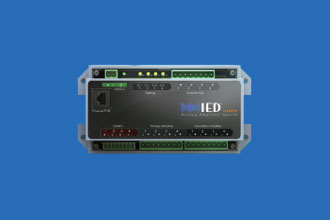 Innovative Electronic Designs (IED) has released the IED1544BAS backup amplifier switch. The IED1544BAS offers four independent channels of backup amplifier switching for 4Ω, 8Ω, 70.7V or 100V speaker lines up to 500 watts per channel.
This unit can be used with any amplifier system that provides dry contact closures for fault conditions. The unit is network capable and can be configured via a standard web browser via IP address or using the IED GLOBALCOM System Management Console. This small unique switch can be DIN rail or wall mounted for use both inside and outside of a rack and it is powered by an external 48VDC power supply or IEEE 802.3af PoE switch. Connections are made via Phoenix connector and unit includes indicator LEDs for power and channel status.
All the details are here.
Leave a Comment
Share Article
Back to Top
JVC Ships 84-Inch Pro 4K 60p Monitors
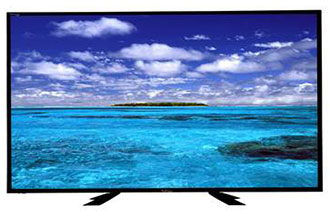 JVC Professional Products is shipping this month its new PS-840UD Professional Series ProVérité and RS‑840UD Reference Series 4K 84-inch LCD monitors. Both models offer native screen resolution of 3840×2160 (4K), as well as 60p input and display capability for professional sports and other high-speed content.
Both models are designed for custom installations where high resolution is a necessity, such as video production studios and trucks, medical imaging and conference rooms. The PS-840UD includes compatibility with the Intel open pluggable specification (OPS), which makes it a high-performance choice for high-end public signage display applications. Plus, the RS-840UD has been licensed with the Imaging Science Foundation (ISF) and includes a C3 mode for professional calibration.
The monitors feature an IPS LCD panel with 120Hz refresh rate and 10 bit color depth. Housed in a slim bezel with a 178‑degree viewing angle, the ELED offer HDMI 1.4a (single cable 4K up to 30p) and HDMI 1.3 (four cable 4K up to 60p). Other features include audio I/O for the built-in 15-watt speaker and a table base.
The PS-840UD 4K panel has a suggested list price of $14,000. The RS-840UD has a suggested list price of $13,500.
Leave a Comment
Share Article
Back to Top

For all you REGULAR readers of rAVe ProAV Edition out there, hopefully you enjoyed another opinion-packed issue!
For those of you NEW to rAVe, you just read how we are — we are 100 percent opinionated. We not only report the news and new product stories of the ProAV industry, but we stuff the articles full of our opinions. That may include (but is not limited to) whether or not the product is even worth looking at, challenging the manufacturers on their specifications, calling a marketing-spec bluff and suggesting ways integrators market their products better. But, one thing is for sure, we are NOT a trade publication that gets paid for running editorial or product stories. Traditional trade publications get paid to run product stories — that’s why you see what you see in most of the pubs out there. We are different: we run what we want to run and NO ONE is going to pay us to write anything good (or bad).
Don’t like us, then go away — unsubscribe! Just use the link below.
To send me feedback, don’t reply to this newsletter. Instead, write directly to me at [email protected] or for editorial ideas, Editor-in-Chief Sara Abrons at [email protected]
A little about me: I graduated from Journalism School at the University of North Carolina at Chapel Hill (where I am adjunct faculty). I’ve been in the AV-industry since 1987 where I started with Extron and eventually moved to AMX. So, I guess I am an industry veteran (although I don’t think I am that old). I have been an opinionated columnist for a number of industry publications and in the late 1990s I started the widely read KNews eNewsletter (the first in the AV market) and also created the model for and was co-founder of AV Avenue, which is now known as InfoComm IQ. rAVe [Publications] has been around since 2003, when we launched our original newsletter, rAVe ProAV Edition.
Everything we publish is Opt-in — we spam NO ONE! rAVe ProAV Edition is our flagship ePublication with what we believe is a reach of virtually everyone in the ProAV market. rAVe HomeAV Edition, co-published with CEDIA and launched in February 2004, is, by far, the largest ePub in the HomeAV market. We added rAVe Rental [and Staging] in November 2007, rAVe ED [Education] in May 2008 and then rAVe DS [Digital Signage] in January 2009. We added rAVe GHGav [Green, Healthcare & Government AV] in August 2010 and rAVe HOW [House of Worship] in July 2012. You can subscribe to any of those publication or see ALL our archives by going to: https://www.ravepubs.com
To read more about my background, our team and what we do, go to https://www.ravepubs.com
Back to Top
Copyright 2013 – rAVe [Publications] – All rights reserved – All rights reserved. For reprint policies, contact rAVe [Publications], 210 Old Barn Ln. – Chapel Hill, NC 27517 – (919) 969-7501. Email: [email protected]
|