|
Volume 6, Issue 10 — October 29, 2015
|
brAVe New World
Aeiforia Technos
Editorial
Editorial
Editorial
|
|

|
Does Your Technology Matter?
By Midori Connolly
AVGirl Productions
In the last year, I have had the great fun of advising a number of tech startups, in both a formal and informal role. It’s been so energizing and refreshing to see these companies bringing such interesting new technologies to the live events marketplace. The blend of science and creativity is really what makes this AVGirl’s heart go pitter-patter.
On the other hand… there are also many moments when the AVGirl’s logical core feels squeezed like a trade show stress ball. The central issue in almost every single case is not about a lack of a business plan or marketing strategy, but when the technology hasn’t been engineered and delivered as a solution to a problem that matters. It’s important to think about both parts of this. First, you can’t just have a good idea and hope to cram it down the neck of an unsuspecting buyer because it’s such a good idea they won’t be able to resist it! Next, if you have identified a problem and come up with a tech solution, the problem has to matter enough for someone to spend money to fix it!
About 90 percent of the tech gurus and tech providers (whether AV or other event technology) that I encounter lament about buyers being so resistant to change — and how we need to educate them more on the way technology can change their life for the better; how they need to get caught up “with the rest of the world” — how they just don’t get it and blah and blah and blah, more of the same. But if this is true, why are there successful startups such as PopBookings, a beautifully engineered, well-designed technology that is event staffing made simple? The founder, Scott Hanson, is supercharged with energy and excitement about the positive industry response to his technology.
Do you know why?
Because the problem he identified, sourcing and managing staffing for experiential events, actually matters. The events industry is very familiar with this problem, and has long struggled with many of the challenges associated with it. And, perhaps most importantly, it’s a common problem. Meaning, thousands of professionals share the same problem. Which means that because of the familiarity of the problem and the number of businesses/people who have it, creating a solution will actually matter. For a tech solution to succeed, there must be buyer who quickly identify that they have this problem (and, hopefully, have been seeking an alternative) and there must be many of them.
What about you? Maybe your technology is a beautiful, creative, brilliant idea. Maybe it even solves a problem. But to truly be successful, and to sell millions and millions of your beautiful solution, you need to be sure that it matters. As you look forward in your business planning and strategy for the future, I challenge you to evaluate your offerings with a keen and honest eye and ask the tough question, “Do I sell a solution to a problem that matters to a lot of people?” This is the true test of the viability of your technology as a sustainable business. Leave a Comment


Share Article
Back to Top |

Click above to learn more
|

|
Is Asia the World’s Green Beacon?
By Raymond Kent
Managing Principal, Sustainable Technologies Group
Is Asia the hot spot for green office buildings in the world? Right now they are certainly poised to be. Take Singapore and its Green Mark certified green building path, for example. The government has set the benchmark of having 80 percent of all buildings be certified green by 2030. This push by the Building and Construction Authority (BCA) started in 2005 and has currently reached a 29 percent gross square footage water mark. This is not driven by demand either but simply by what has become the new normal.
The data as reported by Business Times is that most building owners are detailing that tenants in Singapore are trending towards being multi-nationals and large domestically listed corporations and show a penchant for having sustainability as a core value and key strategy. These companies are serious when it comes to owning up to reducing their carbon footprints by executing aggressive climate strategies and demonstrating these efforts to their key stakeholders (shareholders, clients, employees and the general public).
Many of these commitments revolve around working environments that are sustainable or have robust green initiatives in place and can handle growth. The financial services sector has the strongest commitments followed by Internet and data companies, construction and real estate, as well as energy and commodities. As incentive, many of these companies can take advantage of tax breaks in their country of origin, particularly in the U.S. and Europe.
The outlying question is how does this translate into real dollars from a rental standpoint? Can green buildings command higher rents? It is not an easy answer as there are too many variables such as location, floor plate efficiencies, proximity of other amenities and included amenities with in the building or complex. This most often includes technology from the Information Communications Technology Industry (ICT) such as access to IT connectivity, smart building technology and efficient low-voltage lighting and controls. These larger companies can often tolerate the higher rents as result because they can take advantage of larger savings in operations as a result of green tech and other sustainable aspects of these properties.
The data does show a drop off as expected in the small and medium sized businesses not willing to forgo razor-thin profit margins for better-built, higher-efficiency buildings. This is not to say that things are not happening in these markets in Asia — quite often there is acknowledgement and certification of greening up the interior fit out of a space even if the building itself isn’t green. It is often a herd mentality: that whole buildings that may not be green in bricks and mortar can wind up being just as efficient as their higher rent counterparts through having multiple tenants with sustainable fit outs.
In any case, as I have written about before on many occasions, sustainable work environments provide not only great benefit to the environment but will ultimately effect profitability making these decisions relatively easy for companies. That said, companies in Asia are definitely seeking out green building amenities and supplementing deficiencies through smart fit-outs.
So why has this become the new normal? Perception is everything. Just like many consumers come to expect certain things from products such as safety features in a car, prospective tenants expect developers and building owners to provide a minimum of sustainable features. This incentivizes developers to competitively provide more options to gain market share, which puts them at an advantage rather than having to discount their rental for lack of greenness. In order to accomplish these upgrades, developers are taking advantage of government incentives for green capital under the Urban Redevelopment Authority of Singapore. The fund holders are marking this by increasingly demanding accountability and transparency for sustainability. The government also expect that the developers own companies operate in a sustainable fashion as a means of demonstrating their commitment. This also rolls into private investments as well who are following suit with the government.
None of this is to say that the rest of the world is doing nothing. The Netherlands and Germany are hallmarks of sustainable living weaving it deep into their cultures. Even the United States has a similar high water mark with the Architecture 2030 Challenge. The largest roadblock in the U.S. is the political climate including influences from big oil and gas companies and other major industries who would rather up-regulate to maximize profit rather than deal with sustainability. I am certainly generalizing here with that statement but only one has to watch any news show on either side of the aisle and watch the fireworks especially as we are heading into a presidential election cycle.
One only has to look at real estate giants such as CBRE, Westfield and Simon Malls to see good examples of green building commercial space with incentives. The question will be in the near future is who in the world will lead by example? Leave a Comment
Share Article
Back to Top |
Click above to learn more
|

|
If Your Clients Upgrade to Apple’s iOS 9, Your Wireless AV Collaboration Systems May Stop Working
By Gary Kayye
rAVe Founder
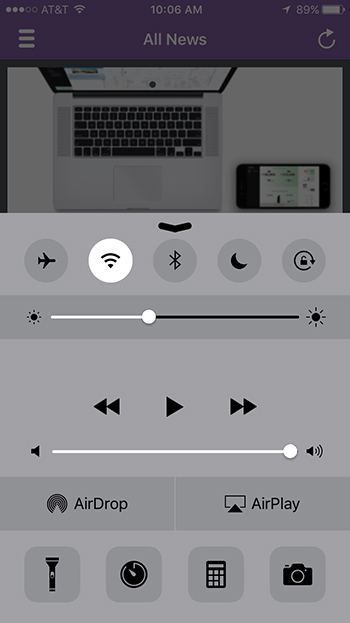
There’s an interesting dilemma developing in the ProAV market where clients are calling their AV integrators because, ever since they upgraded to iOS 9 with their iPhones or iPads, they stopped working with their wireless transmission systems.
There are about a dozen or so companies who have wireless AV systems out there. It all started with Barco and its industry-leading ClickShare launch a few years ago. And, ever since, many BYOD or “collaboration” systems (as well as Huddle Rooms) have been built integrating wireless systems (or at least inputs on a system) that accommodate sending video and audio wirelessly via Apple laptops, Samsung phones, tablets, Windows devices and even iOS (Apple iPhones and iPads). The thought is that it allows for someone (an attendee of a meeting or a group in a brainstorming meeting) to share content without having to connect to the room’s VGA or HDMI cable. It all happens wirelessly.
But, oops, in iOS 9, Apple made that even harder and, all-of-a-sudden, many of the popular wireless systems out there (e.g. any system — other than Apple’s own — using AirPlay to transmit video) stopped working. So, an iOS 8 phone works, but not one using iOS 9.
So, who’s affected?
Well, let’s make this easier and tell you who’s not affected so far — these are the companies with wireless transmission systems are still working in iOS 9 as of October 20th. We will update this list as systems are updated or we hear back from the manufacturers. Here are the collaboration systems that DO work with iOS 9, as of October 27, 2015:
- Crestron AirMedia
- Extron ShareLink
- EPSON iProjection
- Panasonic Wireless Projector App
- Christie Brio
- Kramer VIA
- WolfVision Cynap
- AMX Enzo via MirrorOp
- Barco ClickShare
We will keep updating this list as manufacturer’s fix their systems, but, again, this iOS 9 issue needs to be monitored as many, many installed systems aren’t working any more when your clients update their operating systems. Leave a Comment
Share Article
Back to Top |
|
|
Crossing The Rimikon
By Lee Distad
rAVe Columnist
Slowly but surely, we’re moving towards the future of lighting. In January of 2014, Canada legislated to ban 75- and 100-watt incandescent light bulbs. Then in January of 2015 40- and 60-watt incandescent bulbs were outlawed. Businesses are still allowed to sell through their existing inventory, which is why 40- and 60-watt bulbs are still on the shelves at Rona and Home Depot (but no more 100-watt bulbs, I’ve noticed — those are long gone), but it’s only a matter of time now.
Indeed, the future, and in fact the present now belongs to LED technology.
By now everybody knows that LED bulbs use much less electricity than incandescent bulbs, last substantially longer and generate next to no waste heat. The bulbs contain no mercury, which is far more environmentally friendly than CFL (compact florescent) bulbs. And in the case of new LED fixtures, as opposed to LED bulbs that are intended for high voltage legacy fixtures, they are of a low enough voltage to mitigate any risk of shock during installation.
One lighting vendor who has gone All-In on LED technology is Ottawa, Canada-based Rimikon, who now specializes in LED Lighting and creates, designs, and manufactures low voltage lighting systems.
Rimikon points to a number of features that makes their product stand out, and allows lighting designers and integrators to create exciting lighting solutions for residential, commercial, or architectural applications.
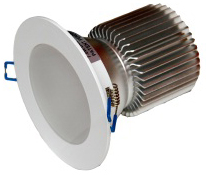
All the LED products in their lighting systems, such as pot lights, cabinet lights and strip lights run on 24-volt extra low voltage DC current. There’s no shock hazard, and their pots, for example, can be wired using 14/2 stranded speaker wire!
It also means that their pots can be retrofitted in ceiling spaces without a metal back can. That makes them ideal for use in ceiling, outdoor soffit or bathroom shower installations.
Rimikon also points to the other usage benefits of LED lighting. Unlike CFL bulbs, there’s no flickering, which can lead to headaches, eyestrain and discomfort. They don’t give off UV light, which can discolor lightly colored furnishings over time. And perhaps the biggest benefit is that they don’t generate heat, which means they can be installed in places, like under-counter task lighting where excess heat could warp and damage cabinets.
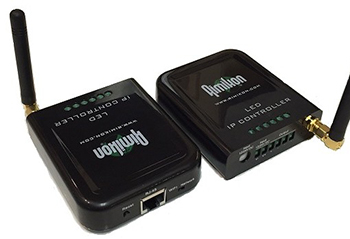
All of that is all well and good, but what’s going to be of more interest to AV pros is that Rimikon is releasing the RIM-IPC, its own IP Controller module for its Extra Low Voltage LED Products. The unit is IP addressable, as well as being able to operate on WIFI, and can be used with the Rimikon Android and IOS App, offering a remote control distance that can reach up to 50 meters indoor and up to 100 meters outdoors. One IP Controller is required for each lighting zone. Additionally, IP control drivers are available to integrate the RIM-IPC for Control 4, Crestron, URC and RTI control systems.
More information can be found here.
Resources:
Leave a Comment
Share Article
Back to Top |
|
|
Collaboration Technology Principles
By David Wolf
Video Architect at Capital One
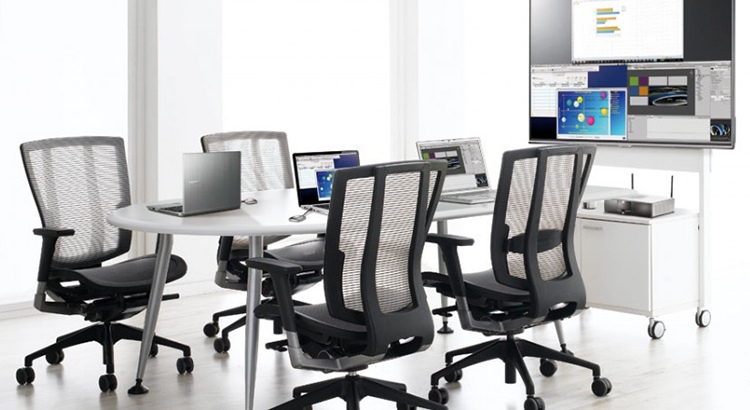 Many in the AV industry are emphasizing collaboration standards focused on an professional IT approach keying in on specific strategic solutions. While this might be an easy approach to apply to collaboration solutions in organizations starting with small inventories or doing complete refreshes; I find this is a difficult approach in a large organization with hundreds of rooms and various funding sources. Still the need to provide consistence, cost effective, and predictable collaboration solutions, this space differs in that there are many complexities in AV, and applying a hard line approach to a standard may look good on paper, but it does not provide a holistic solution to meet the demands of all large enterprises. Instead I’m finding that building and socializing core principles that can align to meet the user requirements of any project by providing a flexible framework that will ensure effective adoption and ROI. These principles communicate the technology values and approach creating space to merge innovation and operational requirements.
User Experience
The goal is for the best achievable user experience; focusing on simplicity, consistency, intuitive operation and reliable up time, to follow the customer’s current UI design guidelines. The core goal is for a unified experience in all spaces and all aspects of the audio, video and control solution. Additionally the audio and video experience should focus on intelligibility, and view-ability, with consistent functional consideration. System control shall be intelligent, simple and aware of the user. This shall include automated actions to minimize the number of touches, touch points, and minimal amount of touch to task time. Never should system control allow user error due to a need for the user to understand, or be aware a device or system operating status. While innovation is welcome the user experience should take precedence.
Normalization
Solutions are designed and installed in a typical manner with consistent operation and support, with consideration around how users expect to work with technology in spaces locally and across the enterprise, with as few solutions or “system types.” Innovation or new system types are to be approached to ensure the solution can replicate into future one or more solution categories.
System design should pivot around efficiency, quality experience, independence, supportability, reliability and ability to replicate. All systems shall include documented resolution plans and hardware solutions that include proper resolution management. Solutions should include and degrade or take away from typical legacy quality and features, while ensuring a consistent user expectations and experience.
Documentation shall be organized by room not project, to include drawings, code, and system files. By allowing the customer to catalog solutions by room or space and not by floor or building, support and move/changes are more effective and efficient. Drawings should be in electronic format organized and compiled by room and or system type. These should be stored local to the system when possible, with a clearly documented storage and revision process.
Deployment and Support
Solutions should be carefully coordinated with the spaces they are being deployed to ensure the core principles are being met. Additionally key goals include industry installation best practices, access, simplicity, efficiency and system operation. The solution provider shall be responsible for proper configuration, function, and validation of all devices and the system as a whole per industry standards and customer requirements. This will include ensuring the solution can be supported with ease of access during times of service. Solutions should be installed in a simple manner without complicated numbering, labeling, and cable types. All solutions shall support integration with the monitoring, alerting, and reporting/analytic systems per customer requirements.
This blog was reprinted with permission from David Wolf and originally appeared here.
Image via Office of the Future Leave a Comment
Share Article
Back to Top |

|
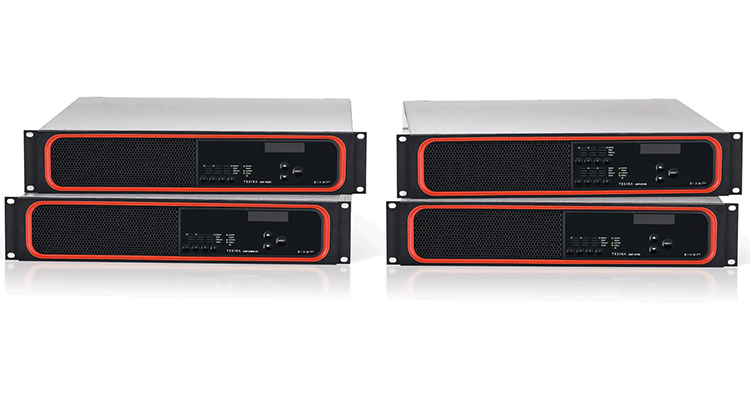
| Biamp Adds to Tesira AmplifiersBiamp Systems introduced four new amplifier models to it’s Tesira’s network amplifiers lineup. The four include the four-channel 175-watt AMP-4175R, the eight-channel 150-watt AMP-8150R, the four-channel 350-watt AMP-4350R, and the four-channel 300-watt AMP-4300R CV with constant voltage. The amplifiers feature dual AVB/TSN ports for tnetwork redundancy and feature slots for optional analog failover cards to continue signal flow if the network stream is lost and these slots can also be used for optional I/O on the back panel. The Tesira amplifiers offer bridgeable channels to combine channels, a front-panel display for quick performance feedback and convenient front-panel adjustments to modify amplifiers locally.
Biamp Systems’ Tesira amplifiers begin shipping in spring 2016 and specs of each model are here. Leave a Comment
Share Article
Back to Top |
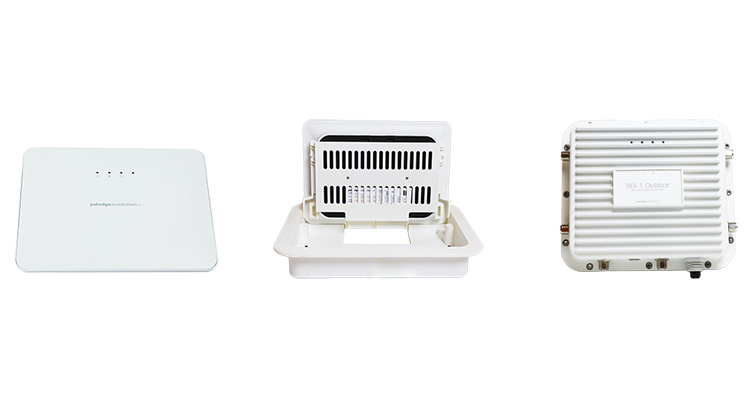
| Pakedge Debuts WX-1 Gigabit AC Wireless Access PointPakedge’s new gigabit wireless access point (AP), the WX-1, is an 802.11ac access point that features a 3×3 Multiple Input Multiple Output (MIMO) radio configuration for what Pakedge claims is up to five times faster connection speed and four times more bandwidth. Supporting twice as many clients, the WX-1 offers a higher channel capacity than N based access points as it has channels up to 80Mhz and is capable of processing up to four times as many signals per channel.
Plenum rated for fire safety compliance, the WX-1 is aimed at ProAV integrators for corporate installation but Pakedge is hoping that it’s used in hospitals, schools, and MDUs. It also supports RADIUS (Remote Authentication Dial-In User Service) servers, which centralize authentication, authorization, and account management for enhanced security. The WX also supports the more secure WPA Enterprise and WPA2 Enterprise signal encryption for those who use RADIUS servers.
Designed for bandwidth intensive multimedia traffic, the WX-1 features something called TruStream and Pakedge Zones which are able to recognize and prioritize latency sensitive voice and video traffic for seamless performance. It’s integrated with six internal antennas.
The WX-1 can be wall/ceiling surface mounted and the in-ceiling/in-wall mounting trays allows integrators to stock only one SKU that can be upgraded as needed. The WX-1 also includes t-bar brackets for drop-tile ceilings and there is even an outdoor version. Because the WX-1 is PoE+ powered, the placement of the AP is flexible and not contingent on whether or not an AC power outlet is available.
Here are all the tech specs. Leave a Comment
Share Article
Back to Top |
| Extron Ships New Edge Mount Enclosure for AV Connectivity, Data, and Power
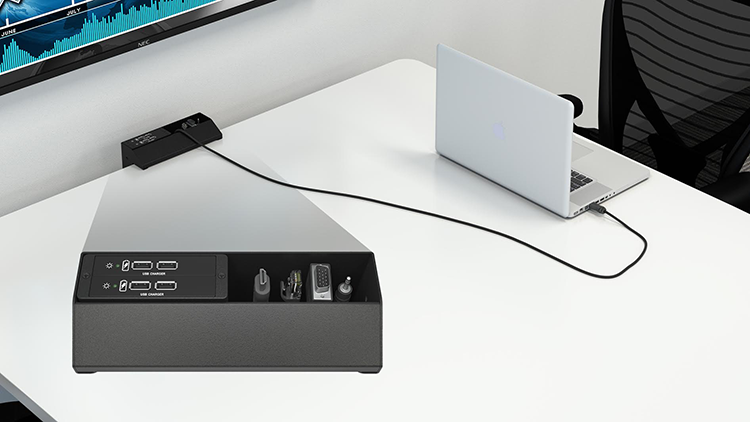
Extron announced the immediate availability of the AVEdge 100, a cable access enclosure designed to mount onto the edge of a tabletop surface in semi-permanent installations where cutting the surface is not desirable. An integrated clamp system secures the enclosure to the tabletop surface without the need for tools or additional parts. The AVEdge 100 accommodates two double-space Architectural Adapter Plates – AAPs, Cable Pass-Through Brackets for up to eight AV cables, or three Retractor cable retraction modules.
AAP power modules are available to provide USB and/or AC power for mobile devices and laptops. The optional CableCover is available to minimize cable tangles and accidental disconnects, and the Extron ZipClip Series is available to mount products, such as the PS Series Desktop Power Supply, directly to the enclosure. The AVEdge 100 is available in a black powder coat finish.
For more information about the AVEdge 100, go here. Leave a Comment
Share Article
Back to Top |
| Almo Pro A/V Makes Final E4 AV Tour 2015 Stop in New York, Now Sells BandwidthAlmo Professional A/V is wrapping up its 2015 “Fully Charged” E4 AV Tour next week in its most popular location, the New York Metro area. The event, which takes place at the Teaneck Marriott New Jersey on October 8, is also the official launching platform for Almo’s third service program: Almo Bandwidth Services and subsequent relationship with the newest E4 exhibitor, Comcast Cable.
“The E4 Tour only comes to this area every two years and it is an entirely different event in 2015 than it was in 2013 or will be in 2017 so it’s absolutely worth taking the day to come out and learn, network and experience the latest and greatest in the Pro AV world,” said Sam Taylor, executive vice president and COO for Almo Professional A/V.
In terms of the new Almo Bandwidth Services program, Taylor explained, “We are helping our integrators focus on recurring revenue streams to make their businesses more valuable. As the first distributor in the AV industry to offer bandwidth services with the top US providers — including Comcast Cable — our partners can now sell their end users long-term contracts for high-bandwidth connectivity as part of an overall installation. Their customers pay for this service on a monthly basis and the integrator makes a recurring monthly commission on those contracts.”
To view an interview rAVe Founder, Gary Kayye, did with Sam Taylor about the Almo Bandwidth Services Program is here.
The E4 New York Metro event also includes two new hands-on “E4 Experience” workshops focusing on Digital Signage Content & Distribution and BYOD & Collaboration. To view an interview about the E4 Experience workshops with Brian Rhatigan, director of business development for Almo Professional A/V, click here.
Another highlight is the return of the highly sought out 90-minute technical HDBaseT Installer Expert Program, which is designed for those who would like to learn more about HDBaseT technology, regardless of whether they are beginner or expert installers. You can register for those classes here. For a complete E4 New York Metro agenda or to register, go here. Leave a Comment
Share Article
Back to Top |

Click above to learn more
|
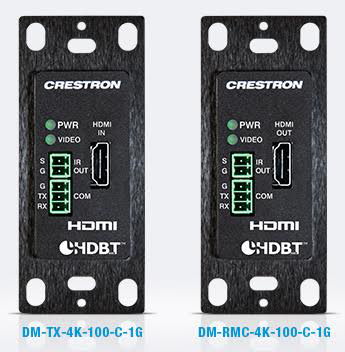
| Crestron Ships Wall-plate Tx/Rx for 4K HDMICrestron is shipping a new 4K wall plate transmitter (DM-TX-4K-100-C-1G) and receiver (DM-RMC-4K-100-C-1G) pair integrated with built-in serial and IR ports control. Both are direct replacements for the DM-TX1-C-1G and DM-RX1-C-1G and are HDBaseT compliant.
Available in black or white single-gang, decors-style plates, Crestron says they are low-cost 4K transmitters that can be powered using the included wall mount power pack, or via PoDM (Power over DigitalMedia). The DM-TX-4K-100-C-1G and DM-RMC-4K-100-C-1G can be mounted in the wall or in 4-inch deep floor boxes.
A single cable connects either device to a DM switcher, transmitting or receiving video, audio, control, networking and power signals all through one category cable. A single HDMI input (DM-TX-4K-100-C-1G) or output (DM-RMC-4K-100-C-1G) port is spec’d to support video at resolutions up to 4K (4096×2160). Crestron specs color-sampling compatibility up to 4:4:4 at 24-bit @30Hz and 4:2:0 at 24-bit color @60Hz.
The DM-TX-4K-100-C-1G and DM-RMC-4K-100-C-1G include built-in serial and IR control ports to allow programmable control of the connected display. They also support CEC (Consumer Electronics Control) as an alternative to conventional control methods.
Here are all the specs. Leave a Comment
Share Article
Back to Top |
| VIVITEK Adds New Wireless Pocket Projector in Qumi Q6
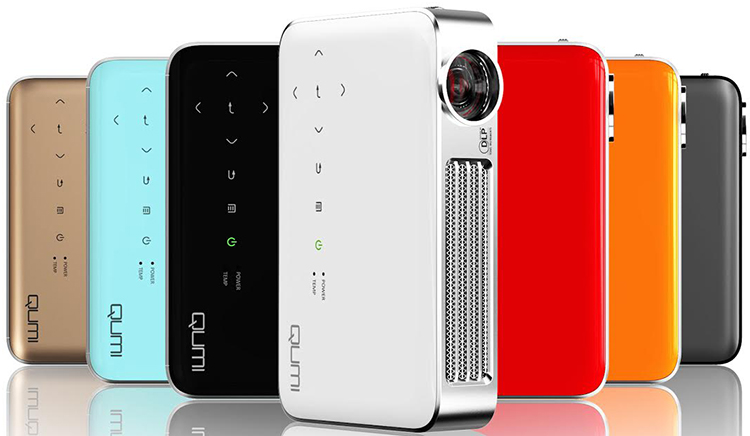
Vivitek today introduced the LED HD Qumi Q6, a WXGA pocket projector with 800 ANSI lumens and capable of projecting an image up to 90’’ diagonal (in the dark). The Q6 also uses an LED light source that’s spec’d at 30,000 hours of use.
The Q6 uses the MHL (Mobile High-Definition Link) connection port for video and audio content. From any MHL-enabled mobile device, such as smartphone or tablet, it is possible to reproduce its screen onto a large screen area while charging it with the MHL cable (included). For those who prefer to project directly from the Q6 (without connecting any device), an embedded media player can display documents, photos, videos and audio files.
Small, light and slim, the pocket sized Q6 is the perfect companion for sharing content from mobile devices. The size of a paperback book, and with a weight of only 475 grams and a thickness of 34 millimeters, the Q6 can be conveniently carried around in a purse, briefcase or backpack.
Other specs include:
- Native WXGA (1280×800) resolution with high definition 720p compatibility
- 800 ANSI lumens and 30,000:1 contrast ratio
- Wirelessly stream and all types of content
- Display contents directly from a USB flash drive or from the on board memory
- Advanced display connectivity including HDMI, USB and internal Wi-Fi
- 3D compatibility with DLP Link and HDMI 1.4b Blu-Ray support for dazzling and realistic life-like images
- Built-in 2 watt audio speaker with multiple audio ports for easy device connection
- Touch-sensitive keypad with illuminated back-lit controls
- Mobile remote control app (Andriod/iOS) for control of the projector’s functions and features
- Available in seven colors including black, white, light blue, red, orange, gold and charcoal gray
The new Qumi Q6 pocket projector will be available from September 2015 and here are all the specs. Leave a Comment
Share Article
Back to Top |
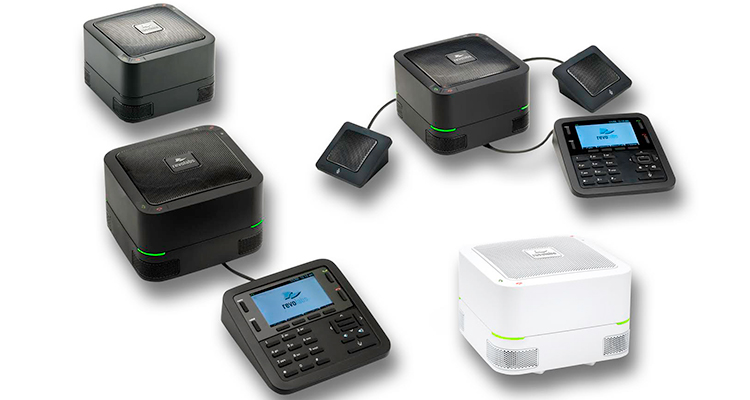
| Revolabs Announces Echo Cancellation for FLX UC Conference Phones
Revolabs today announced it has improved the acoustic echo canceller (AEC) technology in its FLX UC line of conference phones to support up to 16 kHz audio. The enhanced echo cancellation allows the microphones to match the performance of the dual-speaker system in the FLX UC product line, creating a robust, high-performance audio platform for UC that allows users to hear every word in a conference call.
AEC is the technology that allows bi-directional, full-duplex audio in conference phones, enabling natural communication among a call’s participants. Because of the significant processing power and complex algorithms required for using ultra-wideband frequencies, many conference phones cut audio at 8 kHz or below, which results in an artificial-sounding user experience. The new echo cancellation implementation supports up to 16 kHz audio for more natural sound.
The FLX UC 500, UC 1000 and UC 1500 conference phones are shipping now, with more information here. Leave a Comment
Share Article
Back to Top |
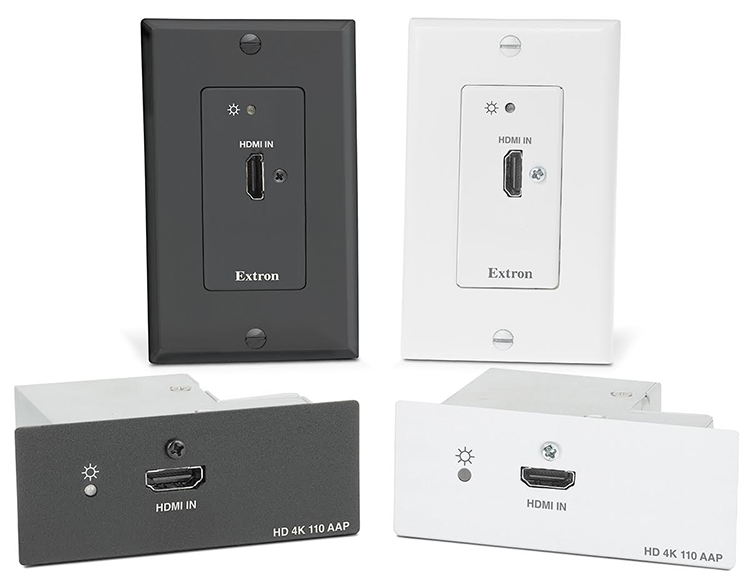
| Extron Intros 4K Signal RegeneratorsExtron’s new HD 4K 110 Series are simply one input, one output signal regenerators that are designed to guarantee signal integrity for HDMI sources with marginal or poor quality output. The signal regenerators are HDCP compliant, and support computer and video resolutions up to 4K, including 1080p/60 with Deep Color. Designed to recondition signals at the source, they equalize the input signal, reduce jitter and skew, and provide output signal pre-emphasis to reliably extend the signal. Video resolutions up to 4K can be extended up to 25 feet (7.6 meters) when used with Extron HDMI Pro Series cable. The HD 4K 110 Series is available in two form factors: a double-space AAP version for use in the Extron Cable Cubby Series/2 enclosure or other AAP mounting frame, and a single-gang Decora-style wallplate version. Both versions can be powered by the HDMI source or the included power supply for integration flexibility. Available in black and white to complement a wide variety of environments, the HD 4K 110 AAP and HD 4K 110 D are ideal for discreet installation with remote HDMI sources.
The HD 4K 110 Series supports HDMI specification features that include data rates up to 10.2 Gbps, 12-bit Deep Color, 3D, Lip Sync, HD lossless audio formats, and CEC. It can be used in conjunction with equalizers and other AV products to ensure optimal image quality within professional applications. Rear panel dip switch settings for input equalization and output signal pre-emphasis make the HD 4K 110 an ideal input connection to enable a strong HDMI signal within matrix switching applications, such as with the Extron DTP CrossPoint 84. For AV equipment that does not provide input cable equalization, the signal regenerator can be paired with an Extron UHD4K 101 equalizer at the far end to maintain a high quality HDMI signal from source to destination.
Here are the specs. Leave a Comment
Share Article
Back to Top |
| Planar Announces the Newest Planar UltraRes Series 4K LCDPlanar Systems has improved not their Planar UltraRes Series of 4K LCDs. The latest Planar UltraRes Series design includes new features available in a 98-inch, an 84-inch and a new 75-inch 4K resolution display that includes built-in Planar MediaPlex Plus Processing for multi-source viewing (four at one time). The 4K 60Hz displays can be driven via single-cable HDMI 2.0 or DisplayPort 1.2. The Planar UltraRes Series is aimed at applications like interactive digital signage, corporate lobbies, airports and museums.
New Features include:
- Advanced multi-source viewing: The new Planar UltraRes Series displays come standard with integrated Planar MediaPlex Plus Processing, allowing multiple sources to be viewed simultaneously that can be viewed in dual, triple, quad or picture-in-picture (PiP) layouts.
- Embedded OPS: The Planar UltraRes Series includes a built-in expansion slot that supports Intel’s Open Pluggable Specification (OPS).
- Easier installation and access: The optional Planar Profile Mounting System has been enhanced to enable even easier installation and access to inputs. The mounting system provides a front service access mode and Planar claims it’s the slimmest mounted profile in the industry.
- Integrated multi-touch functionality: The new Planar UltraRes Touch models with in-bezel touch technology offer support up to 32 simultaneous touch points
- Advanced energy efficiency: The latest generation Planar UltraRes Series comes with redundant power supply for continuous operation using a fan-less edge-lit LED.
- Multi-source viewing management from mobile devices: The updated Planar UltraRes App for iOS and Android enables on-the-fly switching of layouts and sources from a phone or tablet.
Check out all the specs here. Leave a Comment
Share Article
Back to Top |
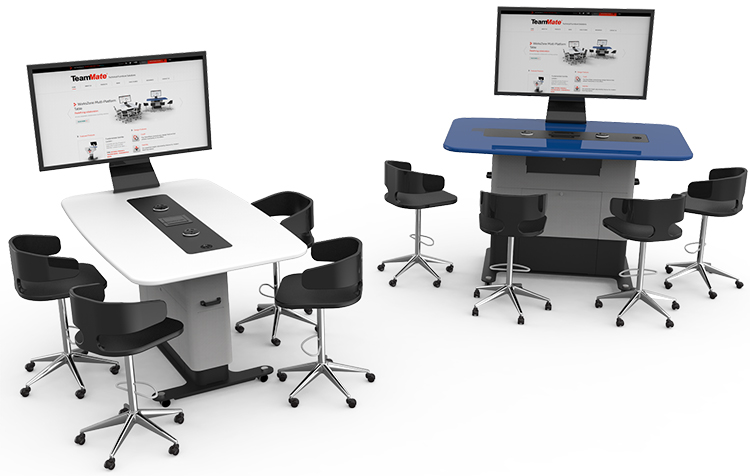
| TeamMate Launches Compact Pre-Integrated Meeting Room Table
The WorksZone Compact is a smaller version of TeamMate’s WorksZone Collaboration Tables. Fixed or height adjustable, the WorksZone Compact is ideal for flexible learning environments and meeting spaces where space is of a premium. The WorksZone Compact has a Central Connectivity Module which has the ability for users to customize their connectivity inputs; from power to the latest wired and wireless collaboration technology.
The Compact offers worktop length options of 1600×1000, 1800×1000 or 2000x1000m enabling the seating of three, five and six people respectively. As with the standard TeamMate WorksZone Collaboration Tables, the Screen Support can be positioned on the side or end of the table depending different applications of the tables in learning and meeting spaces.
A main feature of the WorksZone Compact and indeed the whole WorksZone family of Collaboration Tables, is the option of having electronic height adjustment “VariHite” if needed. Sit/stand workplaces in education and corporate sectors is a growing practice. Botting also adds, “With the VariHite feature of the WorksZone Tables you can now sit and collaborate with colleagues one minute and have a quick stand up meeting the next.”
The WorksZone Compact details are all here. Leave a Comment
Share Article
Back to Top |
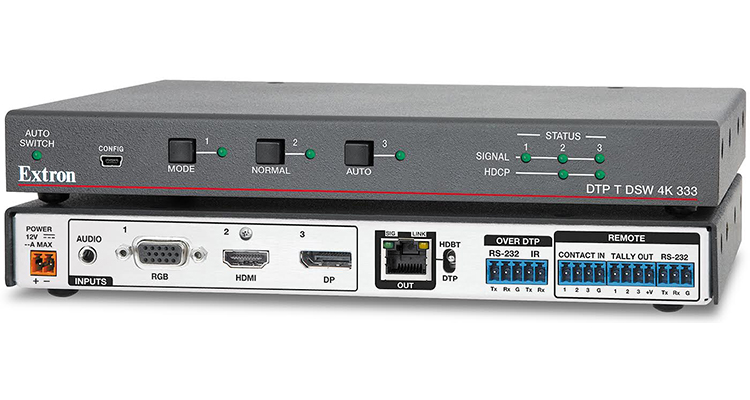
| Extron Introduces DTP 4K Switchers for DisplayPort, HDMI and VGA With Audio Embedding
Extron’s new DTP T DSW 4K 233 and DTP T DSW 4K 333, three input switchers for sending DisplayPort, HDMI or VGA, audio and control over a shielded CATx cable to Extron DTP-enabled products. The DTP T DSW 4K 233 extends signals up to 230 feet (70 meters), while the DTP T DSW 4K 333 extends signals up to 330 feet (100 meters). They provide DisplayPort, HDMI and VGA inputs, and one DTP output. Both DTP T DSW 4K models support video resolutions up to 4K, including 2560×1600 and 1080p/60 Deep Color. Analog stereo audio embedding and RS-232 remote control facilitate integration in professional environments. Integrator-friendly features include EDID Minder, auto-switching between inputs, audio input assignment, and bidirectional RS232 and IR pass-through for remote AV device control.
The DTP T DSW 4K 233 and DTP T DSW 4K 333 can be set up to automatically switch when they detect active video signals, making them ideal for automatic routing and unattended operation. Stereo analog audio can be embedded onto the digital video output signal for transport over DTP. In addition, the analog audio input can be assigned to any of the three video inputs, or it can be set to follow the input switch. For added installation flexibility, the DTP T DSW 4K switchers can be remotely powered by Extron DTP-enabled products over the shielded twisted pair cable. They also offer a selectable HDBaseT output mode that provides compatibility with any HDBaseT-enabled display.
Here are all the details. Leave a Comment
Share Article
Back to Top |
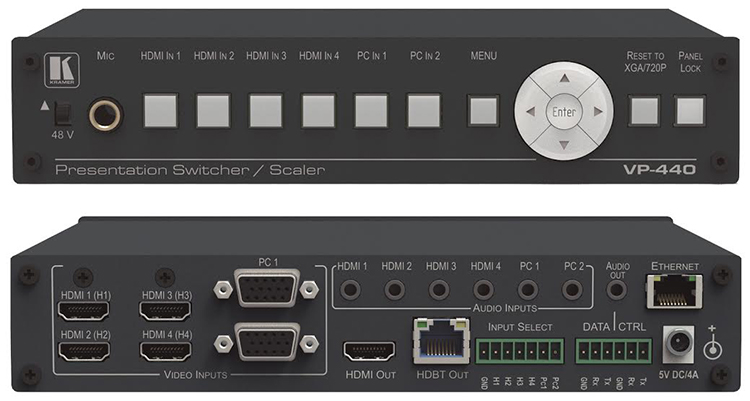
| Kramer Debuts VP-440 Switcher Aimed at Education
Kramer’s new VP-440 is a six-input switcher that’s part of their ProScale line. Aimed at classrooms and meeting rooms, it has four HDMI port and two VGA ports and all of the signals are converted to HDMI or HDBaseT on the output. Featuring front-panel control via an on-screen display (OSD) menu, RS232 and contact-closure control, it can be controlled via the web or through a control system.
VP-440 has unbalanced analog stereo inputs for each video input and embedded audio for its HDMI inputs as well as an unbalanced analog stereo audio output accompanying the HDMI and HDBaseT outputs. The VP-440 includes a separate microphone input that features audio equalization, microphone mixing and talker with delay. The unit also includes level control for the outputs and each individual input.
It’s not on the company’s website yet, but should be soon. Leave a Comment
Share Article
Back to Top |
| Middle Atlantic Unveils HubMiddle Atlantic Products today announced the launch of Hub, an all-in-one furniture solution, integrated with AV, that’s designed to maximize equipment storage and cable management.
Each Hub is comprised of a tabletop featuring a Wiremold InteGreat table box and a TechPed technology pedestal, featuring integrated Lever Lock plates for small device mounting and two Wiremold HDMI cable retractors to facilitate connectivity for anyone at the table. Shipping fully assembled for easy integration, the TechPed also includes 4RU of space with room for additional cable retractors and power distribution with a four-outlet power strip. In addition, Hub includes a wall-mount bracket for flat-panel displays with an additional four-outlet power strip that mounts to the table bracket for connections close to the display. An optional tower, available in black or white, can be used to mount displays directly to the table in a freestanding configuration.
Hub is available in more than 50 color options with a choice of HPL or thermolaminate table finishes. Customers may choose from a range of table configurations to support design flexibility and a variety of applications. Hub’s tabletop is available in two design options: Angle, a trapezoidal shape ideal for videoconferencing, and Bullet, rounded at one end to enable face-to-face collaboration. Table lengths include 6, 7 and 8 feet, accommodating from five to seven people. Each Hub includes an integrated cable trough for tidy cable management and simplified servicing down the line.
More information is here. Leave a Comment
Share Article
Back to Top |
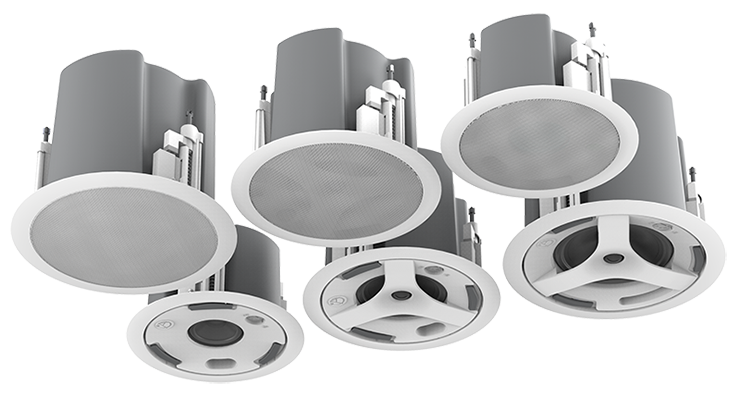
| AtlasIED Launches New FAP Strategy III Series of In-Ceiling Speakers
AtlasIED has announced the release of the new FAP Strategy III Series ceiling loudspeakers. Their big push with them is something they are calling Safety First Mounting System (SFMS) and they claim that it prevents mounting tab damage during installation. The damage is caused by over torqueing during the installation process. This excessive torque can damage the mounting tabs that over time can increase the chance of mounting tab breakage and the loudspeaker falling from the ceiling. The SFMS is the result of over 100 tested prototypes until the final design was approved. This patent pending technology uses t-handles that are integrated into the front of the loudspeaker baffle to tighten the mounting tabs in materials up to 3/4”.
Claiming that the SFMS, decreases installation time by up to 60 percent, AtlasIED’s mounting design installs without the need for tools. A front mounted 70V tap selector allows installers to adjust and set the 70V power taps and a removable four-pole euro-style connector allows for pre-wiring and daisy chaining of additional loudspeakers and subwoofers. They also claim an improved waveguide design provides wider coverage than previous models. The benefit is cost savings due to fewer loudspeakers required, while still maintaining uniform sound throughout. Low-frequency response is enhanced and deeper bass definition is provided via the optimized low frequency tuning port. Additionally all models are safety listed to both UL1480 and UL2043.
All the tech specs are here. Leave a Comment
Share Article
Back to Top |
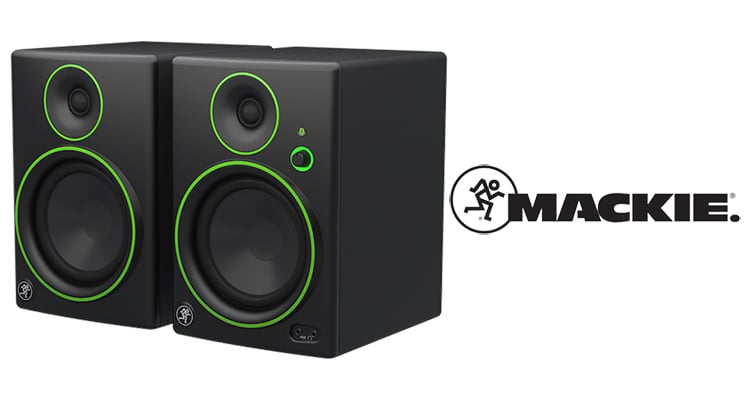
| Mackie Extends CR Series Monitor Line with Two New Bluetooth Streaming ModelsMackie today introduces two new models to its CR Series Multimedia Monitor line- the CR4BT and CR5BT. Both new models feature Bluetooth music streaming from any capable device, adding source flexibility perfect for auditioning comparison tracks or simply enjoying multimedia.
The new CR4BT and CR5BT join the CR3 and CR4, all designed to bridge the gap between professional and personal appications. The new CR5BT features a high-output 5-inch woofer, delivering added low-frequency response, perfect for extended-range music and A/V post-production. All CR monitors utilize 3/4 inch silk-dome tweeters for smooth, articulate highs. Unique to the line, a left/right speaker placement switch allows users to locate the volume control on the left or right of their workstation. The front panel includes a on/off/volume knob with a lit power indication ring that will also control the volume of headphones, which can be plugged directly into the front of the monitors. Both new models feature a front panel Bluetooth button for easy pairing and connection indication. Bluetooth streaming is great for comparing mixes, auditioning files or just enjoying a bit of music or video. There is an additional front panel aux input for connecting alternate audio sources.
All Mackie CR Series monitors come with all the connecting cables needed to get started immediately. As a bonus, there’s even a pair of acoustic isolation pads included. Used in professional applications, acoustic isolation pads minimize unwanted bass buildup that can muddy a mix. Plus, the pads’ angled design allow the user to tilt the monitors slightly up or down for more focused listening depending on their setup.
The new Mackie CR4BT and CR5BT are now shipping and are sold in pairs. CR4BT monitors list for $259.99 and CR5BT monitors will be $329.99.
All the tech specs are here. Leave a Comment
Share Article
Back to Top |
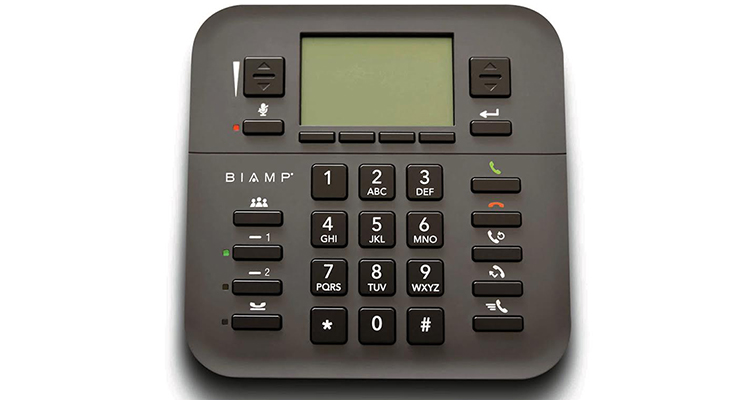
| Biamp Systems’ Tesira 2.4 and HD-1 Hardware Dialer ShipBiamp Systems new Tesira 2.4 platform and HD-1 hardware dialer. Designed to meet the needs of today’s VoIP and POTS conferencing requirements, the solutions provide customers with innovations such as new Lync Enterprise Voice and Skype for Business integration capabilities, an intuitive physical dialing device, and a number of networking enhancements.
Supporting Lync Enterprise Voice and Skype for Business, Tesira 2.4 increases the flexibility of teleconferencing applications that utilize either of these Microsoft suites as the VoIP server by turning a TesiraFORTÉ into a VoIP endpoint for any Microsoft-based system. Lync Enterprise Voice and Skype for Business integration can be used on AVB and non-AVB configurations of TesiraFORTÉ VI, as well as Tesira SERVER and any SERVER-IOs equipped with the SVC-2 card.
Biamp’s HD-1 hardware dialer instantly interacts with Tesira to allow users to carry out VoIP- or POTS-based calls easily. Sleekly designed, the HD-1 is powered by PoE and features a backlit LCD display, as well as a 12-button dial pad with 13 dedicated function buttons and four menu navigation buttons. Other features include call status, programmable speed dials, recently dialed numbers, multi-line support, and hold and flash functions. The device is compatible with Tesira SERVER and SERVER-IO, as well as AVB and non-AVB configurations of TesiraFORTÉ TI and TesiraFORTÉ VI.
The HD-1 hardware dialer is now shipping. Tesira 2.4 firmware and software upgrades are available for download in the software and firmware section on Biamp’s website here. Leave a Comment
Share Article
Back to Top |
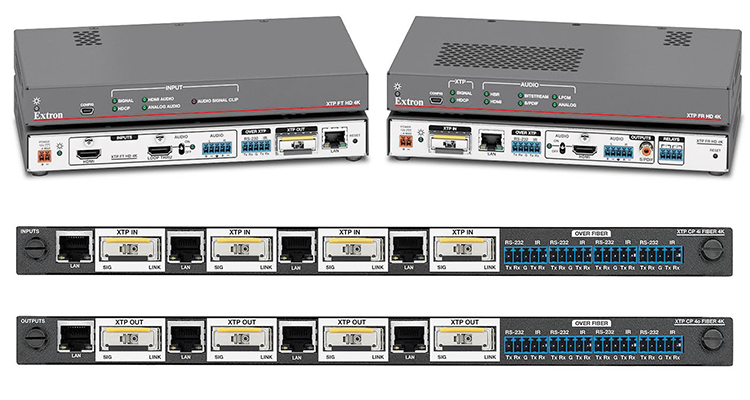
| Extron Ships XTP 4K Fiber Products for XTP SystemsExtron announced the immediate availability of the XTP CP Fiber 4K input and output matrix boards, XTP FT HD 4K transmitters, and XTP FR HD 4K receivers that expand the XTP Systems family. These products enable switching and long distance transmission of video signals up to 4K/30 with 4:4:4 chroma sampling at 8 bits per color (this is, so far, the highest spec for 4K we’ve seen int he market), along with multi-channel audio, bidirectional control, and Ethernet, over a single fiber. The I/O boards and endpoints are HDCP compliant, and support data rates up to 10.2 Gbps, 12‑bit Deep Color, 3D content, and HD lossless audio formats. XTP 4K Fiber products are compatible with the new XTP II CrossPoint Series as well as the original XTP CrossPoint matrix switchers. Available in multi-mode and single-mode, Extron exclusive and custom designed XTP 4K Fiber optical modules increase distance performance over standard OM4 fiber optic cabling.
XTP II CrossPoint matrix switchers are the first in the Pro AV industry to offer a 50 Gbps switching backplane. Designed and engineered to the highest standards, the 50 Gbps backplane delivers bandwidth performance that exceeds HDMI 2.0 and DisplayPort 1.3 signal requirements for all 4K/60 rates and gives future support for emerging resolutions, such as 8K.
All the detailed specs are here. Leave a Comment
Share Article
Back to Top |
| InFocus Releases Interactive JTouch Whiteboard and Touch Display to Simplify Group WorkInFocus Corporation just unveiled a 65” version of the JTouch Whiteboard (INF6501w) interactive touchscreen display. The 65-inch, 1080p-resolution, multi-point touchscreen INF6501w lets users display and control their Windows, Mac and Chromebook devices, allowing teachers and presenters to show and edit files from the display rather than behind their computers. It has a built-in interactive whiteboard that features digital pens, highlighters, shapes and a variety of colors to choose from, ensuring note-takers have all they need to capture ideas.
Aimed at people who want the Microsoft Surface Hub (but, a lot less expensive), the JTouch Whiteboard (INF6501w) has nearly identical specifications to the JTouch Whiteboard with LightCast (INF6501c) that InFocus released earlier this year but can access a network or the Internet only through a connected computer. The INF6501w supports edge-to-edge touch and Windows 7/8 gestures and offers integrated stereo speakers for 20W stereo sound. It has four front-facing USB ports as well as four HDMI ports, DVI, VGA (HD15 VESA), USB Type-A x 4, 3.5mm stereo audio in, 3.5mm stereo audio out and a USB Type-B port for touch screen control.
The JTouch Whiteboard will list for $2,899 and ship in Q4 2015. K-12 schools can purchase the device for $1,999. All the details are here. Leave a Comment
Share Article
Back to Top |
| Extron Adds Three New Models to DTP CrossPoint 4K Scaling Matrix Switcher Series Extron introduced this month three new models to the DTP CrossPoint 4K Series — the DTP CrossPoint 86 4K, DTP CrossPoint 84 4K and DTP CrossPoint 82 4K featuring 8×6, 8×4, and 8×2 matrix configurations, respectively. Extron says the DTP CrossPoint 4K Series are designed, technologically, so that they can be used to design and integrate an advanced AV system in one product. This includes a matrix switcher with 4K inputs and outputs, built-in 4K scalers powered by Extron Vector 4K scaling technology, seamless switching and logo insertion, integrated DTP and XTP signal extension, comprehensive audio DSP and AEC capabilities unmatched in the industry, a high performance mono or stereo amplifier, and an advanced control processor that is uniquely expandable. The DTP CrossPoint 4K Series greatly simplifies system design and installation, and dramatically reduces total cost of ownership.
The DTP CrossPoint 86 4K includes four built-in scalers, while the DTP CrossPoint 84 4K and DTP CrossPoint 82 4K include two built-in scalers. The scalers, powered by Extron Vector 4K scaling technology, are paired to the DTP outputs and enable independent scaling up to 4K. The exclusive Vector 4K scaling engine is specifically designed with best-in-class image upscaling and downscaling, and it embodies a new set of image processing algorithms that deliver uncompromising performance with 30-bit precision processing. The DTP twisted pair inputs and outputs provide extraordinary flexibility in distributing AV and control. They can be used to connect to any display with an HDBaseT input, or tie into a centralized, facility-wide XTP System to add local room-based AV systems. Customize any presentation using the professional source transition effects, or insert a custom logo into the foreground of the scaled output video.
The integrated professional-grade audio DSP technology features all of the audio processing tools and capabilities of a fully equipped, professional outboard DSP. All DTP CrossPoint 4K models also include four independent channels of high performance AEC for conferencing applications, as well as a digital audio expansion port that links the internal DSP to a DMP 128 for expanded I/O capacity. Additionally, the built-in mono or stereo 100 watt amplifier features the same Extron core technologies found in the ENERGY STAR-qualified XTRA Series.
DTP CrossPoint 4K IPCP models feature an integrated Extron IP Link Pro control processor, with the features, processing power and technologies found in the standalone Extron IPCP Pro 350 control processor. This allows for complete, customizable control of an entire AV system. DTP CrossPoint 4K IPCP models with LinkLicense allow a tablet or laptop to serve as the primary control interface for the AV system.
Here are all the specs. Leave a Comment
Share Article
Back to Top |

|
For all you REGULAR readers of rAVe ProAV Edition out there, hopefully you enjoyed another opinion-packed issue!
For those of you NEW to rAVe, you just read how we are — we are 100 percent opinionated. We not only report the news and new product stories of the ProAV industry, but we stuff the articles full of our opinions. That may include (but is not limited to) whether or not the product is even worth looking at, challenging the manufacturers on their specifications, calling a marketing-spec bluff and suggesting ways integrators market their products better. But, one thing is for sure, we are NOT a trade publication that gets paid for running editorial or product stories. Traditional trade publications get paid to run product stories — that’s why you see what you see in most of the pubs out there. We are different: we run what we want to run and NO ONE is going to pay us to write anything good (or bad).
Don’t like us, then go away — unsubscribe! Just use the link below.
To send me feedback, don’t reply to this newsletter. Instead, write directly to me at [email protected] or for editorial ideas, Editor-in-Chief Sara Abrons at [email protected]
A little about me: I graduated from Journalism School at the University of North Carolina at Chapel Hill (where I am adjunct faculty). I’ve been in the AV-industry since 1987 where I started with Extron and eventually moved to AMX. So, I guess I am an industry veteran (although I don’t think I am that old). I have been an opinionated columnist for a number of industry publications and in the late 1990s I started the widely read KNews eNewsletter (the first in the AV market) and also created the model for and was co-founder of AV Avenue, which is now known as InfoComm IQ. rAVe [Publications] has been around since 2003, when we launched our original newsletter, rAVe ProAV Edition.
Everything we publish is Opt-in — we spam NO ONE! rAVe ProAV Edition is our flagship ePublication with what we believe is a reach of virtually everyone in the ProAV market. rAVe HomeAV Edition, co-published with CEDIA and launched in February 2004, is, by far, the largest ePub in the HomeAV market. We added rAVe Rental [and Staging] in November 2007, rAVe ED [Education] in May 2008 and then rAVe DS [Digital Signage] in January 2009. We added rAVe GHGav [Green, Healthcare & Government AV] in August 2010 and rAVe HOW [House of Worship] in July 2012. You can subscribe to any of those publication or see ALL our archives by going to: https://www.ravepubs.com
To read more about my background, our team and what we do, go to https://www.ravepubs.com Back to Top |
Copyright 2015 – rAVe [Publications] – All rights reserved – All rights reserved. For reprint policies, contact rAVe [Publications], 210 Old Barn Ln. – Chapel Hill, NC 27517 – (919) 969-7501. Email: [email protected] |
|
|
|