

SMART Technologies Buys NextWindow  It's a classic case of corporate romance: first you fight, then you fall in love.
Last week, SMART Technologies announced they will acquire NextWindow — an interesting move since in April of 2009, SMART was filing a lawsuit against NextWindow to enforce its DViT (Digital Vision Touch) technology. Both companies use optical imaging touch technology, their target markets are different. NextWindow must have defended itself so well that SMART CEO Nancy Knowlton now likes NextWindow’s consumer-facing business model.
 SMART is the leading provider of interactive whiteboards, which are mainly used for education/training applications. It has both resistive and optical imaging touch technologies. They are here: http://www.smarttech.com/us/We+have+made+some+changes+about+us
From New Zealand, NextWindow makes optical imaging touch technology for integration. NextWindow is here: http://www.nextwindow.com/
Back to Top
Minicom Spins off DS Division with $6 Million Investment  Minicom has spun off its DS division into a separate company — called MDS for Minicom Digital Signage — and says they have raised $6 million to finance its operations independently. The investment, which was led by Jerusalem Venture Partners and joined by Aviv Ventures, will supposedly be used to broaden its platform from its new offices in Jerusalem’s JVP Media Quarter.
MDS claims its technology is currently deployed on over 400,000 screens worldwide, and facilitates the distribution of content to consumers in retail, education, finance, transportation, and hospitality environments. In addition to the company’s headquarters in Israel, MDS has offices in the UK, Switzerland, and the U.S. in order to meet the localized needs of its customers.
If you want more information on Minicom Digital Signage, go to: http://www.minicomdigitalsignage.com/
Back to Top
Building IPTV to Build Up in 2010  The demand for building IPTV solutions will keep growing over the next 12 months according to research findings revealed by Exterity. A survey of qualified attendees at the ISE 2010 Show found that 88 percent expect the building IPTV market to grow in the year ahead, with 35 percent predicting a significant increase in demand.
This represents a notable increase compared to 2009, during which, when more than half (53 percent) of respondents saw growth in Building IPTV, and only 12 percent noted significant increase.
Respondents say ease of integration with other parts of an organization's infrastructure as the key benefit of building IPTV (23 percent), while its ability to deliver a rapid return on investment for customers (21 percent) was also seen as an important driver. Other benefits include building IPTV's ability to deliver an improved end-user experience compared to traditional TV/AV technologies (13 percent), its cost effectiveness compared to alternative technologies (13 percent) and its ability to generate significant revenue opportunities for organizations (11 percent).
One in five respondents say education generates the biggest demand for building IPTV deployments to date, whilst 15 percent believe the corporate space was responsible for the greatest demand. Surprisingly, 15 percent of systems integrators believe Government & Public Services are leading the charge in building IPTV deployments, while only 8 percent believe Hospitality is generating the greatest demand.
The complete report can be found here: http://www.exterity.com/aboutexterity/pressandnews/iptv_survey.html
Back to Top
Chief Launches Certified Dealer Program  Chief Manufacturing has announced the launch of the industry’s first certification program for mount solutions. The Certified Partner Program offers interactive product and installation training to improve customers’ business results, differentiate their business and improve overall mount product knowledge. Customers completing the course will receive exclusive benefits from Chief as well as earn InfoComm CTS RUs and CEDIA CEUs.
According to Chief, they have over 3500 development hours invested in program development and the program features more than 13 hours of content and 46 videos featuring Chief products and installation solutions divided into two tracks –one for those who install or deal with technical aspects, and one for dealers or sales people focusing on configuring solutions or selling product. Each track is focused on their specific needs and walks them through scenarios in common applications, such as home theaters, classrooms, hotel lobbies, corporate offices, etc.
Participants in the program should expect to complete an entire track in approximately three-to-six hours. Many modules take 30 minutes or less to complete so users can come back as often as they need to until the entire track is completed.
To register for the program, go to: http://certification.chiefmfg.com/selectCountry.aspx
Back to Top 
Crestron Ships HDMI DigitalMedia Wall Plate Transmitter 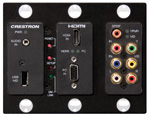 Crestron told rAVe this week that it has started to ship, in limited quantities, their DM-TX-400-3G — a wall plate transmitter for their DigitalMedia line that includes HDMI, VGA, Audio, control and USB via DigitalMedia cable up to 450’ away. Crestron says the DM system is designed to provide an upgrade path from analog to digital without replacing installed equipment (e.g., QuickMedia). The Crestron MPS, for example, is engineered to transmit all analog signals from the MPS to the DM-TX-400-3G over one VGA cable. A single DM cable connects the transmitter to a DM matrix switcher or room controller, which sends HDMI to the display.
To learn more, go to: http://www.crestron.com/products/show_products.asp?jump=1&model=DM%2DTX%2D400%2D3G
Back to Top
Extron Launches Modular DVI Matrix Switchers  Extron just launched the DMS 3600 and DMS 1600, two modular DVI matrix switchers that, as far as rAVe can tell, are the industry’s first modular DVI matrix switchers. They accept various combinations of 4-port DVI input boards, 4-port DVI output boards, and 4×4 DVI input / output boards for switching high-resolution DVI digital video signals without copy protection. The DMS 3600 is an 8U enclosure that can be configured in I/O sizes from 4×4 to 36×36, while the DMS 1600 is a 4U model, configurable from 4×4 to 16×16. A modular, field-upgradable, and hot-swappable design allows for future system expansion, as well as continuous system reliability with a fan assembly and redundant power supplies that can be replaced at any time.
To learn more, go to: http://www.extron.com/product/product.aspx?id=dms1600
Back to Top
RGB Spectrum Adds HDCP Support  RGB Spectrum's MediaWall 4200, MediaWall 4500 and SuperView 5000 display wall processors and multi-viewers are now available with High-bandwidth Digital Content Protection (HDCP) support.
As you may know, HDCP is an audio and video entertainment industry standard designed to protect digital content by employing complex authentication during transmission from a source device to a display device. Proper authentication across the entire signal path is required for source content to be decrypted and for transmission to occur. The authentication process is highly active at connection time, as well as throughout playback to ensure that the transmission of the content remains secure. Until now, the complexity of authenticating display devices has made it impossible to provide HDCP-protected material on their display walls and multi-image displays.
The HDCP option is now available on all new MediaWall 4200, MediaWall 4500 and SuperView 5000 products.
Back to Top
Analog Way To Show New Seamless Matrix Switcher at InfoComm  Dubbed the Eikos and billed as a multi-layer scaler and seamless switcher, the 12-input, 2-output matrix can switch, cut or fade between any input to any output or even produce picture-in-picture imaging on the fly. Designed for the rental and staging markets, the 12 inputs include four SDI ports and two DVI-d ports. The outputs can be DVI or VGA (RGBHV) and can scale up to 2K.
The product will debut at InfoComm next month in Vegas, so it’s not on Analog Way’s website yet. When it is, it will be here: http://www.analogway.com/products/newproducts.php
Back to Top
Extron Debuts Modular Power Enclosure for Twisted Pair and Fiber Optic Transmitters  Extron recently introduced the PowerCage 1600, a rack-mountable, 16-slot enclosure that supports the range of Extron fiber optic and twisted pair A/V transmitter and receiver boards. Billed as providing an efficient way to power and mount multiple transmitters and receivers, the PowerCage 1600 simplifies integration for large, rack-mounted systems by offering an optional redundant, hot-swappable power supply plus active power and thermal management to optimize reliability in mission-critical applications.
Available boards for the PowerCage 1600 include 14-fiber optic and four twisted pair extenders to support a broad range of video resolutions and formats. The fiber optic and twisted pair boards operate independently, and may be mixed and matched within the enclosure, making the PowerCage 1600 a solution for larger systems that need to support remote sources and destinations.
To learn more, go to: http://www.extron.com/company/article.aspx?id=pc1600ad
Back to Top
Prysm Launches Environmental Cost of Operation Calculator for Displays  Prysm, Inc., this week announced the launch of its online Environmental Cost of Operation (ECO) calculator, which analyzes the total energy consumption of major display technologies, including LCD, LED, and plasma technologies, compared to Prysm’s Laser Phosphor Display (LPD). The calculator assesses the environmental impact of various large format displays, along with operating costs. The company says the new online tool demonstrates that LPDs can achieve over a 75% cost savings when compared to conventional display technologies.
You can check out the ECO calculator on Prysm’s homepage here: http://www.prysm.com/
Back to Top 
New Headset Interface for Polycom SoundStructure 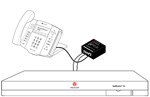 A new headset interface adapter for the SoundStructure C-Series from Polycom allows for simplified audio-only calls when using a SoundStructure. The advantages of the new adapter are the ability to use your phone's dialing interface to dial or answer calls with SoundStructure processing the audio, that it connects to a standard digital or VoIP telephone via RJ-9 headset interface, that you can use your existing phone system – no need for an analog POTS interface, and it’s an easy way to add-in audio-only participants to any video call.
To learn more, go to: http://www.polycom.com/products/voice/conferencing_solutions/conference_phones/installed_audio/soundstructure_c_series.html
Back to Top 
Barco Ships Field-Level LED Screens – LED Ad Borders for Screens  Barco has entered the “Sports Perimeter” market in launching the SP-4816 LED field perimeter ad boards. Made popular at European Soccer matches where the pitch (field) is lined end-to-end and side-to-side with banner advertising at eye level to the field, field perimeter signage is going digital with this new Barco LED solution.
Barco tells rAVe the system was designed specifically to meet the demands of outdoor signage while being creative in the way it displays advertising as the sports perimeter can be genlocked with camera equipment – thus, making it flicker-free on the television screen at home and to the live audience. Barco also claims to color-balance the two.
Go here to learn all about it: http://www.barco.com/en/sports/product/2255
Back to Top
Little-Known CyberResearch Develops Sunlight-Readable Display  CyberResearch is announcing the CyberResearch CyRAQ 1000, what they say is a sunlight-readable outdoor digital display with portrait, landscape, and wall-mount options. Specified at 1080p native, the LCD displays include a series of 23", 32", and 40" pylon-mounted digital signage displays that the company says are built for use in all-weather outdoor video or digital signage applications.
The CyRAQ 1000 LCDs use AR-Bonding to reduce excessive light reflections when used in sunlight and increase contrast ratio. Apparently AR-Bonding also provides extra mechanical support to the LCD and eliminates the problem of air-gap glass fogging from condensation.
You can see all the specs at: http://www.cyberresearch.com/store/product/monitor-size-display/industrial-monitors-lcd-flat-panel-displays/lcd-monitors-displays-keyboards-kvm-switches/20-21-22-24-inch-monitors-displays-and-larger/CyRAQ_1040SC_1080p_Monitor_9777.2.htm
Back to Top 
Sanyo Shows 120Hz 1080p Projector  SANYO announced the introduction of the PLV-Z4000, a 120 Hz FullHD 3LCD front projector with 1080p24 capability. With SANYO’s exclusive TopazReal HD system, the projector includes a 3D color management system that enables color accuracy. Through dual HDMI 1.3b inputs, it is Deep Color and x.v.Color capable and listed at 1,200 ANSI lumens with a 65,000:1 contrast ratio, and it’s one of the brightest FullHD projectors on the market now. Scheduled for release at the end of this month, the SANYO PLV-Z4000 will have list price of only $2,495.
For all the specs, go to: http://us.sanyo.com/Projectors-by-Market-Home-Theater-Sub-Category/PLV-Z4000
Back to Top 
Sharp Finally Ships Long-Awaited Four-Color, 3D LCD TV  Sharp Corporation has developed what they are claiming as the world’s first four-primary-color 3D LCD TV. Obviously requiring you to wear special 3D glasses, the 3D LCDs use a system based on time-sequential display technology with special active LC (liquid crystal) shutters in the glasses. In this system, images intended for the left and right eye are displayed on the LCD screen sequentially, alternating between the two perspectives. The LC shutters in the special 3D glasses are synchronized with this display, “opening” (becoming transparent) and “closing” (becoming opaque) in such a way that the left and right eye see separate images. The human brain combines these two slightly different images to create the perception of depth in a three-dimensional image. Sharp claims that displaying 3D images on a conventional display using this system resulted in low brightness and crosstalk.
Sharp’s four-primary-color technology utilizes four primary colors, adding Y (yellow) to the three conventional primary colors of R (red), G (green), and B (blue). According to Sharp (and most people at CEDIA 2009, too), this technology contributes to brighter, more vivid colors thanks to higher light transmission efficiency through the panel and a wider color gamut (range of colors that can be reproduced), which had been difficult to attain on conventional three primary color displays.
Sharp’s actually set up an educational site on their 3D LCD technology at (but it’s all in Japanese?!?): http://www.sharp.co.jp/3d-tech/
Back to Top 
Architects Can Earn CES LUs at InfoComm  Work with architects, interior designers or contractors? More than 10 courses at InfoComm 2010 will provide continuing education credits for AIA. The list includes sessions that architects have been asking to attend. This is a great way to let your architect clients know that the AV industry has valuable training for them. The AIA exhibition is on the other side of the country (Miami) at the same time this year, and for those who aren’t traveling to that show, InfoComm 2010 offers a great alternative. Sessions include:
- IS98: Acoustics in Architecture — 2 CES LUs
- T01: Technology Tour of the Recording Studio at the Palms — 3 CES LUs
- IS01: Standard Guide for Audiovisual Systems Design and Coordination Processes Workshop — 2 CES LUs
- IS61: Conference Room Design Tutorial — 1.5 CES LUs
Log on to http://www.infocommshow.org for more courses, or email [email protected] to get the complete list mailed to you. Back to Top 
News from The Whitlock Group, Crestron, Salitek… Chief will be teaching classes that offer CTS RUs from their Chief Certified Partner Program at InfoComm. Click here to register… Crestron has announced its new HD Digital Transport and Distribution System Specification (HD-DTDS) and DigitalMedia Certification Program that has two levels, the DMC-D and DMC-E… The Whitlock Group has won the "Integrator of the Year" award from Tandberg… SurgeX has partnered with D-Tools and joined their Manufacturer Vantage Point Program… Salitek is launching a distribution relationship with AV Stumpfl… Crestron announced the launch of expanded Prodigy training classes — it's now a three-day course… Analog Way has opened Analog Way UK, a new direct sales office based in London and dedicated to the British market… AVW-TELAV is one of three recipients of InfoComm's first ever Green AV awards… ClearOne has named Chris Wildfoerster as vice president of business development… Gefen has appointed John Novak as director of digital signage… Alpha Video, a professional video systems integrator, has hired Jerry Gale to their marketing department. Back to Top 
For all you REGULAR readers of rAVe ProAV Edition out there, hopefully you enjoyed another opinion-packed issue! For those of you NEW to rAVe, you just read how we are — we are 100% opinionated. We not only report the news and new product stories of the ProAV industry, but we stuff the articles full of our opinions. That may include (but is not limited to) whether or not the product is even worth looking at, challenging the manufacturers on their specifications, calling a marketing-spec bluff and suggesting ways integrators market their products better. But, one thing is for sure, we are NOT a trade publication that gets paid for running editorial or product stories. Traditional trade publications get paid to run product stories — that's why you see what you see in most of the pubs out there. We are different: we run what we want to run and NO ONE is going to pay us to write anything good (or bad). Don't like us, then go away — unsubscribe! Just use the link below. To send me feedback, don't reply to this newsletter – instead, write directly to me at [email protected] or for editorial ideas: Editor-in-Chief Sara Abrons at [email protected] A little about me: I graduated from Journalism School at the University of North Carolina at Chapel Hill (where I am adjunct faculty). I've been in the AV-industry since 1987 where I started with Extron and eventually moved to AMX. So, I guess I am an industry veteran (although I don't think I am that old). I have been an opinionated columnist for a number of industry publications and in the late 1990s I started the widely read KNews eNewsletter (the first in the AV market) and also created the model for and was co-founder of AV Avenue – which is now known as InfoComm IQ. rAVe Publications has been around since 2003, when we launched our original newsletter, rAVe ProAV Edition. Everything we publish is Opt-in — we spam NO ONE! rAVe ProAV Edition is our flagship ePublication with what we believe is a reach of virtually everyone in the ProAV market. rAVe HomeAV Edition, co-published with CEDIA and launched in February 2004, is, by far, the largest ePub in the HomeAV market (we blow away ANY other Publication in the high-end home AV market. We added rAVe Rental [and Staging] in November 2007, rAVe ED [Education] in May 2008 and then rAVe DS [Digital Signage] in January 2009. You can subscribe to any of those publication or see ALL our archives by going to: https://www.ravepubs.com To read more about my background, our team, and what we do, go to https://www.ravepubs.com Back to Top
Copyright 2010 – rAVe [Publications] – All rights reserved – All rights reserved. For reprint policies, contact rAVe [Publications], 210 Old Barn Ln. – Chapel Hill, NC 27517 – (919) 969-7501. Email:[email protected]
rAVe contains the opinions of the author only and does not necessarily reflect the opinions of other persons or companies or its sponsors. | 






 Also, if you haven't heard me talk about it before, we're also busy preparing for Swim for Smiles' first event of the year — the 4th Annual Youth Triathlon, which takes place a week from Sunday. Swim for Smiles is the charity I founded in 2005 and holds swimming- and athletic-related events for kids and families, and donates all money to the North Carolina Children's Hospital here in Chapel Hill. If you're interested in learning more about the foundation or events, check out the website here:


 I cannot tell you how excited I am about this year’s InfoComm show!
 But in my opinion, it was mostly through incremental steps of improvement.

 After recently spending four days at the 2010 National Association of Broadcasters (NAB) conference in Las Vegas, I’d like to offer my exhibit-hall perspective on what’s hot in the world of video content production and distribution. This year’s attendance was up — 88,044 registered attendees vs. last year’s 82,650. I don’t think this represented a flood of job-seekers and there seemed to be no decrease in spending (or attendance) by exhibitors, either.
 My assessment — 3D and mobile TV are being pushed in a big way by the content industry, it will only get more frenetic, and the delivery of content will continue to evolve in ways that current players are only beginning to understand. Expect the single "broadcast-like" ecosystem to evolve into a very personalized, customized media consumption process, with both large and (many) small players. This is just one observer’s take on a vast topic — look for more in-depth reporting of these and many other products and technologies in this month’s Mobile Display Report andLarge Display Report.

 News item: NCR announces it will install digital download kiosks at 35 airports. NCR and MOD Systems have been experimenting over the past year with movie and TV show downloads to secure SD memory cards and flash drives via kiosks in select retail locations. Now, the program is rolling out nationally in a partnership with InMotion Entertainment, with kiosks to be spotted in 57 locations in 35 airports across the US.
 News Item: Hulu will start charging subscription fees. A story in the Los Angeles Times says that on May 24, Hulu will start testing a business model that would provide the five most recent episodes of programs on Fox, ABC, and NBC for free, but charge $9.95 per month to access older content.
 News Item: Seagate adds video streaming to media players. Seagate, a long-time manufacturer of hard disk drives, has added Netflix streaming functionality to its FreeAgent Media+ HD media players (Are there any products left that don’t stream Netflix?). In addition, users will be able to access YouTube, vTuner, and Mediafly sites to watch Internet videos.
 News Item: Avatar sets the new record for first-day Blu-ray sales. According toThe Washington Post, four-day sales of James Cameron’s 3D epic on Blu-ray and red laser DVDs exceeded 6.5 million copies (rental and retail) — that’s 6.5 million 2Dcopies, by the way. The article stated that 2.7 million BD copies were sold in North America. For comparison, Warner Brothers’ The Dark Knight sold a total of 2.5 million BDs over 1.5 years.
 As for the rest of the market, how will Netflix 2D streaming revenue for Avatar compare to traditional DVD rental income? (Netflix customers will gain access to the Na’vi pic in late May.) And how long before digital downloads are made available to services such as InMotion? Consumers are clearly moving towards streaming and digital downloads and away from optical media, based on industry trends for the past five years. What impact will this trend have on the enhanced 2D and 3D releases?

