

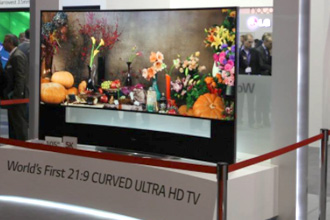

As indicated above, curve TVs have only “slightly curved” screens, and you may be surprised just how slight, if you haven’t seen one up close. On the new LG curve TVs the corners are only 1.4-inches (3.6 centimeters) forward of the center (rear portion) of the screen. That gives the LG 55-inch (55EA9800) set a total curve radius of about 16.4 feet (5 meters). That is, if you extended the curve to a complete circle, the radius would be 5 meters from its parameter to the center of the circle. Remarkably, this slight curve offers an extended list of measurable viewing benefits.
Soneira writes: “The concave screen shape cuts down on reflections from surrounding ambient light two ways: by reducing the screen’s 180 degree opening angle, which eliminates reflections from some ambient lighting on the sides, and also from specular (mirror) reflections off the concave screen, which directs some reflected ambient light from behind the viewers away from their line of sight.” The contribution this makes to the viewing experience is enhanced with these new displays offering “perfect blacks” and “excellent dark image content,” because “… you don’t want that spoiled by ambient light reflected off the screen,” according to Soneira.
Visual geometric distortions (keystone effect) are characterized by Soneira as double elongated trapezoids, that are diminished as the corners of the screen move slightly forward in curved TVs. ”The slight curvature on the LG OLED TV reduces this subtle keystone geometric distortion by 50 percent at a typical 8 foot (2.4 meter) viewing distance,” Soneira wrote.
Viewing from the sides (out of the central sweet spot) is also improved in curve TVs as this inward curvature compresses the “foreshortening,” where the image on the side of the screen closest to you appears larger, and the image on the side of the screen furthest away appears smaller. From this off-axis viewing angle, the top and bottom of the screen won’t appear perfectly straight with a measurable geometric effect of about 1.5 percent (at 8 feet viewing distance) according to Soneira.
Other design elements of the new OLED TV include a very thin (0.16-inch, or 4.3-millimeter) display with an impressively small flush border that measures 0.4-inch or 1-centimeter in width. This along with the its unique non-flat design that by its very nature call attention to itself, makes for quite a sexy package for the curve TVs.
We see this new change toward curve TVs contributing to mainstream TV sales this year, particularly as prices continue to drop and LCD technology also gets on board. Look for curve TVs to continue to make their way to the mainstream as both the marketing and viewing benefits make for an irresistible combination too hard for set makers to ignore.