

As many of my readers will know, I have just returned from the ISE show in Amsterdam.
As many of you may know, from my articles, blogs and podcasts, I am pretty enthusiastic about this particular show. Not only does it combine InfoComm and CEDIA, it also features more exhibits of products and product lines for staging then any of the U.S. shows do. Not only that, but since the rental and staging market is influenced both by commercial technologies and by the technologies that our customers use at home, for the rental and staging portion of our industry, I believe the show represents the best mix of products and product applications.
Last month, and in the final podcast that I did with Gary Kayye, I promised that I would pick out the two products or technologies that showed the most promise at ISE, especially centered around rental and staging needs.
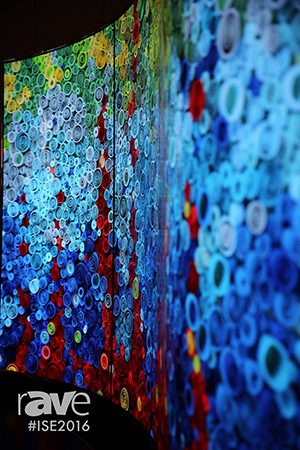

First, and most importantly, this was the best showing that I had seen for OLED. I have been monitoring OLED closely for years, as it made its way from camera viewfinders to virtual-reality headsets to small laptop and desktop displays and, finally, to large screens. OLEDs Have been touted for years as being the technology that would eventually offer a number of advantages over other flatscreen displays technologies, the biggest of them being cost, brightness and the one that we really want the most for staging: flexibility. No, I don’t mean flexibility in terms of the use of the product, I mean that the product can actually be flexible, as OLEDs can actually be inkjet printed onto any compatible substrate. At the show, a number of manufacturers showed very high-end OLED products, with the biggest of them being LG, who showed a dazzling array of very thin, very bright OLED monitors, my favorite of which was an array of curved two-sided 65 inch displays standing vertically in the middle of a space. They were dazzlingly thin, especially when considering that they made an image on both sides. In the future, this technology will allow us to progress to printing video surfaces on walls, on roll-up screens, and on stage sets. So keep tracking this one, it will be important to us in the future, as these displays at ISE showed us only too clearly.




Dr. Kaku walked us through a future full of walls printed with video screens (See OLED, above), clothing that monitored our vital signs and reported them to our doctors and then to orbiting automated ambulances, and eyeglasses that augmented reality with computer-generated information. Not that any of these things were particularly hard to see in the future, but Dr. Kaku presented them with an entertaining manner and an infectious enthusiasm.
What was important about this to the AV rental and staging industry?
The actual examples from the show, as well as Dr. Kaku’s examples, pointed the way to an audiovisual future in which our clothing could be printed with OLEDs that would allow us to become invisible when the client was looking for us (to move that stage for a third time), eyeglasses that would point out to us all of the places a forklift had pinched our cabling, and orbiting drones always ready to deliver that adapter that we had forgotten.
And yet you wondered why I thought ISE was the most important show to see?