

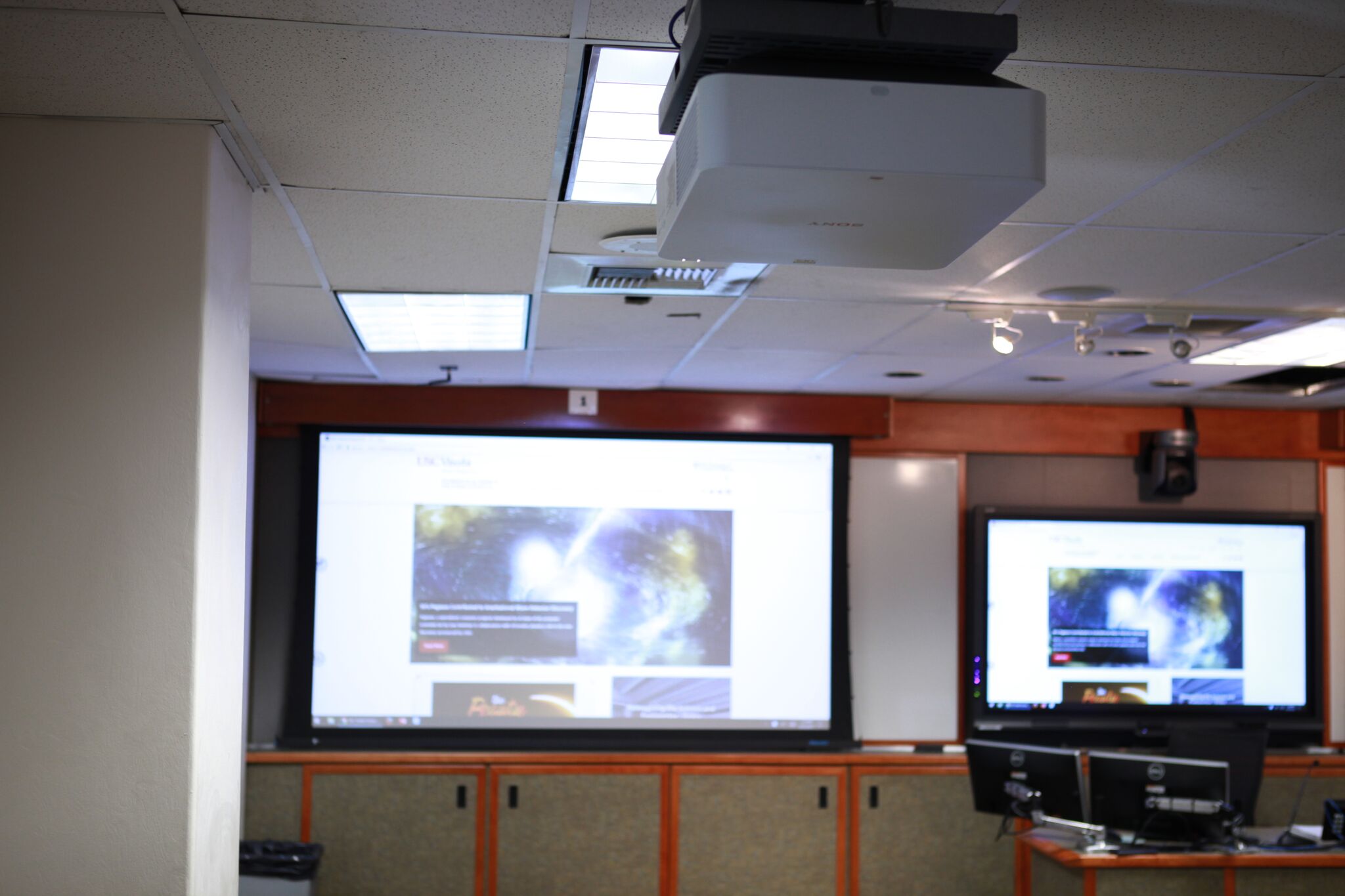
While the DEN@Viterbi classrooms look like regular classrooms, their lectures are broadcast live using Sony’s BRC-H700, BRC-H800 and BRC-H900 cameras and remote controllers. Traditional on-campus students benefit from the presence of Sony’s laser projectors, including VPL-FHZ60, VPL-FHZ65 and VPL-FHZ700L and the distance students benefit from the high quality video recordings generated from the Sony equipment.
Dominic Lau, Director, IT and Operations detailed how the school’s reputation as the number one online program required tools that matched its cutting edge status and complemented each instructor’s unique pedagogical style, from PowerPoint to SMART Board to video and even pen and paper. “We push ourselves to set the pace for all distance education programs by providing the latest and greatest technology,” he said. “So when we see that there’s deficiencies in some of our existing equipment or workflow, we definitely need to improve upon it. In the end, we make technological decisions based on what is the best quality, by conducting side-by-side comparisons. We brought in other cameras and projectors from other brands and we found that the Sony products outperformed the competitors,” he explained.

Of their previous projectors, Nadia Barosy, Manager, Instructional Operations said, “One of our professors actually commented on the output of the old projectors that we had, saying that it was too dim for him to see and the picture quality wasn’t up to par. We recently replaced it with one of the Sony projectors and the professor could immediately tell the difference, because the image is so much brighter and sharper than it was previously.”
Lau favored Sony’s lampless laser projectors, after years of using projectors with bulbs. “I like the fact that we have gone away from replacing projector bulbs, which means less money for us to spend, while also saving time,” he said. “Some of the projectors are mounted high up in the ceilings and changing bulbs is a time consuming process.”
Sheldon echoed Lau’s comments. “It has been a time saving solution for us. The fact that we don’t have to find time to replace projector lamps has been a huge benefit. Before, we would have to pull out a 20-foot ladder and climb up to replace those lamps. We could do it within an hour, but we’d have to change the lamps in most classrooms, nearly every semester.”
Barosy also commented on the time the projectors saved. “In terms of preparation, the fact that our projectors come on quickly make it very efficient, allowing us to maximize our instructional time. We often have a ten minute gap between classes, which allows minimal time for one professor to end and a new professor to come in. Even if a professor goes into a classroom that wasn’t just in use, you can turn the projector on in less than 30 seconds, which is greatly beneficial,” she explained. “In the past, it would take minutes to come on – from power up, to warming up, and then the image finally displaying on the screen. These minutes saved are priorities when it comes to professors being able to use their time efficiently and effectively in class.”
Additionally, she provided insight into how the school’s three PTZ cameras, which are located at the rear of the classroom to show the professor or their presentation, overhead to show notes and props and an audience camera which captures the students and their interactions, are all managed through the use of one controller and are primarily managed by the students. “We hire student workers to operate the equipment in a separate control room,” Barosy said. “A majority of the time, they’re not very well versed in camera technology, so we definitely need equipment that make the technical aspects of camera operating as simple as possible for the novice. Having the joystick with built in PTZ capabilities for the camera provides integrated control, which is very helpful to us.”
She went on to explain how this ease of use translates to greatly reduced training time, which is crucial for the 60+ student workers juggling the demands of classes, work and their personal lives, who are operating and controlling live robotic cameras from each of the control rooms to 15 different classrooms, from 7AM to 10PM daily. And as the students cycle in and out of the program, it allows the DEN@Viterbi team to quickly train new students each semester to use the cameras and remote controllers.
While Barosy praised the camera’s “sleekness and design” as well as the “aesthetics and compact size,” Casas appreciated their “rock-solid reliability and low-maintenance” after years of use. Kirk Segura, Chief Engineer, Instructional Operations Engineering called the cameras “extremely durable,” adding, “the Sony PTZ cameras outweighed and outshined the competition, when side-by-side analysis was conducted against other brands. Sony’s offerings are the best in the market in my opinion, and that’s what influenced my decision to buy these cameras.”
DEN@Viterbi’s AV technology upgrades are a source of pride for the whole school. Lau commented on the noticeable difference in quality saying, “We recently upgraded three of our classrooms that were running in 4:3 to 16:9. I can now proudly say that we are HD end-to-end, starting with the Sony cameras to the final output that we send out to students. There’s a significant observable difference.” As DEN@Viterbi further establishes itself as the preeminent online graduate program, its technology will no doubt continue to evolve to help set the tone for the school’s first-rate curriculum and unmatched distance learning experience.