


If you missed SYNNEX’s first-ever COLLABSolv Education Day — part of the SYNNEX COLLABSolv LAVNCH Days series — then, boy, do we have the recap for you.
Kicking off the day was a familiar face to rAVe: resident assistant editor Steph Beckett! After a warm intro to the day, Beckett pumped us up for the three specialized education sessions SYNNEX had planned for us. Each session was held with industry experts, live speakers and presenters.
Though it didn’t “open” until later in the day, an organized and thorough vendor toolkit (if you clicked that link, scroll down) gave COLLABSolv Education Day attendees something really valuable: a chance to book one-on-one meetings with SYNNEX vendors right through the platform. Being able to see actual, concrete solutions for this market through videos, product collateral and manufacturer features in one place — and by being able to book video appointments directly with manufacturers on the spot — was a huge benefit.
For obvious reasons (just turn on the news), education is a hot topic right now. Wednesday, we got some really fantastic and timely insights from each of the education-specific SYNNEX sessions. Our key takeaways are below, but to get the full scoop, register for COLLABSolv Education Day here to view the archived video content for yourself.
Keynote: Making Sense of Structure and Tools
Kenneth Grover is a national education consultant, former teacher and founder of the SOYLA Foundation in Guatemala. With 20+ years of experience as the director of education in a Salt Lake City school district, Grover’s keynote was all about making sense of structure and tools today, even if that means facing the reality that many schools and education environments aren’t prepared for this new world. The objective of Grover’s keynote was to give the AV community great talking points to have with partners. We think it’s fair to say that objective was accomplished.
Two points Grover led with:
- Despite new technology and tools, all in all, the STRUCTURES of the classroom — the students receiving instruction by a teacher standing at the front of the room — are pretty much the same as they were when schools were founded. But what will this look like in the next six weeks as schools fire up? Confusion, uncertainty and disruption, Grover argued.
- All students learn differently, so we need to deliver various instructional practices. Grover’s approach and advice: rethinking these structures — this will be so important for our school systems. How do we shift education while dealing with the dynamic of the pandemic? Once we get through it, our schools will never be the same.
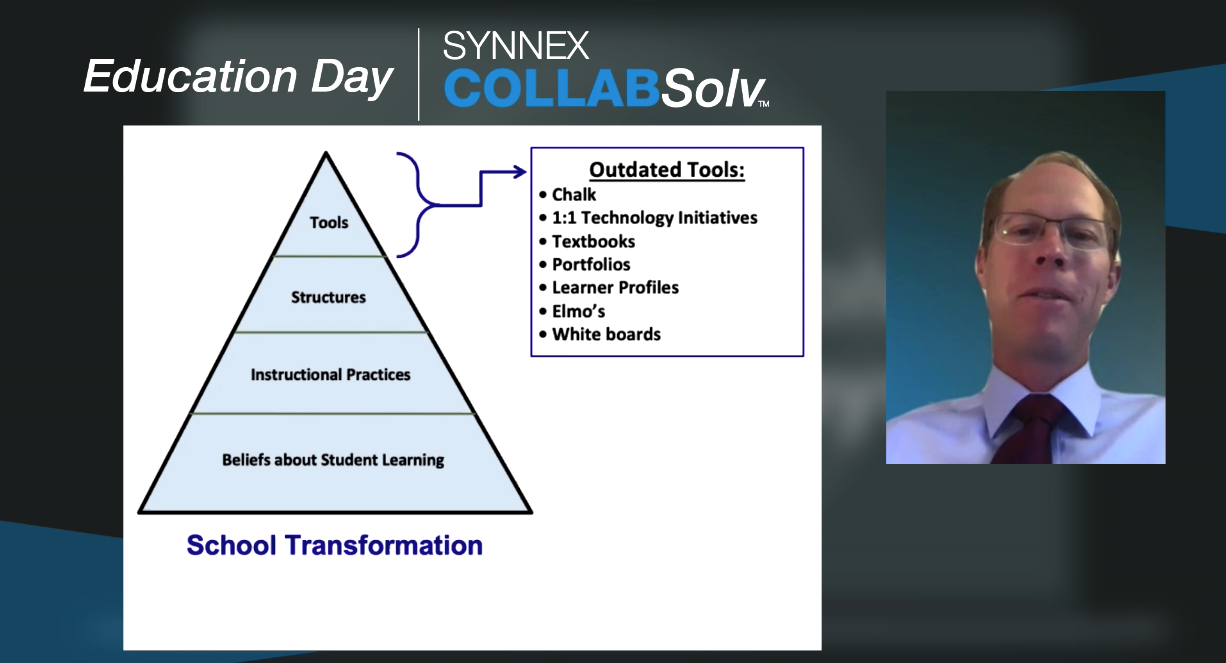
Some current structures in education include strict schedules, bells, curricular guides, grade levels (when were you born determining the grade you were in), start/end times, etc. The new structures you’ll start to see include personalized learning (tailoring to each student working from a different place), virtual learning, remote learning (is this just a “flash in the pan” until we become normalized again? Grover thinks not), competency- and mastery-based education (realizing that some students get “stuck” in the forced timeline of learning plans regardless of whether they’ve mastered the topic or not) and elimination of seat time. How do you deliver all this in a way that maintains the integrity of the education system? By rethinking the tools used within them. The new structures school systems are dealing with will not be temporary, Grover stated. These are the conversations you’ll start to have with teachers, board members, etc. as you see this “new face of education.”
Grover’s look at the outdated tools — like chalkboards, 1:1 technology initiatives and textbooks:

Grover’s look at the essential tools needed NOW — like an LMS (learning-management system) and digital textbooks/curriculum:
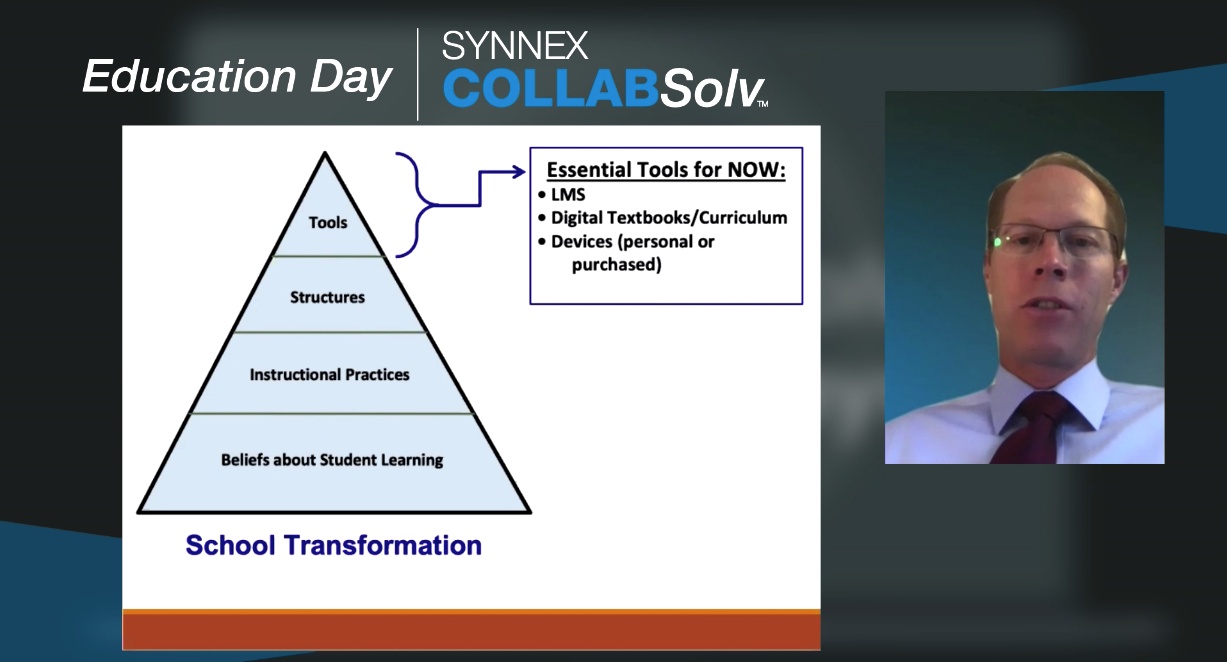

Changes are already happening, more so in some areas than others depending on leadership and views and school boards. We’ll have to see what specifically sticks for good, but what we know for sure is students can learn in different environments and places — but we have to help our students and leaders understand this by shifting our instructional practices and adopting the new tools mentioned. If schools can capture all the new tools — solidifying new beliefs in schools’ “bases” — they will see sustainable school transformation. But if it’s just a focus on one solution or the other (focusing only on an LMS, for instance), schools will have “false starts.” No one likely believes we’ll leave our school buildings, along with the existing dynamic between teachers and students, behind. But what all that looks like is going to completely shift — starting today.
A Vendor Panel with SYNNEX Manufacturer Partners
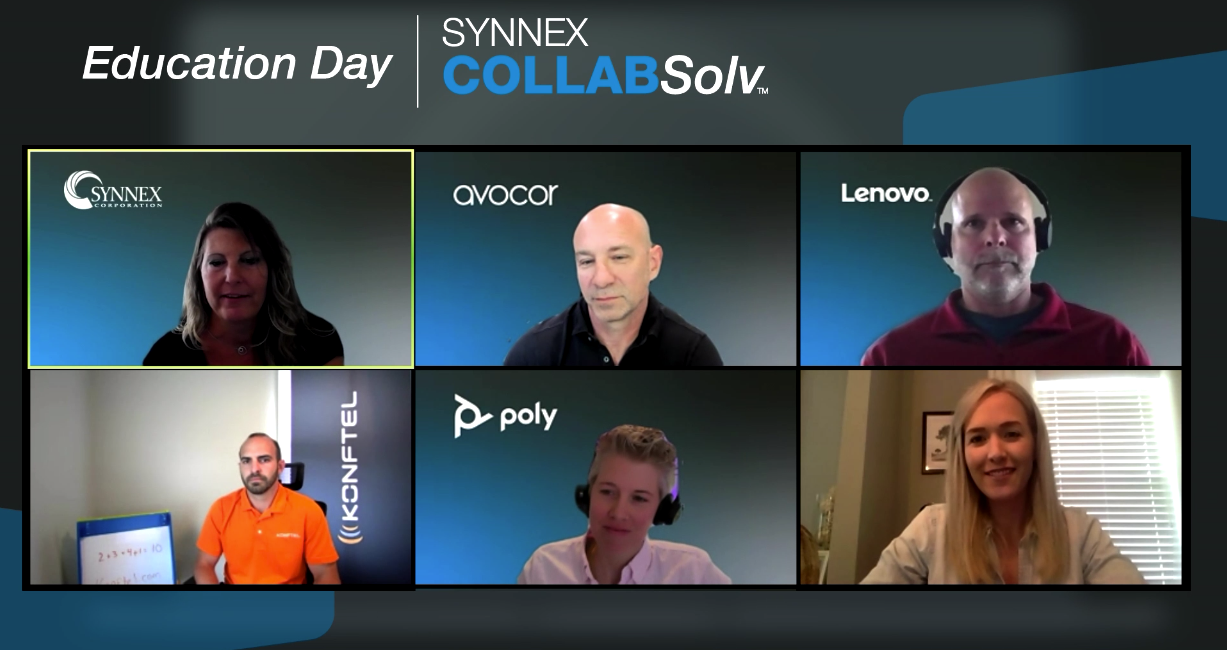
In a vendor panel with five SYNNEX vendor partners — Avocor, Konftel, Lenovo, Lifesize, Poly — we heard how each of these manufacturers is using its strengths in AV to help the education market and reimagine education with virtual/hybrid learning. SYNNEX’s Pennie Crosslin was our moderator.
Here are some insights from each vendor:
- Poly: Poly channel systems engineer Danielle Stanton talked about how Poly’s solutions, like its headsets and webcams, support the idea (or, really, reality) that audio is the most important element of a video call; audio quality and audio fatigue severely affect engagement. Prior to COVID-19, Stanton explained that Poly had already done the research to understand engagement and attention to audio — all this data, specifically regarding at-home learning — has driven Poly’s technology features around audio fencing, and passive and active noise cancellation (which should be distinguished between each other, by the way). Importantly, when students are learning at home, we need to ask what equipment is easiest for students to use — the solutions need to be both durable and cost-effective.
- Lifesize: Brittney Gillis, Lifesize director of channels for the Americas, offered a perspective from the UCC platform side of things. Lifesize addresses some of the challenges in going between in-person and virtual learning. Being able to work and learn from wherever — no matter if the hardware is set up in the classroom but the teacher is sick and needs to teach from home — is the heart of the Lifesize solution. Features like the ability to record and livestream are key to this value; with this flexibility, teachers can record classes in advance and much better tailor to remote students and learners. This is just one case highlight in Lifesize’s overall solution.
- Lenovo: Lenovo’s Bennett Bauer discussed how Lenovo (see some of its latest K-12 solutions if you’re curious) is still fairly new in the education space but has already overcome many barriers to market, like speed, price point, strategic partnerships and turnaround time. The technology built into the ThinkSmart View products, for instance, is strategically simplified for the education community and industry. A key element for Lenovo is focusing on deployment in an “all in one” context in the classroom. Teachers need to be able to instruct differently based on their particular collection of students — plus, naturally, the environment has changed and will continue changing this year and into 2021; many instructors are now looking into cameras to teach. All these new realities add a different dimension, Bauer explained. If you can simplify the technology and make the changes — like toggling between devices — easier, students will benefit.
- Konftel: Peter Gasparro of Konftel, a manufacturer of products for effective distance meetings, discussed Konftel’s POV within the uncertainty of current education tools. Through his discussions with teachers, parents and superintendents, Gasparro has learned a few things are needed; audio is crucial, “the cake” as he illustrated, to provide HD audio to kids at home. Another element is video — the teacher needs to be able to show different points of the classroom. Konftel has developed a number of kits and products (like its OCC Hub) as all-in-one solutions with a vendor-agnostic approach — no matter what collaboration platform the classroom is using. This helps drive the classroom discussion forward.
- Avocor: Dana Corey took us through what video and voice collaboration mean for Avocor’s interactive displays — most importantly, in helping the students and teachers. Avocor’s large-scale displays can be centered around your video provider of choice; Corey added that Avocor’s displays are the visual convergence, that first visual point of entry and the thing students and teachers actually see and touch. Avocor’s role is to provide “freedom” for end users in the delivery of meaningful content in a way that lets them experience learning via their preferred method, not someone else’s.
SYNNEX’s ability to bring these partners together provides two-fold value — to both the reseller and the end user. These vendor partnerships help SYNNEX provide “total solutions” in the education space. Ultimately, what’s all this about? A better experience in the classroom.
A Blended/Virtual Education Environment, Plus the Impact of Fall 2020 Funding Initiatives
For session three, SYNNEX specialists Brent Odom and Will Reid took us through two hot topics in education today. Reid, SYNNEX GOVSolv education program manager, discussed the differences between a traditional and blended/virtual learning environment as education organizations consider multiple options for fall 2020 reopenings. Odom, M.Ed., SYNNEX GOVSolv public policy manager, gave us the rundown on the federal and state funding initiatives impacting the education market and buying season.
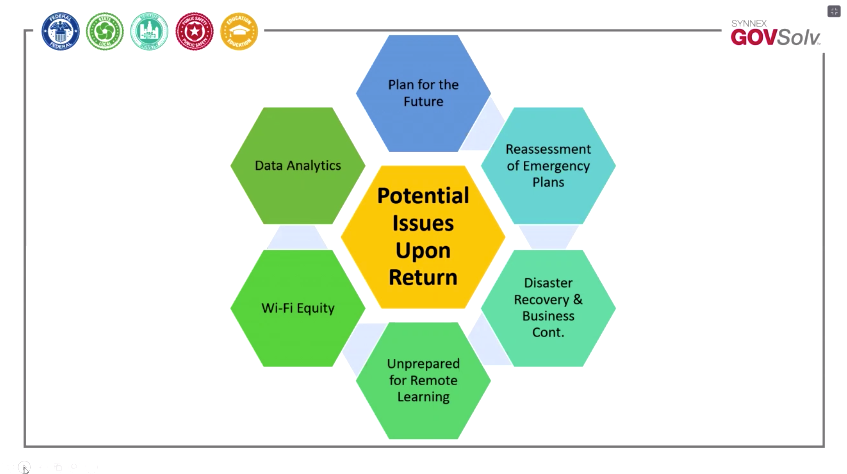

COVID-19 has brought forward a complete paradigm shift in education, Will Reid started. While we still have the same three categories in education (see them below in the screen shots), what’s changed is where they’re at and how they’re accessed. Student devices are now at home; so now, we want to know how often they’re logging into the device, how they’re using the apps we’re paying for (or not paying for) and more. Suddenly, our challenges change to device management, data analytics, etc. — much different priorities from what we had in the past. Take a look at how the same three categories Reid mentioned — network & infrastructure, facilities and learning environment — change when you go from a traditional brick and mortar education space to a virtual/blended education space:
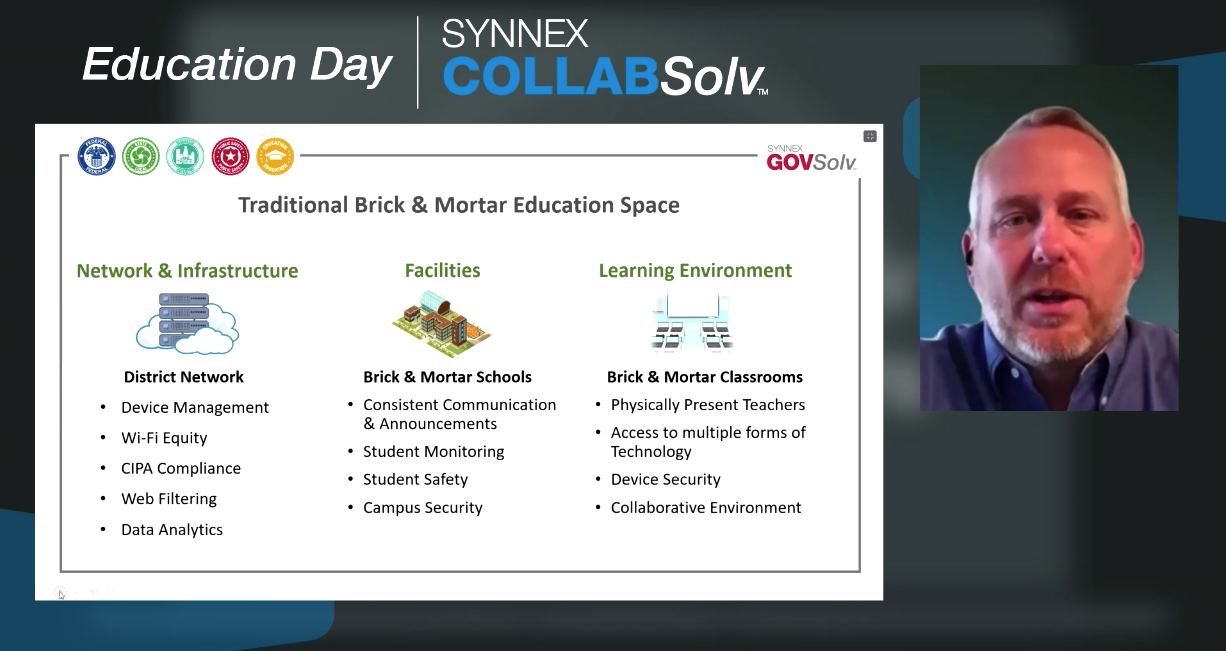

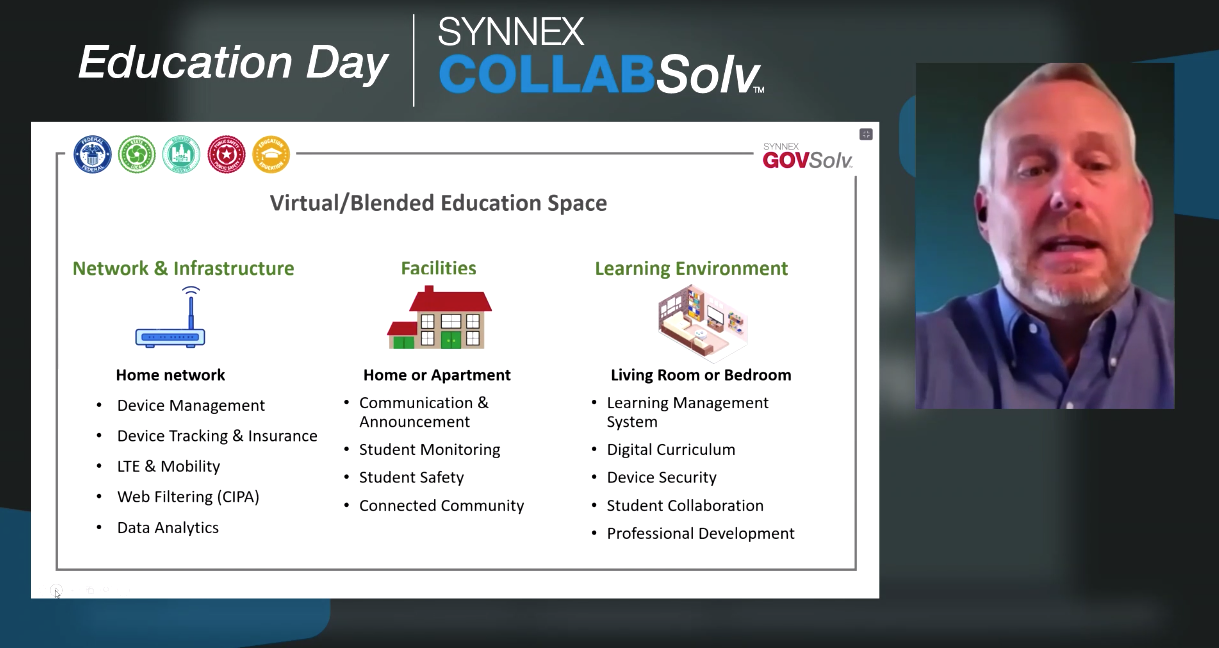

Frankly, a lot of what was working in a traditional brick-and-mortar environment no longer works in a virtual/blended space. Expected technology needs, Reid explained, will be for:
1) The immediate response now (like student devices, hotspots, cameras, etc.).
2) Virtual preparedness for fall 2020 (like learning management systems, data analytics, asset tracking, classroom cameras, etc.).
3) Future-proofing technologies for 2021 and beyond (like connected school busses, a connected community, cybersecurity and a long-term virtual platform, which — like it or not — may or may not eliminate the “snow day” we all know and love).
One of Reid’s takeaways: build strategic partnerships with your districts. When it comes to technology and the transformation they’re seeing, know that they haven’t seen this before either — education environments really, really need strategic partners who can meet them at the table. As this education environment shifts, so must the AV industry.
Next up was Brent Odom, M.Ed. Brent provided some key updates on education funding to help us better understand the ecosystem we’re working with as we go into the fall.

Responding to crisis, Odom explained, it’s a phased approach:
- Immediate (now): surge buying for immediate needs
- Evaluation (mid- to late-2020): public entities will evaluate current situation and changes
- Recovery (2020-2021): opportunity for new solutions
- Future-proofing (2021): new standards of normal
Additional topics Odom discussed were the CARES Act (unpacking 3.28 trillion dollars), being in an era of “states’ rights” (the federal government will not micromanage state funds) and who we, in the technology industry, will be working with to roll out new technologies. While all this is a lot to take in, know that SYNNEX offers support to its vendors regarding public policy topics like those discussed Wednesday. Its purpose is to advise partners on ways to apply technology and applicable IT solutions to relevant legislation and funding streams in the public sector. SYNNEX can also provide intelligence on current federal, state and local legislation and policy where technology/IT solutions are applicable.
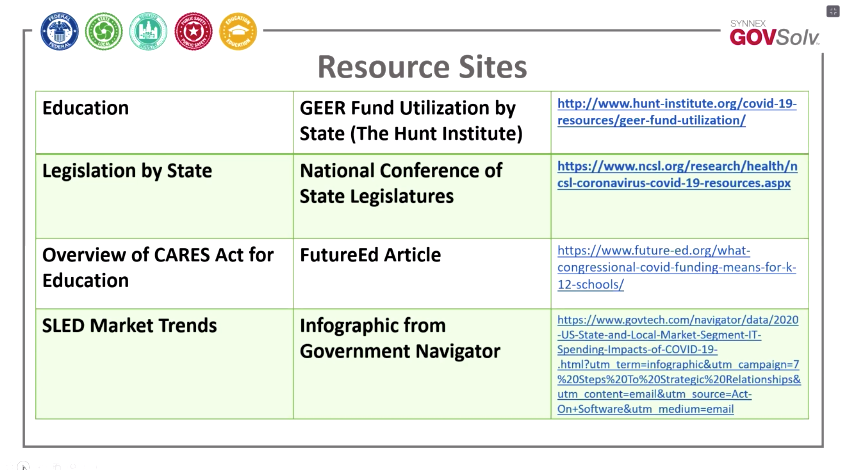
Want more info? See this helpful resource slide Odom wanted to share with all our readers:

Where Do We Go From Here?
During SYNNEX COLLABSolv Education Day, we dived deep into the education market and the collaborative technologies that support virtual learning. We received insights from best-in-class vendors on their education solutions set to empower the reimagined classroom for our current climate. We heard from SYNNEX education and public policy specialists discussing the new, blended virtual learning environment for fall 2020 along with the federal and state funding initiatives that will impact the AV industry. Wednesday’s event proved SYNNEX and its vendor partners are committing to be thought-leaders and innovators in the education market.
Some good news: you can still register to view the archived content.
Some more good news: SYNNEX will be holding another day of fresh content in its next installment of SYNNEX COLLABSolv LAVNCH Days. This will take place August 20, with a theme and more details to be announced soon. Keep an eye open for registration (set to open mid-August) on SYNNEX’s Twitter page and at https://theraveagency.com/lavnch-days/synnex-collabsolv.