
Behind the Booth at InfoComm 2026: An Interview With Clear-Com’s David MacKinnon

THIS IS A PROMOTED POST

InfoComm 2026 is about more than product launches — it’s about the people, strategies and ideas driving the next phase of the AV industry. In this Q&A series, exhibitors share what they’re showcasing at the show, the trends influencing their roadmap and the conversations they’re hoping to have with integrators, consultants and end users in Las Vegas. In this edition, we spoke with David MacKinnon from Clear-Com.
Q: What trends or challenges in the AV industry most influenced what you’re bringing to InfoComm 2026 this year?
A: A few big shifts are driving it:
- IP and cloud aren’t experiments anymore—they’re the default
- AV and IT have fully converged, but complexity is still a real pain point
- Expectations on latency, reliability, and mobility keep going up
- And more customers are doing broadcast-style production in more places
So what we’re focused on is pretty simple: taking all that complexity and delivering something that just works—and that production teams can actually trust in a live environment.
Q: What specific solution, product or capability should attendees make a point to see at your booth — and what real-world problem does it solve?
A: The one I’d point people to is FreeSpeak Cell and our broader private wireless intercom capability. At a high level, it solves a problem every production team is dealing with right now—they need rock-solid, low-latency comms, but they’re operating in environments where Wi‑Fi is congested, RF is unpredictable, and coverage isn’t guaranteed.
What we’re doing is bringing a more deterministic approach using private cellular, so instead of “best effort” connectivity, you get something that’s much more controlled and reliable. The goal is simple: give teams the confidence that their comms are just going to work, so they can focus on the production instead of fighting the network.
Q: Where are you seeing the most momentum right now in the AV market — and how is your company positioning itself to meet that demand?
A: We’re seeing the most momentum anywhere the lines between broadcast, live events, and enterprise are blurring. More customers are building always-on production environments—whether that’s corporate content, sports venues, or large-scale live events. At the same time, everything underneath that has shifted to IP and software-defined infrastructure, which raises the bar on scalability, manageability, and reliability. Where we’re focused is pretty straightforward. We’re bringing production-grade comms into those environments, but doing it in a way that’s actually practical to deploy and operate. That means leaning into private wireless, integrating cleanly into IP workflows, and making sure the performance is there without adding a bunch of complexity for the end user.
Q: For integrators, consultants and end users trying to navigate the show floor efficiently, what makes your booth worth adding to their must-visit list?
A: If you’re walking the floor with limited time, I’d say come by our booth because we’re focused on solving a very real, very practical problem—not just showing another piece of gear. What you’ll see is how to deliver production-grade comms in environments that weren’t traditionally built for it. We’re talking about crowded RF, unreliable Wi‑Fi, large or complex venues—places where comms are usually the weak link. What we’re showing is a way to make that reliable and predictable using private wireless, without forcing you to rethink your entire workflow. So it’s not just a demo—it’s a working answer to something most integrators and end users are already struggling with. You can look at it and immediately understand how it applies to a stadium, a corporate campus, a broadcast setup, or a live event—and more importantly, how you’d actually deploy it.
Q: Without giving everything away, is there anything new or unexpected attendees should keep an eye out for at your booth?
A: There are a couple of things we’re pretty excited to show, but I’d say the interesting part isn’t just a single new feature—it’s how some of these pieces are coming together. Without getting too far ahead of it, people should keep an eye on how we’re extending beyond just traditional intercom into more of a complete, network-aware solution. That means tighter integration with IP workflows, more flexibility in how and where you deploy, and a cleaner path to incorporating private wireless alongside existing infrastructure. The theme is really about removing friction. Not just adding capability, but making it easier to deploy, scale, and trust in real-world environments. If you’re dealing with complex venues or distributed production, you’ll see where we’re headed pretty quickly.



More Stories Like This

Clear-Com Powers Critical Communications at Rock in Rio 2026

Clear-Com played a critical role in the production communications infrastructure for Rock in Rio 2026, one of the world’s largest and most recognized music festivals. With multiple stages, major international and Brazilian artists, and a live broadcast operation reaching audiences around the world, Rock in Rio demands communications technology that can perform reliably at an […]

First Baptist Nashville Drastically Upgrades Production Communications with Clear-Com’s Arcadia Central Station

Clear-Com announced that First Baptist Nashville has upgraded its production communications with a Clear-Com intercom solution as part of a comprehensive sanctuary technology renovation led by systems integrator Mankin Media. Centered on the Arcadia Central Station, the installation delivers reliable wired and wireless communications to support worship services while preserving the integrity of the church’s […]
Clear-Com Delivers Integrated Communications for Fryderyk Awards Gala in Kraków
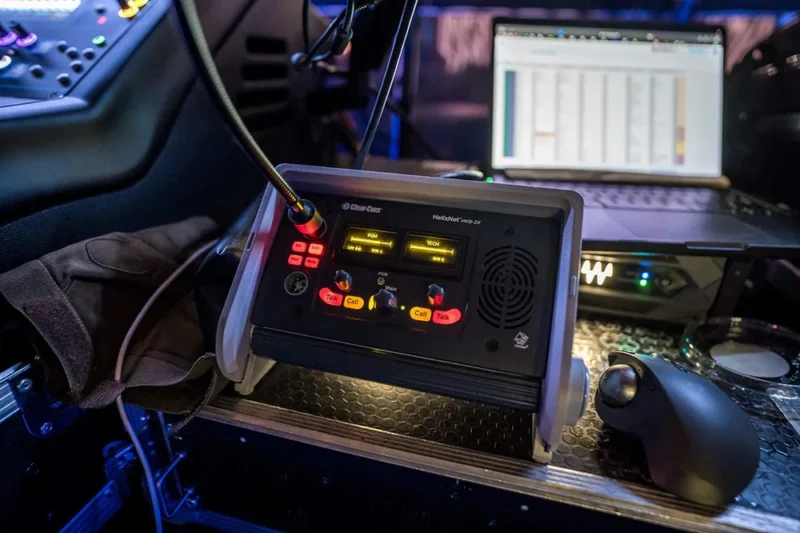
ALAMEDA, USA – July 22, 2026 – Clear-Com played a central role in delivering seamless, real-time communication for the Fryderyk Awards Gala, one of Poland’s most prestigious live music television broadcasts, held at Tauron Arena in Kraków. The large-scale production relied on Clear-Com to connect stage, broadcast, front-of-house, and technical teams throughout rehearsals and the […]