

Blackmagic Design Cameras Film “Texas Legacy in Lights”


Blackmagic Design today announced that the new live-action projection mapping film “Texas Legacy in Lights” was captured with Blackmagic URSA Cine 12K LF and Blackmagic PYXIS 6K digital film cameras.
Director John Franklin Rinehart of Austin Film Crew created the project for the Gonzales Memorial Museum, producing a first of its kind narrative film that’s projected twice a day against the large exteriors of the museum. Rinehart collaborated with DP Alex Walker for the project.
“When we first conceived ‘Texas Legacy in Lights,’ the world’s first live action projection mapping film which covers the Texas Revolution of 1835, there were a lot of technical questions and challenges that came up right off the bat. Alex and I were pioneering something together, solving problems that didn’t yet have answers. There were moments on set where we’d look at the monitor and realize we were capturing something that had never existed before,” said Rinehart.
Blackmagic Design said that the project’s main challenge was properly shooting for the architecture of the Gonzales Memorial Museum, which is 96 feet by 32 feet, about one and a half times the size of an IMAX screen.
“When you’re shooting for projection mapping, you’re shooting for the architecture of the building itself. We picked different points in the building’s architecture and different surfaces that would house various parts of the story, with the plan to blend the images together so that you could see the whole narrative on one giant canvas. In a way, we were shooting multiple films simultaneously and then compositing them into a single experience,” said Rinehart.
The company said that Rinehart selected the URSA Cine 12K LF as the A camera due to its large format RGBW sensor.
“There’s something about shooting large format that you just can’t replicate: the shallow depth of field, the scope, the cinematic feel,” said Rinehart. “Even though we were doing something very foreign to audiences, as people aren’t used to seeing multiple pieces of the story on screen at the same time, we still wanted to keep it incredibly cinematic and familiar so the audience could lose themselves in the story. At the end of the day, this wasn’t about being a technical marvel. It was about telling an incredible story in a different way.”
Blackmagic Design said that the scale of the project required five URSA Cine 12K LFs shooting simultaneously, all capturing one take. The team used DaVinci Resolve Studio across editing, color grading, visual effects (VFX) and audio post production.
“History can feel quite boring to many people, but we had the chance to make it come alive in a way that hadn’t been done before. These weren’t just historical figures, they were somebody’s grandmother, somebody’s child. The weight of that responsibility, to tell it right, to honor what they went through, that stayed with us through the entire production. And the story gets to live on for the next 15 years, for future generations,” Rinehart said.”This film, beyond its technical breakthroughs, wouldn’t be anything to talk about if we hadn’t been able to properly tell the story and let people know it won’t be forgotten. The cameras, the resolution, the workflow, all of that served a larger purpose. We built something permanent for a community that deserves to have their story told on the same scale and ambition usually reserved for major cities, and that’s what makes all the technical problem solving worth it.”



More Stories Like This
InfoComm 2026 Opens with Microsoft Keynote, Media Day and New Industry Initiatives

Microsoft keynote, inaugural Media Day, analyst briefings, and the launch of RESIDE set the tone Las Vegas, NV – June 17, 2026 – InfoComm 2026 officially opened its exhibits today at the Las Vegas Convention Center, bringing together thousands of professionals from across the AV, IT, broadcast, and integrated experience industries to explore the technologies […]
InfoComm 2026 Debuts First-Ever Media Day with Curated Press Tours Showcasing Breaking Industry Announcements

FAIRFAX, Va. June 2, 2026 — InfoComm 2026, the largest professional audiovisual trade show in North America, will debut its first-ever Media Day on Wednesday, June 17, a new, curated experience designed to give attending media and analysts early access to the most significant announcements, innovations and industry developments at this year’s show. Media Day […]
Paragon 360 Partners with Venture Church to Deliver Modern Worship Space
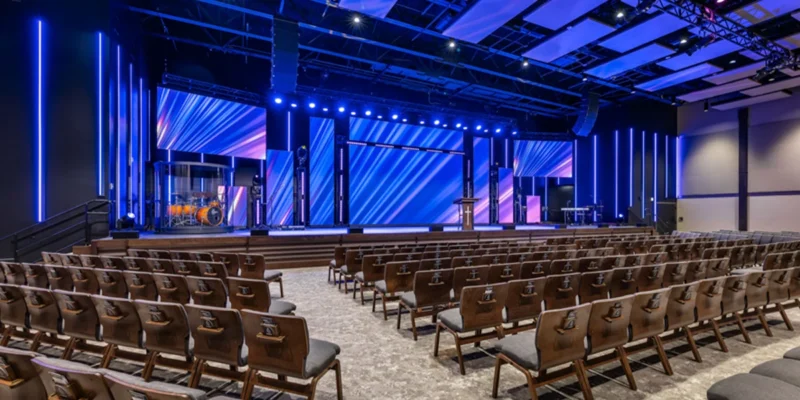
Paragon 360 partnered with Venture Church in a project with the goal to transform the portable ministry into a permanent campus designed for long-term impact. Venture Church was founded in 2016 by Pastor Tim Neptune as a portable church meeting weekly at Florida SouthWestern State College. Access to the facility was unexpectedly lost during COVID. […]