

Moving from ProAV to Broadcast AV with PTZ Cameras with Advanced Optical Performance

THIS IS A PROMOTED POST
By Jim Bask, Broadfield Distributing
Why ProAV Integrators Are Being Asked to Play in Broadcast Territory
Corporate clients are no longer satisfied with “good enough” video. After years of Zoom fatigue and the normalization of high-production livestreams from major brands, even mid-sized companies now expect broadcast-level quality for internal and external communications.
At the same time, houses of worship, higher education institutions, and performing arts venues — core ProAV verticals — are investing in streaming infrastructure that mirrors what regional television stations were running just a decade ago. The result: clients are walking into the AV integrator’s office with broadcast expectations and a ProAV budget.
Broadfield Distributing Inc. has many years of experience serving the Broadcast AV space and has seen the business from ProAV integrators grow significantly. The opportunity is financial: broadcast-capable PTZ systems command significantly higher margins, longer contracts, and stickier client relationships.
Understanding the Technical Jump: ProAV vs. Broadcast AV
Before diving into specific camera platforms, it helps to map the key differentiators between conventional ProAV PTZ cameras and their broadcast-grade counterparts.
Sensor Size and Optical Format
Most ProAV PTZ cameras use 1/2.5-inch or 1/2.8-inch CMOS sensors. These are perfectly capable for meeting rooms and classrooms, but they exhibit limited depth of field control, more noise in low light, and restricted ability to accept interchangeable broadcast glass.
Broadcast-grade PTZs move to 1-inch sensors and beyond — the same formats long used in ENG and studio cameras. Larger imagers capture more light and offer better dynamic range. These cameras allow for a shallower depth of field for a traditional cinematic look with bokeh – a style that presenters in Corporate AV and house of worship are looking for more often. For integrators, this means a client can add PTZ cameras to an existing studio camera system and achieve genuine color and resolution parity.
Signal Infrastructure
ProAV workflows lean heavily on HDMI and USB. Broadcast environments are built on SDI and AV over IP protocols including NDI, Dante AV, and ST 2110. These allow for longer cable runs without amplification and rock-solid interoperability with switchers, routers, and production systems from Sony, Panasonic, Quicklink, Grass Valley, Ross, and more.
Color Science and Matching
In a multi-camera broadcast setup, all cameras must match — not just in white balance, but in gamma curve, color matrix, skin tone rendering, and highlight rolloff. Broadcast PTZ platforms include the controls found in full-size studio cameras, allowing a technical director to dial in matching across a fleet of cameras from a single control surface or RCP (Remote Control Panel).
The Cameras: A Deep Dive

Sony ILME-FR7
The Sony ILME-FR7 occupies a category of its own in the broadcast PTZ landscape. It is the world’s first PTZ camera built around a full-frame 35mm sensor with interchangeable E-mount lenses — a specification that would have seemed implausible in a pan-tilt-zoom body just a few years ago. Where other broadcast PTZs are engineered around fixed zoom lenses optimized for specific focal ranges, the FR7 allows integrators and DPs to bring any lens in Sony’s extensive E-mount ecosystem to the installation: wide-angle primes, fast portrait glass, telephoto cinema lenses, or anamorphic optics. The result is a PTZ camera that can genuinely replicate the image character of Sony’s FX3 and FX6 cinema cameras while retaining the remote operation, preset recall, and automation capabilities expected of a broadcast PTZ.
For integrators, the FR7 opens conversations that no other PTZ can — broadcast drama production, high-end commercial shoots requiring robotic camera moves, concert and performing arts applications where depth-of-field and lens character matter as much as framing. It represents the top of the Sony PTZ line and should be positioned accordingly.
Key Specifications:
- Sensor: Full-frame (35mm) back-illuminated Exmor R CMOS sensor
- Mount: Sony E-mount (interchangeable lenses; no lens included)
- Resolution: 4K (3840×2160); 1080p. HD high-frame-rate capture up to 240
fps (recording mode dependent) - Outputs: 12G-SDI, HDMI 2.0, IP (SRT, RTSP, RTMP)
- Color Science: S-Log3, S-Cinetone, HLG and S-Gamut3.Cine workflows
compatible with Sony Cinema Line cameras - ND Filter: Electronic variable ND: Clear to 1/128 ND
- Autofocus: Fast Hybrid AF with phase-detection (inherited from FX3/FX6)
- Control: VISCA over IP, RS-422, Sony RCP compatible
- Streaming: NDI|HX, SRT
- Pan/Tilt: Pan ±170°; Tilt -30° to +195°
Sony BRC-AM7
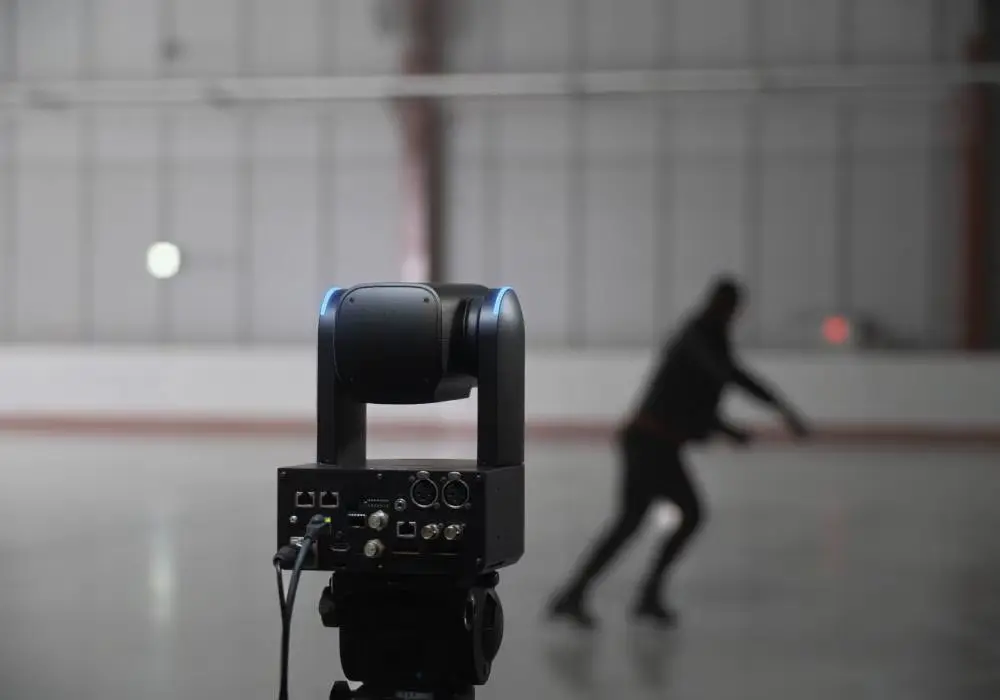
Sony’s BRC-AM7 represents one of the most significant leaps in PTZ camera engineering in recent memory. Where the FR7 is a full-frame interchangeable-lens instrument for specialized high-end applications, the BRC-AM7 is designed as a production-ready broadcast workhorse: a studio camera in a pan-tilt-zoom body, built around Sony’s latest imaging technology and offering deep compatibility with Sony broadcast infrastructure. It is also notably compact — Sony claims the BRC-AM7 is the smallest and lightest camera of its type in the world — making it practical to deploy in locations where a traditional studio camera would be structurally or aesthetically prohibitive.
Key Specifications:
- Sensor: 1.0-type Exmor RS back-illuminated CMOS; approximately 14.0
million effective pixels - Lens: Integrated 20x optical zoom (24–480mm equivalent), F2.8–4.5
- Processor: BIONZ XR image processing engine
- Resolution: Up to 4K (3840×2160) and HD formats supported
- Frame Rates: High-frame-rate HD operation supported depending on mode
and workflow configuration - Outputs: 12G-SDI, 3G SDI, HDMI 2.0, IP (NDI, SRT, RTSP, RTMP)
- Color Science: S-Log3 / S-Gamut3 workflows compatible with Sony Cinema
Line and broadcast environments - Autofocus: Focal-plane phase-detection AF with PTZ Auto Framing subject
tracking - Control: VISCA over IP, RS-422, Sony RCP compatible; S700PTP and free-d
protocol support - Special Features: PTZ Auto Framing for automated subject tracking across a
scene
The BRC-AM7’s PTZ Auto Framing capability is worth highlighting for integrators. Combined with the focal-plane phase-detection AF system, the camera can follow a performer moving across a stage — reliably and in sharp focus — without a dedicated operator. In multi-camera installations at houses of worship, performing arts venues, or broadcast studios, this enables a significantly leaner crew requirement. A performer who is actively moving around on stage can be reliably followed while precise focus is maintained.
Panasonic AW-UE160

The Panasonic AW-UE160 is a highly refined broadcast PTZ that has established itself as a workhorse in high-end corporate media centers, broadcast studios, and large-venue production environments. Its design reflects Panasonic’s deep heritage in studio camera systems: the UE160 is engineered to integrate natively into existing broadcast infrastructure, with control compatibility, color science, and signal architecture consistent with full-size studio cameras. For integrators working in environments where the PTZ cameras must coexist with a manned broadcast camera fleet — or where long-term reliability under continuous production conditions is the primary requirement — the AW-UE160 is a proven choice.
Key Specifications:
- Sensor: 1.0-type MOS single sensor
- Sensitivity: Rated sensitivity of F14 at 2000 lx
- Autofocus: Newly developed PDAF (Phase Detection Autofocus) with focus
guide for manual operation - Image Stabilization: Optical Image Stabilization (OIS) + Electronic Image
Stabilization (EIS) - Outputs: 12G-SDI, HDMI, IP (NDI|HX, SRT, RTSP)
- Color Science: V-Log; HDR (HLG) support
- Special Features: Optical low-pass filter for moiré reduction; Auto Iris
Window; professional preset management with smooth mechanical PTZ mechanism - Control: AW-RP150 Remote Camera Controller (hardware panel with joystick, paint controls, and multi-camera logic); IP-based control
Panasonic’s AW-RP150 Remote Camera Controller deserves specific attention for integrators. It is among the most capable hardware control surfaces in the broadcast PTZ category — a full panel with joystick control, preset recall, paint controls, and multi-camera switching logic. For deployments requiring a traditional broadcast production workflow, the RP150 bridges the gap between PTZ camera operation and full studio camera control.
Case Study: Panasonic and Creative Technology Deliver Studio-Quality Production Remotely
Creative Technology deployed Panasonic’s Media Production Suite alongside a suite of Panasonic PTZ cameras, including 10 AW-UE150 and 10 AW-UE160, marking the first time Panasonic’s Advanced Auto Framing technology was used in a live event setting.
Panasonic’s PTZ Cameras were deployed in a variety of formats, including hanging and mounted, offering flexible, high-quality video capture while remaining unobtrusive. Their compact footprint made them ideal for event spaces requiring discretion and minimal disruption. Panasonic’s advanced low-light performance, combined with SRT streaming protocol support, ensured a stable and consistent live stream across challenging lighting conditions and large-scale venue bandwidth typically present in broadcast environments.
Panasonic’s Advanced Auto Framing incorporated intelligent auto tracking, multi-subject image recognition, and human-like auto framing composition technologies to deliver precise, user-defined camera framing for high quality, natural content. By following presenter movement naturally, this feature ensured each session was professionally captured.
Canon CR-N700

Canon’s CR-N700 is the company’s flagship broadcast PTZ and represents the culmination of Canon’s optical engineering heritage applied to the PTZ form factor. For integrators with a history in Canon EOS and Cinema EOS products — or clients who have built production workflows around Canon color science — the CR-N700 is a natural and powerful entry point into broadcast PTZ. But it is emphatically not a consumer product: the CR-N700 competes directly on image quality with the Sony and Panasonic platforms discussed above, and in certain applications — particularly optical quality, depth-of-field character, and autofocus performance in unscripted environments — it sets the benchmark for the PTZ category.
Key Specifications:
- Sensor: 1-inch 4K CMOS (Canon-designed, same optical heritage as EOS Cinema line)
- Lens: Canon-developed 15x optical zoom (25.5–382.5mm equivalent, 15x optical zoom), f/2.8-4.5
- Resolution: 4K UHD (3840×2160) up to 59.94fps; 1080p up to 59.94fps
- Outputs: 12G-SDI, 3G-SDI, HDMI 2.0, IP (SRT, RTSP, NDI|HX support)
- Color Science: Canon Log 3 (CLog3), Wide DR, BT.709
- ND Filter: built-in ND filter system with fine adjustment steps
- Autofocus: Dual Pixel CMOS AF (Canon’s phase-detection AF from EOS Cinema line)
- Control: VISCA over IP, RS-422; Canon RC-IP100 / RC-IP1000 controllers
- Tally: Two-color tally
The CR-N700’s integrated lens was developed specifically for this camera body, and it shows. The optics are sharp corner-to-corner at all focal lengths, with excellent contrast, minimal chromatic aberration, and smooth bokeh characteristics uncommon in the PTZ category. Both the BRC-AM7 and CR-N700 share the 1-inch sensor format; Canon’s differentiation is in the proprietary optical system and Dual Pixel AF implementation, which provides a tactile depth-of-field and subject-isolation quality that cameras with narrower optical systems cannot replicate.
The Dual Pixel CMOS AF is genuinely transformative in unscripted applications. In fast-moving environments — sports post-game interviews, panel discussions where talent stands and moves, or breaking news scenarios — the CR-N700 tracks subjects reliably enough that a single operator can manage multiple cameras simultaneously with reduced risk of soft shots.
Canon Log 3 is a flat, wide-dynamic-range gamma curve designed to maximize dynamic range and simplify color grading. For live broadcast where a technical director is doing live color correction, CLog3 provides an excellent starting point with strong highlight retention. Wide DR mode offers a pre-graded HDR option suitable for direct-to-air without a separate grading step.
Case Study: Live Sports Production — AFL Saturday Night Fights
Video Destination is a production company specializing in professional live streaming for musical, corporate, and sporting events. Along with their Canon Cinema EOS workhorse cameras, Video Destination uses Canon CR-N700 PTZ cameras in places camera operators would find it difficult to maneuver to. The Auto Tracking Application allows them to frame and pick a subject to track automatically, helping to reduce the camera operator’s workload and letting them focus on other tasks such as camera switching and streaming. Learn how integrating Canon PTZ cameras into their workflow expanded the possibilities of how they capture the action during an AFL combat sport tournament.
Watch the case study here:
BirdDog XL Ultra
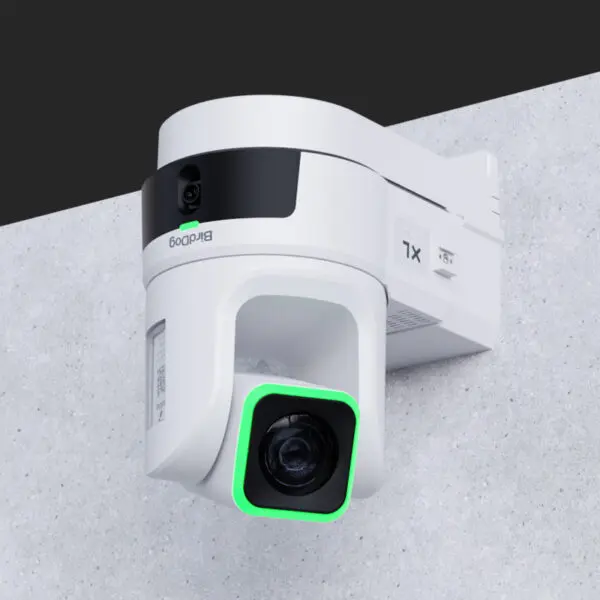
BirdDog has carved a distinctive position in the broadcast PTZ market by building its cameras around full-bandwidth NDI from the ground up. The XL Ultra is BirdDog’s flagship PTZ expression of that philosophy: a high-zoom, 4K broadcast camera engineered for IP-native production environments where NDI High Bandwidth is supported alongside NDI|HX.
For integrators deploying new facilities on NDI-based architectures — or helping existing broadcast clients migrate away from SDI infrastructure — the XL Ultra is an affordable flagship PTZ camera solution. This is a natural fit for cloud production workflows, REMI setups, and facilities designed around software-based production (vMix, Viz Vectar Plus, Quicklink StudioPro) rather than traditional broadcast routers.
Key Specifications:
- Sensor: 4/3
- Zoom: 20x optical zoom with up to 40x Zoom in HD
- Resolution: 4K UHD (3840×2160)
- Outputs: 12G-SDI, 3G-SDI, HDMI, SFP+ fiber options
- NDI: Full-bandwidth NDI, NDI|HX2, NDI|HX3
- Protocols: SRT, RTSP, RTMP
- Genlock / timecode
- FreeD
- OLPF for LED wall work
- Built-in ND filter
- Control: VISCA over IP; BirdDog Central management software
BirdDog’s software ecosystem — BirdDog Central — allows integrators to manage fleets of cameras from a single interface, monitor signal health, push firmware updates, and configure presets remotely. For IP-native workflows where a traditional RCP panel is not part of the production infrastructure, this software layer becomes the practical equivalent of a broadcast control surface.
PTZOptics: Flagship Model Announced at NAB Show 2026
PTZOptics — a manufacturer known for making PTZ cameras accessible to smaller production environments, houses of worship, and higher education — announced a new flagship model at NAB Show 2026. PTZOptics previewed an upcoming broadcast-focused camera platform featuring a reported 1-inch sensor, 20x optical zoom, 12G-SDI, HDMI, genlock, and 4K60 operation. Final specifications and release timing remain subject to change but it is anticipated for 2027.
For integrators who have built practices around PTZOptics’ accessible pricing and strong software ecosystem, the upcoming flagship is worth tracking. Additional specifications and pricing are expected to be released ahead of the 2027 launch.
Follow PTZOptics at ptzoptics.com for product updates.
Integration Considerations for ProAV Firms Entering Broadcast
Build Your Broadcast Vocabulary
Before presenting broadcast PTZ solutions to clients, ensure your sales engineers and project managers are fluent in broadcast terminology and infrastructure. Clients and their broadcast consultants will test your team’s knowledge. Training resources include SMPTE certification programs, manufacturer training academies (Sony, Panasonic, and Canon all offer structured programs), and industry organizations including the IABM and SBE (Society of Broadcast Engineers). Broadfield Distributing Inc. also has a team of sales engineers who support our sales account managers to help you find the best cameras for your clients and even help build the complete quote with cameras, mounts, IT infrastructure and more.
Partner with a Value Added Distributor
Many of the projects described in this article will help create new opportunities for your Pro AV business. As you are approached by schools, corporations, and houses of worship who are looking to produce broadcast quality content you can benefit from the years of Broadcast AV experience of Broadfield Distributing.
Lead with Total Cost of Ownership
Broadcast-grade PTZ cameras carry higher upfront costs than conventional ProAV PTZ products — the Sony ILME-FR7, BRC-AM7, Panasonic AW-UE160, Canon CR-N700, and BirdDog XL Ultra all carry broadcast level MSRPs. Frame this as a TCO conversation: broadcast-grade infrastructure lasts longer, performs more reliably under production stress, and generates higher ROI for clients who monetize their content through syndication, streaming, or licensing.
Don’t Overlook the Control Layer
Camera bodies are only one piece of the puzzle. Budget and specify properly for remote camera controllers, production switchers with broadcast-grade tally and genlock support, SDI infrastructure, and IP network design for NDI or SRT workflows. Undershooting the control layer is the most common mistake ProAV integrators make on their first broadcast project.
Service Contracts Are Your Recurring Revenue Engine
Broadcast facilities operate under significantly tighter uptime requirements than ProAV installations. A broken camera in a conference room is an inconvenience; a broken camera on a live broadcast is a crisis. This risk profile creates a compelling case for premium service contracts with guaranteed response times, spare camera bodies on-site, and remote monitoring. These contracts represent some of the strongest recurring revenue available in the AV integration business.
Conclusion: The Broadcast Opportunity Is Now
The convergence of enterprise media, live streaming, and broadcast production has created a once-in-a-generation opportunity for ProAV system integrators willing to invest in broadcast competency. The Sony ILME-FR7 and BRC-AM7, Panasonic AW-UE160, Canon CR-N700, and BirdDog XL Ultra represent the current state of the art in broadcast PTZ cameras — tools that can genuinely satisfy broadcast-quality demands while fitting within the networked, IP-centric infrastructure that ProAV firms know how to design and deploy. And with new entrants like the forthcoming PTZOptics flagship on the horizon, the category continues to evolve.
The integrators who win in this space will be those who invest now: in training, in partnerships, in demo gear, and in the language of broadcast. The clients are ready. The cameras are ready. The question is whether your firm is. Broadfield Distributing Inc. is always welcoming new system integrators and dealers who want to learn more. Call them at 800-634-5178.



More Stories Like This

Sony Cameras Power Production for Netflix’s “Wonka’s The Golden Ticket”

Sony announced that its Sony ILME-FR7 and Sony BRC-AM7 cameras powered production for Netflix’s reality competition series, “Wonka’s The Golden Ticket.” The company said that this highlights the growing role of PTZ production technology in premium television. The series premiered on Sept. 23, 2026, featuring 12 contestants and their partners inside a retro-futuristic chocolate factory […]
CEDIA Announces Winners of 2026 Smart Home Awards Americas
CEDIA officially announced the winners of the 2026 CEDIA Smart Home Awards Americas. The organization said that the year’s theme, “Beyond What You See” captured the outstanding achievements in innovation, technical excellence and design. The winners were revealed at CEDIA Expo in Denver, supported by headline sponsor Lutron, category sponsor AVPro Global and sponsors DMF […]

Want to Simplify Digital Signage at Scale? See How Sony and Carousel Approach It
THIS IS A PROMOTED POST Digital screens are no longer vessels for rotating announcements. They’re critical communication systems. But that expanded role comes with a challenge. If displays now wear many hats: internal communications, operational information, wayfinding, safety messaging and more, how do you keep them from becoming overcomplicated? I.e., How do you keep them […]