

Institut Pasteur Modernizes Paris Campus With Philips ePaper and EcoDesign Displays


Institut Pasteur has upgraded digital communications across its Paris headquarters with a network of Philips Tableaux ePaper and 3000 Series EcoDesign displays, installed in partnership with PPDS, Exaprobe and Telelogos.
The biomedical research institute selected a fleet of 20 Philips Professional Displays to modernize its aging visual infrastructure across its 538,000-square-foot campus. The five-hectare site includes 39 buildings, a conference center and 48,000 square meters of laboratory space, serving more than 3,000 staff.
Founded in 1887, Institut Pasteur sought a solution that would preserve the aesthetics of its historically significant buildings while improving energy efficiency and operational flexibility. Displays were required to meet strict standards for electrical safety and durability while supporting a reduced carbon footprint.
Romain Gentile, key account manager at PPDS, said performance, readability and energy efficiency were critical factors in the project, given the institute’s need to communicate scientific, institutional and logistical information across a wide range of environments.
The installation includes 32-inch Philips Tableaux ePaper displays and 55-inch Philips Signage 3000 Series EcoDesign models. The ePaper units are primarily used for wayfinding, mapping and campus information. Designed to operate unplugged, the displays consume power only when content is updated. According to PPDS, a single image change uses 0.0025 kilowatt-hours.
For larger-scale communications such as presentations and internal video content, the institute deployed Philips Signage 3000 Series EcoDesign displays. The 4K Ultra HD screens are designed to reduce power consumption by more than 50 percent compared with other digital signage models, while maintaining image quality. The series is also EPEAT Climate+ Gold certified, a designation that evaluates environmental and social impacts from production through end of life.
Both display types run on integrated Android system-on-chip platforms, enabling centralized management and remote control. Telelogos’ Media4Display software was integrated to provide 24/7 monitoring and content scheduling across the campus. The system allows the institute’s technical team to update messaging in real time without on-site intervention.
The integration was completed without disrupting research activities, with connectivity and content management testing conducted on site before full deployment.
Franck Fromet, AV manager at Institut Pasteur, said the new system modernizes communications while aligning with the organization’s environmental commitments.
Gentile added that the institute now benefits from a sustainable display platform tailored to its scientific environment, enabling more efficient information distribution and reduced energy consumption.


More Stories Like This

PPDS Announces ReDesign Sustainability Initiative
PPDS announced the evolution of its EcoDesign learnings with its ‘future proof product thinking,’ becoming ReDesign. The company said it has extended its circular design approach to the development of new products. PPDS said the philosophy reinforces its long term commitment to sustainability, circularity and social responsibility, embedded through every stage of its product lifecycles. […]
PPDS Launches Philips Unite LED 3000 Series
PPDS officially announced the global launch of its new Philips Unite LED 3000 Series. The company said this brings a new generation of flexible, energy conscious dvLED panels, accessible to a wide range of businesses and budgets. PPDS said that the recent launch of the Philips Signage 2000 Series as well as the introduction of […]
Philips Unite LED Brings New Energy and Seamless Collaboration Capabilities to Government Offices with a 135” All In One Display Solution
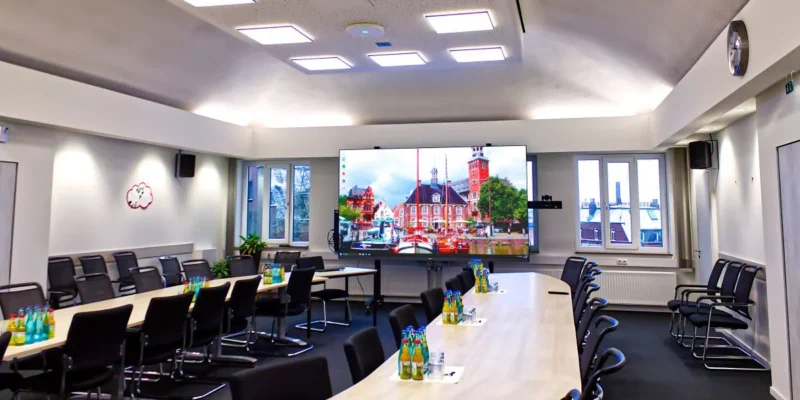
Amsterdam, July 2026: PPDS, the exclusive global provider of Philips Professional Displays, is excited to announce that its advanced Philips Unite LED 6000 Series All In One solution has been selected to deliver ‘transformational’ meeting room capabilities and experiences at the upgraded Leer Municipal government offices in Germany. Leer Municipal – based in the Rathaus […]