

Temperature Check Results: The Relationship Between AV and IT


The relationship between AV and IT teams hasn’t always been a smooth one. This month’s temperature check survey focused on this evolving relationship — some of the remaining challenges, and overlapping expectations in today’s technology workflows. The responses from you, the readers, provided perspective on this relationship. In this piece, we examine those findings and also ask experts to provide important context.
First, we asked how you would describe the relationship between AV and IT teams today.
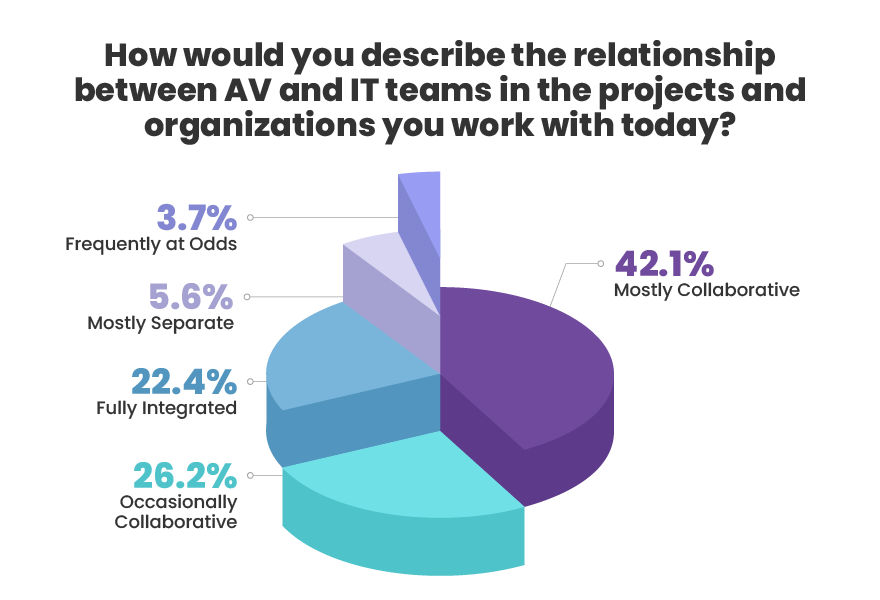
A majority of responses indicated that the relationship between the teams is mostly collaborative, with only 22.4% of respondents describing it as fully integrated.
Eric Olson, senior business development manager at Almo Pro AV, was recently featured on an Almo Pro AV webinar: “AV Meets IT: The Reality of Networked AV Systems,” alongside Wade Johnston, senior manager of learning and development at Legrand AV. Olson said that this somewhat aligns with what he is seeing in his work.
“Overall, I agree that AV and IT teams are becoming more collaborative, and I see that reflected in many projects today. As AV systems become increasingly network dependent, both teams recognize the value of working together early in the design and deployment process,” Olson said. “That said, there are still environments where IT policies can be restrictive, particularly in government, education, and financial sectors. Security requirements and strict network policies can create challenges for AV connectivity, making early collaboration between AV and IT teams essential to ensure both performance and compliance.”
John Bailey, senior vice president of technology and innovation at AVI-SPL said that he was surprised by those numbers. He said that AV and IT collaboration is an integral part of ensuring success at every stage of a project.
“That seems like a low number to me. Everything we are doing today in the Digital Workplace is either managed, governed or owned by IT. Certainly there are other service owners in the business, commonly Facilities, Marketing, Human Resources or Lines of Business. Lack of collaboration with IT will slow down or stop technology deployments, create significant IT security risks, and jeopardize end-user adoption,” he said.
Next, we asked you which IT-related skill is becoming important for AV professionals in the industry.

Networking was identified as the leading IT-related skill that is becoming increasingly expected for AV professionals to adopt. Johnston said that networking is emerging as a critical skill for AV professionals because remote monitoring, management and support are now becoming expectations for AV systems.
“The reality is that today’s AV professional is becoming part AV expert and part network professional. Those who can bridge both disciplines are better positioned to deliver reliable user experiences while helping organizations save time, reduce support costs and scale their technology ecosystems more effectively,” he said.
Olson provided similar insights. He said that from his perspective, the increased value of networking in the industry has made collaboration between AV and IT teams more important than ever.
“As AV systems have evolved from standalone technologies to network connected platforms, AV professionals need a solid understanding of networking concepts such as IP addressing, multicast, VLANs, QoS, cybersecurity and bandwidth management. This has helped bridge the gap between the two teams by creating a common technical language and enabling more productive conversations during design and deployment,” he said.
Last, we asked what you see as the biggest challenge that occurs when AV and IT teams collaborate.

Differing priorities was identified as the biggest challenge. Olson said that he has seen differing priorities arise in collaborative projects, but he expects that friction to reduce as teams are expected to manage connected experiences for end users through a combination of skills.
“I think the biggest disconnect is that both teams often have different priorities. The AV team is focused on delivering an exceptional user experience. They want the system to be intuitive and reliable. IT is focused on protecting the network, maintaining security, and minimizing operational risk,” he said. “Neither side is wrong; they’re simply optimizing for different outcomes. The projects that go smoothly are the ones where everyone sits down early, agrees on network requirements, defines responsibilities, and designs the infrastructure together rather than treating networking as something to figure out during commissioning.”
Johnston said that while he anticipates most of the friction between teams to disappear in the future due to the importance of networking, some struggles will remain due to these differing priorities. He said that strong relationships between AV and IT are not built overnight, but that evolving relationships will be an integral part of the success of projects.
“The organizations that are most successful are the ones where AV and IT approach deployments as a shared responsibility. The more we invest in cross-functional education, planning, and communication, the faster both industries will adapt to an increasingly network-driven future. Ultimately, successful AV-over-IP deployments are not an AV project or an IT project, they’re a team effort.”



More Stories Like This

One Equity Partners to Acquire Almo Pro AV Parent Nexora

One Equity Partners (OEP) has entered into an agreement to acquire Nexora, the parent company of Almo Pro AV, with the transaction expected to close by March 2027. The proposed acquisition is expected to support investments in technology, digital services and distribution operations across North America and Europe. For Almo Pro AV’s integrator customers and […]

rAVe October 2026 Temperature Check Survey — Now Open

In an industry that evolves as quickly as AV, learning doesn’t stop after your first job or your first certification. New technologies, changing customer expectations and evolving best practices mean professional development is an ongoing part of the job. This month’s Temperature Check explores how AV professionals continue to grow, what role certifications play and […]
Rants & rAVes — Episode 1547: From AV Cybersecurity to Drones: What We’re Teaching at E4 Boston

E4 Boston is coming up Oct. 15, and I’m not the only one taking the stage. In this Rants & rAVes episode, I’m joined by AVNation’s Tim Albright and Almo Pro AV’s Patrick Booth and Eric Jameson for a preview of the education we’re bringing to the next E4 Experience. Tim dives into AV network […]