

The AV Forecast Is Partly Cloudy With a Chance of Edge

For the better part of the last decade, the technology industry treated “The Cloud” like the answer to every question. Need more processing power? Cloud. Need analytics? Cloud. Need AI? Definitely cloud. For a while, that was the industry’s favorite chorus.
And for a while, that made perfect sense.
Centralized cloud computing gave organizations enormous flexibility. Instead of stuffing every office, meeting room or branch location with expensive dedicated hardware, companies could offload workloads to massive hyperscale environments run by firms with virtually unlimited computing resources. It lowered barriers, simplified deployments and enabled capabilities that many organizations could never have built on their own.
But like most technology revolutions, the pendulum may have swung a little too far.
One of the clearest analogies comes from autonomous vehicles. Early in the development of self-driving systems, engineers quickly realized something obvious: if a car is about to hit a mother pushing a baby carriage, it cannot afford to first upload camera images to a distant cloud platform, wait for an AI engine to identify the threat and then receive instructions telling it to brake.
The round-trip delay might only be measured in milliseconds, but in safety-critical systems, milliseconds matter—and the bandwidth used for the connection costs money.
That realization helped accelerate the modern push toward “edge” computing – intelligence and decision-making that happen locally, closer to where events are actually occurring.
The AV and collaboration industry is increasingly moving in the same direction, even if the stakes are usually less dramatic than a car deciding whether to stop.
Defining the Edge
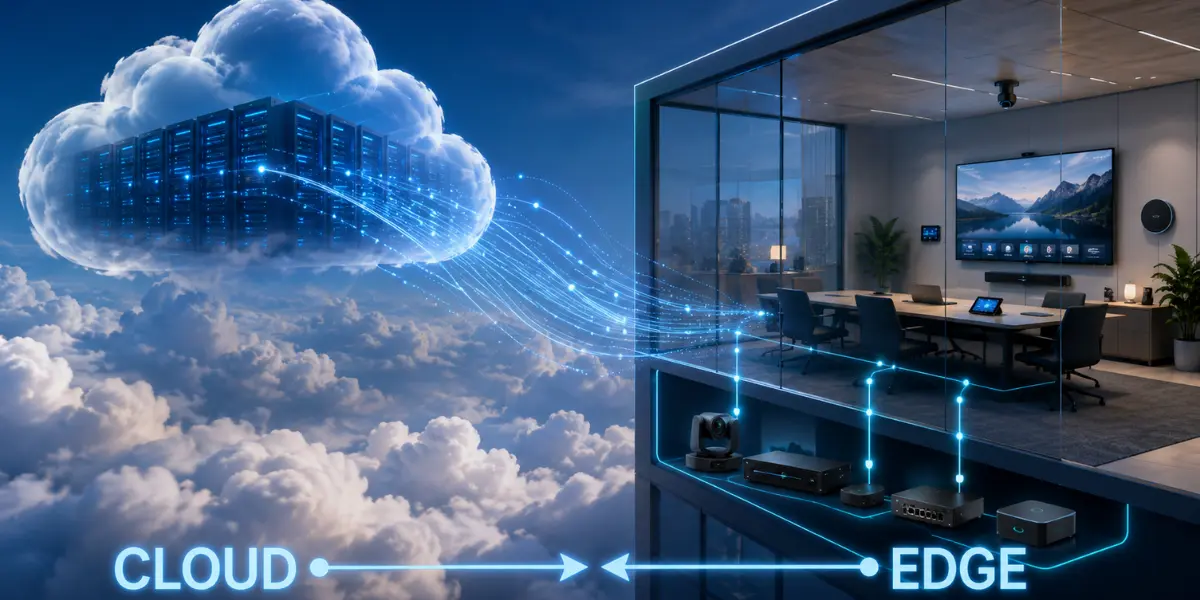
In the simplest terms, edge computing means processing data closer to the source instead of relying entirely on distant cloud infrastructure.
Sometimes the edge is literally a box. It might be a local appliance in a meeting room, a compute engine in a data center or an AI processor sitting inside a collaboration device.
Increasingly, however, the edge is becoming less about one box and more about multiple interconnected systems acting together as what could best be described as an “intelligence array.”
In these environments, intelligence is dispersed across cameras, microphones, DSPs, room controllers, compute appliances, occupancy sensors, displays and network-connected peripherals. Instead of every device independently reaching into the cloud for every decision, these systems share information locally and collaboratively.
That matters because collaboration systems are becoming dramatically more dynamic.
A modern meeting room might contain several cameras connected over IP. One camera captures the whiteboard. Another tracks the presenter. Another captures the audience. Multiple cameras capture various angles of the participants. Some intelligence somewhere in the room has to act as the “quarterback,” gathering information from the various sources and determining which camera has the best shot at any given moment.
If every one of those decisions depends on a round trip to the cloud, latency becomes a real issue. So does reliability if connectivity is interrupted.
This is why the edge conversation is suddenly becoming much more important in AV.
The Cloud Isn’t Going Away
None of this means cloud is dead.
In fact, cloud services remain enormously valuable for centralized management, large-scale analytics, software updates, fleet management, security policy enforcement, scheduling, monitoring and AI training. Many of the collaboration systems we rely on every day would be far less useful without cloud infrastructure sitting behind them.
The real trend is not “cloud versus edge” as a religious war. It is the emergence of hybrid architectures where the cloud handles broad orchestration while the edge handles time-sensitive intelligence and localized decision-making.
Where Orchestration Fits
What’s emerging now is not the elimination of the cloud, but rather a reassignment of responsibilities. Increasingly, the cloud is becoming the orchestration and management layer while the real-time intelligence lives closer to the room itself.
A company like NetSpeek illustrates that distinction well. Rather than positioning the cloud as the place where every decision must occur, the cloud becomes the supervisory layer that communicates with the various on-premise systems, verifies that devices are functioning correctly, monitors workflows, coordinates automation and helps maintain operational consistency across large deployments without heavy on-site manpower.
That is a very different philosophy from some of the broader “cloud-first” messaging we’ve heard over the last several years. In many cases, portions of the industry appear to be building cloud organizations, alliances and frameworks more than they are delivering practical solutions that solve immediate room-level problems. We may need a new term for vaporware in the cloud—“fog-ware.” The distinction matters because orchestration and execution are not necessarily the same thing.
The cloud remains ideal for visibility, analytics, management and coordination. But when immediate decisions need to occur, especially in AI-driven environments, the edge increasingly becomes where the actual work happens.
The Cloud and Edge Trade-Off
Cloud’s strengths are scale, reach, central visibility, easier updates and the ability to learn from enormous pools of data. Its weaknesses are latency, connectivity dependence, cost unpredictability and the governance discomfort that comes when sensitive data has to leave the local environment.
Edge’s strengths are speed, resilience, privacy and contextual awareness. Its weaknesses are that the intelligence has to be deployed, secured, updated and coordinated across real spaces full of real devices. In other words, cloud simplifies some operational problems, while edge introduces a different set of design and management responsibilities.
That is why the most successful collaboration architectures will likely use both. The cloud can supervise the estate while the edge can make the room work in the moment.
That shift is also being accelerated by sovereignty concerns and data repatriation efforts.
Organizations in government, healthcare, finance and regulated industries are increasingly uncomfortable with sensitive information constantly traversing public cloud environments. Some enterprises are discovering that workloads they enthusiastically migrated to the cloud a few years ago are becoming expensive, difficult to govern or problematic from a compliance perspective.
As a result, parts of the industry are quietly rediscovering the value of localized processing and on-premise intelligence. Repatriation is a word we’re hearing more and more of.
Modularity Changes the Conversation
What makes this especially interesting in collaboration is that the edge is increasingly modular.
The AV industry traditionally lived in a “best of breed” world where integrators assembled systems from multiple vendors and hoped everything cooperated after enough staging and programming.
Then came the era of tightly integrated single-vendor systems and all-in-one videobars.
Now, the industry appears to be landing somewhere in the middle.
Manufacturers are increasingly building modular collaboration ecosystems that can scale from very small rooms to very large environments while preserving centralized intelligence and operational consistency.
AudioCodes is a good example. Its room solutions increasingly resemble modular building blocks that can scale from simple collaboration spaces into more sophisticated secure deployments with centralized orchestration and management.
Neat has also embraced modularity. What started primarily as appliance-style collaboration devices has evolved into more flexible room ecosystems capable of scaling into larger and more sophisticated deployments through combinations of cameras, controllers, displays and partner technologies.
Cisco has long pursued a similar philosophy, pushing AI processing onto the edge devices themselves, with its cameras and microphones carrying audio, video, control and power over a single network cable. The result is rooms, peripherals and codecs connected through standard network infrastructure, reducing integration friction and allowing what were once isolated products to behave as coordinated platforms.
Q-SYS has arguably built much of its modern identity around distributed intelligence, with audio, video, control and automation deployed across a modular, networked architecture instead of primarily centralized hardware. This architectural emphasis has recently come into clearer focus as edge computing has become more critical to modern AV and collaboration environments.
Then there are externally bundled systems.
Barco’s ClickShare Hub combined with Logitech MeetUp 2 is a particularly interesting example because it illustrates how edge services can exist across products from entirely different manufacturers yet still be certified by platforms such as Microsoft’s Teams. The room experience is no longer dependent on one monolithic appliance doing everything. Instead, multiple specialized devices collaborate as a coordinated system.
These examples are not identical, and that is the point. Some modular systems are internally bundled by a single manufacturer. Others are externally bundled across multiple brands. Some are designed as appliance ecosystems. Others are networked platforms. What they have in common is that the collaboration room is becoming less like a single endpoint and more like a coordinated collection of intelligent parts.
The New AV “Stack”
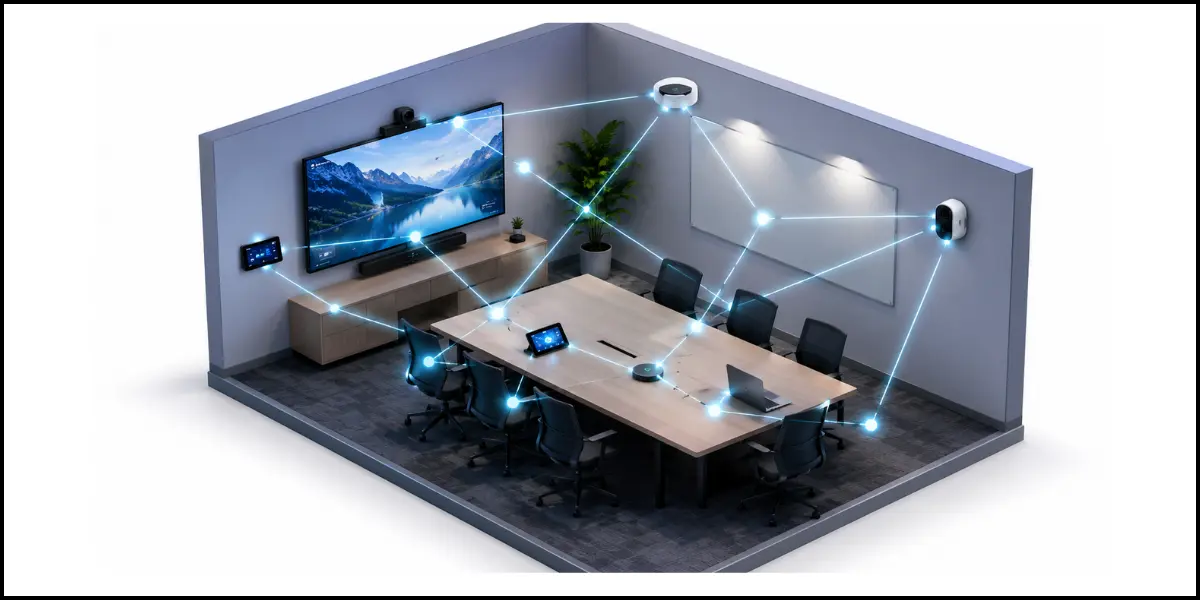 This modularity creates both opportunities and challenges.
The upside is flexibility. Organizations can scale systems more naturally, replace individual components without forklift upgrades and tailor room intelligence to specific workflows.
The downside is complexity.
As distributed intelligence grows, somebody still needs to act as the “quarterback.” Some device, platform or orchestration layer has to gather contextual data, make decisions, prioritize resources and coordinate outcomes across the broader system.
That raises important questions for the future of AV.
Will the “quarterback” be the videobar? The room operating system? The DSP? The control platform? The cloud service? The AI engine? Or some combination of all of them?
Right now, the answer appears to be “yes.”
And that may ultimately define the next phase of collaboration technology.
The industry spent years believing the future of intelligence belonged primarily in distant hyperscale data centers. Now it is rediscovering that some intelligence works best when it lives closer to the room, closer to the user, and closer to the moment decisions actually need to be made.
The future probably is not cloud-only or edge-only.
It is modular, distributed, collaborative intelligence where the cloud provides reach and scale while the edge provides speed, resilience, sovereignty, and contextual awareness.
For buyers and integrators, the practical question is no longer whether a system has cloud capabilities. Nearly everything does. The better question is where the intelligence actually lives, which component controls the local decision-making, what happens when the network connection is impaired and whether the vendor can support the full modular system rather than only its own individual box.
Ironically, after years of assuming a single device would run the room and the cloud would centralize everything, the collaboration industry is now rediscovering the value of thinking modularly and locally again.



More Stories Like This

Why the Best AV Technology Fails in the Wrong Room: An Integrator’s Guide to Environmental Optimization

By Doug Barlett, CEO, EzoBord As an AV integrator, you have likely experienced this scenario: your team designs and deploys a state-of-the-art meeting space with beamforming microphones, high-resolution displays and seamlessly integrated UC technology. The room passes commissioning. The client signs off. Then the calls start. Remote participants cannot understand people in the room. Voices […]
Building Meeting Rooms People Can Trust
THIS IS A PROMOTED POST By Brian Phillips, Director of Product Marketing for HP Poly Meeting room “success” is often measured by the technology deployed within the space. Are we using certified devices? What are the camera specs and microphone pickup? Are the camera and microphone appropriate for the room? Did we deploy the features […]

How to Communicate With Other Humans Using Technology: Part One

A lot has happened since my last column was published in 2023. I worked part time for two different companies as an independent contractor, attended or hosted (and paid for) several trade shows and mini-tech events, and so much more, but I’m not going to get into at this time. I joined A-V Services, Inc. […]