

Oregon State University Brings Interactive Virtual Forest to Life with Scalable Display Technologies


Oregon State University has created an interactive virtual replica of Oregon’s Elliot State Forest utilizing advanced technology.
This is the brainchild of Associate Professor Raffale de Amicis. Using advanced geographic datasets and LiDAR scans, de Amicis and his team at OSU’s School of Electrical Engineering and Computer Science created a digital twin of 26,000 trees across a section of Elliot State Forest.
In this virtual landscape, users can participate in the environment, easily manipulate time and weather, traverse rugged terrain and teleport to any point in the forest. The simulation also allows users to model the effects of full-scale clear-cutting, offering new insights into environmental impact and forest management. de Amicis wants to eventually scale this digital twin to encompass the entire 2.8 million-tree forest and beyond.
The creation of the digital forest started with detailed survey data provided by the Oregon Department of Forestry and was later expanded with datasets from the Oregon State University College of Forestry. This information was processed through geographic information (GIS) software to analyze and map environmental features in real-world coordinates. From there, game engines Unity and Unreal were deployed to generate the forest’s striking scenery.
To bring these virtual environments to life in physical spaces, de Amicis selected Scalable Display Technologies for its cutting-edge projection mapping and edge blending capabilities, ensuring a seamless, immersive experience.
“After doing some research, specifically when I came across technical documentation while working with Unreal Engine, I became curious about Scalable’s technical capabilities,” said de Amicis “That was the first time I encountered their software, and it prompted me to explore it further. A key benefit of Scalable’s technology is the integration with multiple platforms, like Unreal and Unity, which is essential for our use case.”
Scalable, combined with platforms like Unreal and Unity, enhances the realism of the simulation and empowers the research team to engage with the digital forest in the same dynamic way gamers interact with virtual worlds.



More Stories Like This

Scalable Display Technologies to Showcase Automated Projection Mapping on Large-Scale Mount Rushmore Display at InfoComm 2026

Cambridge, Mass. (June 9, 2026) — Scalable Display Technologies, an industry-leading application provider that automatically calibrates images’ alignment, color, intensity and geometry from multiple projectors, will showcase a large-scale immersive projection mapping demonstration at InfoComm 2026, highlighting the latest developments in its Atlas software platform. Created in recognition of America’s 250th birthday, Scalable’s demonstration will […]
Vector Simulations and Scalable Display Technologies Develop Automotive Training Simulation Solution
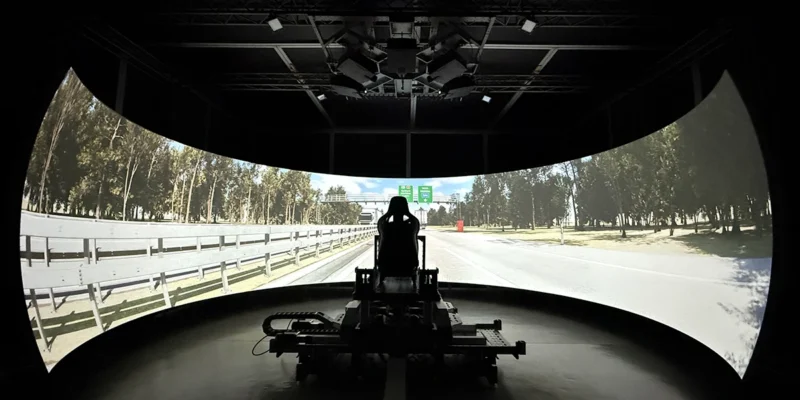
Vector Simulations AG partnered with Scalable Display technologies to engineer an advanced driving simulator designed for fully immersive experiences across a wide array of vehicles. The solution aims to provide a realistic user environment. A spherical projection screen supports the simulator alongside five projectors. Vector Simulations said that the simulator was originally designed for automotive […]

Here’s How BETA Technologies Elevated Its Aviation Training Using Scalable Technologies

Based in South Burlington, Vermont, BETA Technologies is an aerospace manufacturer developing next-generation aircraft, including electric vertical takeoff and landing (eVTOL) and electric conventional takeoff and landing (eCTOL) aircraft. Founded in 2017 by pilot and engineer Kyle Clark, the company quickly gained recognition for its pioneering work in electric aviation. BETA’s ALIA aircraft, unveiled in […]