

Designing Display Systems Without Overengineering

THIS IS A PROMOTED POST

In many large venues and shared spaces, display systems are often treated as a showcase for what technology can achieve rather than what the environment actually requires. The assumption is that higher resolution, greater brightness and more advanced configurations will naturally deliver a better experience. In practice, that approach frequently leads to overengineering, creating systems that increase cost, energy consumption and operational complexity without improving outcomes for the audience.
A more effective approach begins with a shift in perspective. Display design should not start with maximum specifications. The design should start with how the system will be viewed, what content it will support and how it will operate over time. When those factors are properly aligned, the result is a more efficient system and a design that performs more consistently in real-world conditions.
One of the most common areas where overengineering occurs in dvLED systems is pixel pitch. Pixel pitch measures the distance between individual LEDs, with tighter pixel pitches increasing LED density and, in turn, overall resolution. Specifications are often driven toward the smallest possible pixel pitch under the assumption that higher resolution always results in better image quality. In reality, the benefits of increased resolution are only meaningful within the context of the viewer’s distance from the display.
In most medium to large environments, audiences are positioned far enough away that extremely fine pixel pitches offer no visible advantage. A widely accepted guideline is that the optimal viewing distance in feet is approximately 10 times the pixel pitch in millimeters. A display with a 2.5 mm pixel pitch, for example, is ideally viewed from around 25 feet. At that distance, the difference between that display and a significantly tighter pixel pitch is largely imperceptible.
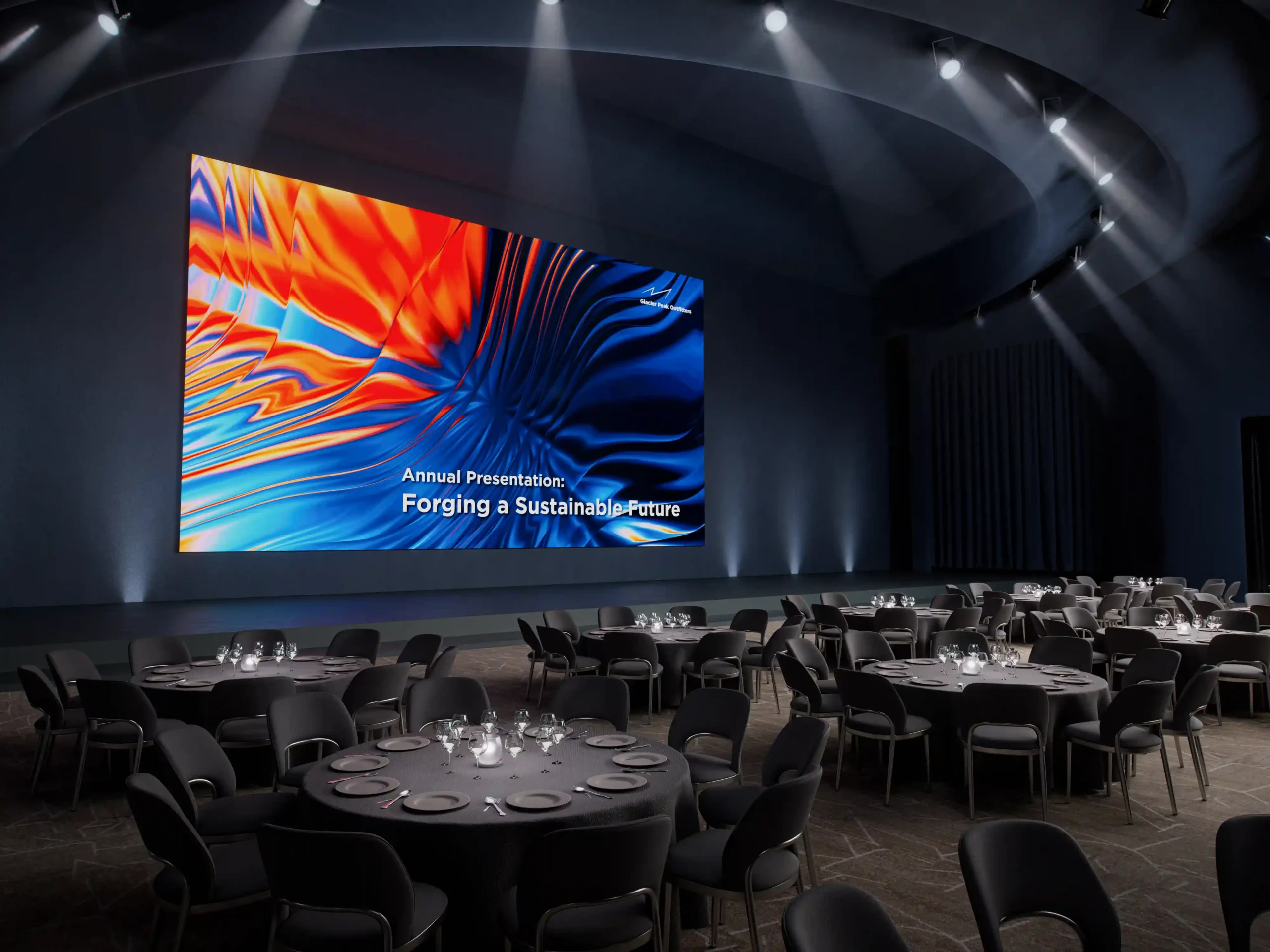
This principle becomes even more important in auditoriums, lecture halls and performance spaces, where the majority of viewers are seated at a distance. Specifying ultra-fine pixel pitches in these environments does not enhance the audience experience, but it does increase system cost, power consumption and heat output. Specifying higher-resolution displays can also introduce additional demands on content creation, as these systems require more detailed source material.
As a result, resolution should not be treated as a standalone benchmark. The resolution should be evaluated in direct relation to how the display will be used and who it is intended to serve.
Brightness presents a similar challenge. In earlier generations of display technology, particularly projection, ambient light was a significant constraint. High-brightness solutions were often necessary to maintain visibility, especially in spaces with uncontrolled lighting. While modern direct-view LED displays have reduced this dependency, the tendency to overspecify brightness remains.
In many indoor environments, extremely high brightness levels are unnecessary. Specifying an outdoor display for indoor use often results in wasted energy and increased operating costs. In some cases, systems are installed with brightness levels that must be reduced during operation to create a comfortable viewing experience.
A more measured approach considers the actual lighting conditions of the space. Natural light, architectural design and intended use all influence how much brightness is required. When brightness is aligned with the environmental factors, displays can maintain clarity and contrast without introducing unnecessary strain on power and cooling systems.
Beyond resolution and brightness, the type of content displayed also affects system requirements. Different content types place different demands on display performance, and designing without accounting for these differences can lead to mismatched capabilities.
Live video, for example, requires higher refresh rates to ensure smooth motion and to avoid visual artifacts, particularly in environments where content may be recorded or broadcast. Static content, such as presentations or digital signage, places less emphasis on motion performance but may require strong color accuracy and sharp text rendering. Data-driven content, including dashboards and visual analytics, requires greater clarity and readability at a finer level of detail.
Aspect ratio is another factor that is often overlooked. While it may be technically possible to fill an entire wall with a display, doing so can create unconventional dimensions that complicate content delivery. Nonstandard aspect ratios frequently require custom content, which adds time and cost for every use case. In many situations, aligning display dimensions with standard formats provides a more practical and sustainable solution.
Taken together, these considerations reinforce a broader point that display systems should be designed around the content they will deliver, not just the capabilities they can support.
Operational complexity is where the impact of overengineering becomes most apparent over time. Systems that appear impressive at installation can become difficult to manage if they rely on complex configurations, multiple components or specialized expertise.
Early design decisions play a role in determining how manageable a system will be. Integrated, all-in-one display solutions offer one path toward simplification. All-in-one displays are typically pre-configured, pre-calibrated and designed to reduce the need for extensive setup or ongoing adjustment. As a result, they can streamline both installation and long-term maintenance.
More traditional modular systems, while flexible, often introduce additional layers of complexity. Separate controllers, manual calibration and more involved troubleshooting processes can increase the burden on integrators and end users. Over time, this complexity can affect system reliability and increase the resources required to support it.
A design approach that prioritizes simplicity does not mean sacrificing performance. Instead, it focuses on selecting the right level of performance for the intended application. Systems that are easier to deploy, operate and maintain are more likely to deliver consistent results over their lifecycle.
Ultimately, the challenge of display design is centered around applying the technology in a way that aligns with real-world conditions. Viewing distance, ambient light, content type, and operational requirements all contribute to how a system will perform in use. Overengineering occurs when these factors are overlooked in favor of maximum specifications. The result is often a system that is more expensive and more complex than necessary, without delivering a meaningful improvement in experience.



More Stories Like This

Cal State Fullerton Uses ViewSonic dvLED to Expand Access to Data-Driven Learning

THIS IS A PROMOTED POST California State University, Fullerton, is deploying ViewSonic Direct View LED displays across learning, research and shared-use spaces to support collaboration, visual storytelling and more equitable access to professional-grade technology. The university faced a challenge shared by many higher education institutions: giving students and faculty better ways to work with complex […]

Raising the dvLED Bar at InfoComm 2026
If you attended InfoComm26, you no doubt noticed the number of companies on the floor that make Direct-View LED (dvLED) products. From well-known brands to emerging market contenders, the breadth of cabinet-based, curved and custom dvLED offerings at pixel pitches from 5mm down to 0.7mm is downright daunting, to say the least. It would be […]
Rants & rAVes — Episode 1533: All Things Epson After InfoComm 2026

InfoComm 2026 is in the books, and Epson’s Chris Teguh joins me to discuss the conversations that defined this year’s show. We talk about attendee reactions to Epson‘s latest launches, the growing interest in flexible display solutions, and the trends that stood out across projection, interactive displays and dvLED. Chris also shares what surprised him […]