
Maximizing Your Trade Show: Preparation is Key


My old boss had an aphorism that he shared with us almost daily, even more often when he was frustrated with our efforts.
“Proper preparation prevents poor performance.”
A big part of preparation is planning. And the best time to start planning is early.
Why do I bring this up now, you ask?
I’ve been tasked with preparing a matrix of regional and national-level industry trade shows in 2027.
It’s not that different from identifying and qualifying companies to cold call as prospective clients – find them, identify them and assess their suitability as a venue to find new business.
There is one key difference between cold calling businesses and reaching out to show organizers: you don’t have to get past any gatekeepers.
Show organizers actually love to hear from you, because they want to rent you a booth!
Any metrics they share with you about attendance and engagement at their show last year should be treated as a sales pitch. There’s nothing wrong with that, just keep it in mind when the show’s rep is spinning how great last year’s show was, and how this year’s will be even bigger and better.
The reason for exhibiting is straightforward: you’re there to find new business. It’s important to focus on the details that support the outcome you want – seeing a return on your investment.
As the saying goes, ‘many hands make light work.’ If you’re a dealer, ask your vendors for support. For us, the distributor, we plan to partner with both our product vendors and specific industrial dealers who actually install our products.
There are two reasons to partner up on trade shows – money and expertise. Splitting the costs co-operatively stretches the money spent on the show, and staffing the booth with people with a range of expertise covers more bases.
I don’t mind admitting that I’ve exhibited at a lot of trade shows, both as a dealer and as a brand rep. It’s important to have a strong bench of team members with various strengths, especially at shows that cater to pacific industries.
At industrial shows, there are times when you need a salesperson to talk to a prospective future customer, and there are times when you need an engineer. As a sales guy, when the prospect is an engineer themselves, introducing them to someone from our engineering team that can delve into technical details is always the right play.
I know this sounds like stating the obvious, but the best booths make a visual impact, as well as a statement that makes it absolutely clear who your company is and what you do.
Cluttered booths muddy the water. A pet peeve of mine is booths that have one of everything on display, similar to a stall at a flea market.
Now, it’s time to focus on why you’re there: generating warm leads. Engage with everyone at the show as if they just walked into your showroom – for the duration of the show, this IS your showroom!
Probe, qualify, gauge their interest and collect their contact information to follow up with them just as you would any other prospect. That’s how you make it work.
One of the nice things about exhibiting commercial and industrial solutions is that one good new contact can lead to a project that covers the cost of doing the show, and then some. Keep that in mind as you make your preparations beforehand, and even during the show.



More Stories Like This

Surviving the InfoComm Zombie Apocalypse: The Redux

It has been 13 years since I wrote the initial guide to Surviving the InfoComm Zombie Apocalypse, so I thought it was time for a reboot for 2026! Nearly 750 companies will be on the floor exhibiting at InfoComm 2026, and with around 30,000 attendees, there is potential to leave after three days transformed into an AV […]

When the Booth Lights Go Out: What InfoComm 2025 Revealed About Vendor Values

Disclaimer: This is an opinion piece. The views expressed are those of the author and don’t necessarily represent rAVe [PUBS] or its staff. Trade shows are supposed to showcase the best of what this industry has to offer — new innovations, sleek technology and fresh ideas about how to make work and communication better. InfoComm […]

22Miles Adds Trade Show AI Assistant to Its Digital Signage Platform
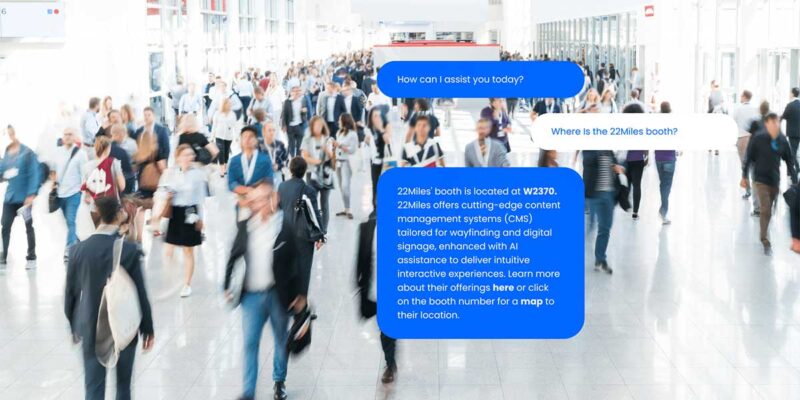
22Miles released its Tradeshow AI Assistant: a custom-trained conversational AI tool that streamlines event operations and attendee support via an engaging, user-friendly and responsive chat interface. This solution offers a “first-of-its-kind experience, leveraging the 22Miles generative AI solution integrated with the brand’s 3D Wayfinding App and content management capabilities.” Trade show organizers spend countless hours […]