
Daft Punk Lied to Us: Faster Isn’t Always Better

The other day, I read this article in Techdirt about how the so-called “billion-dollar” AI company Medvi is a giant scam. The whole thing is basically a house of lies built on fake AI-generated images and testimonials, plus a metric ton of spam. The GLP-1 drugs they dispense are glorified placebos (they’re “pharmacologically inert” in pill form). Medvi even made up their own valuation.
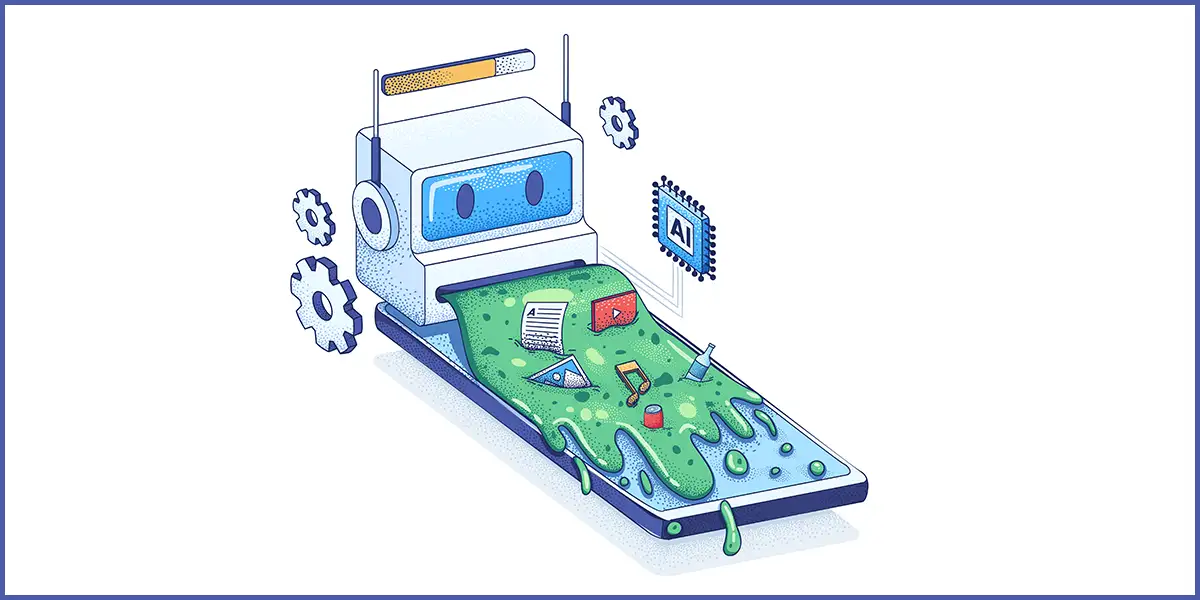
That’s the problem with so many of these new AI-driven “breakthroughs.” They promise us that we’ll be able to build things faster than ever, but we never stop to think if the thing was worth building in the first place. Faster slop is still slop.
Let’s see how this plays out with something that we interact with in our daily lives: LinkedIn posts. Some of us have jobs that rely on demonstrating that we have an online following. LinkedIn’s own documentation will tell you this: you need to post consistently in order to garner those sweet, sweet impressions. But good writing takes time, and most of us don’t have enough of it.
Enter the LLMs.
I don’t know how to tell you this, but it’s pretty obvious when you use AI to write posts for you. The 🌟 overly 😊 friendly 🤗 visit 🚪 from 👋 the ✨ emoji 😄 fairy 🧚. The gratuitous em dashes — the bane of professional writers who had their style corrupted. The phrasing? Not this. But that.
Every sentence.
Gets its own line.
Rule of three for comedy.
If I spend more than about 5 minutes on LinkedIn, all of the posts bleed together and my palms get itchy. They’ve diluted their own product by rewarding quantity over quality. And we’ve fallen into the trap along with them. People churn out their regular posts using LLMs, LinkedIn trains its LLMs on said posts, and we fall deeper into the LinkedIn Singularity.
“What Outsourcing My Critical Thinking Taught Me About B2B Sales”
The past few weeks, I didn’t have anything to say so I just … didn’t say anything. And you know what happened? LinkedIn emails me saying my impressions are down. And I’ll be honest, I felt bad the first time I got one of those.
And then I remembered that impressions are worth less than Marlboro Bucks.
I find it telling that most AI hype focuses on quantity and speed. Write more articles! Vibe code faster! There aren’t a lot of people out here saying you can use AI to make your work more thoughtful or meaningful. In my not-so-humble opinion, it’s not enough to have a good idea and then use AI to create it. It’s the long (and often tedious) work of revising your own work that makes it truly better.
I read these breathless articles about how AI allows authors to churn out more newsletters or romance novels. But the headlines never ask if the faster words are worth reading. As evidenced by my backlog of open tabs, I only have so much time for reading. I’d rather read one thoughtful think piece than have to slog my way through multiple auto-generated articles.
Does this mean that everything generated by AI is worthless? Of course not. AI is a proverbial hammer. It’s up to us to make sure we aren’t going around assuming that everything we see is a nail.
Earlier this week, I created a Power Automations to sync my personal calendar with my work calendar. I don’t know Power Automation syntax, so I clicked the little Copilot button and used a prompt. It worked, but the start/end times were consistently off by two hours.
This is where I had two choices: I could keep throwing prompts at the formulas until they seemed to work. Or I could stop and use some critical thinking skills to figure out what was really going on. It was then that I realized I needed to switch to an unrelated field to fix the problem. Using my human brain yielded a better overall solution, one that will work no matter what time zone I’m in.
I understand the appeal of AI to an overworked AV industry. We’re so often tasked with doing more work with fewer resources. The “don’t leave the electrical closet until it works” mentality is brutal and burnout inducing. But we’re sowing the seeds of our own obsolescence when we focus on speed over quality.
When was the last time you heard someone say, “I sure do love browsing LinkedIn?”
Instead of wielding AI like a sledgehammer, let’s be thoughtful about when and why we use it. Taking the time to be thoughtful involves buy-in from all of us. It starts at the top, with realistic expectations and deadlines. We need training and skill-sharing programs that help us humans create work output that’s superior to machines’. As a junior programmer, I was often given the tedious tasks that were beneath the pay grade of our senior developers. Doing this scut work was what made me a better programmer. We need to play the long game: take the time to let the next generation learn and grow.



More Stories Like This

How Multimodal Biometrics Are Being Adopted in Security and Surveillance Systems

By B. Scott SwannCEO, ROC.ai As physical security and digital identity systems converge, organizations are rethinking how identity is verified across access control, surveillance and command center environments. Single-modality biometrics, such as facial recognition alone, are increasingly being supplemented by multimodal approaches that combine face, fingerprint, iris and other identity signals to improve confidence and […]

AV Has Solved Visibility. Now It Needs Understanding.

THIS IS A PROMOTED POST A few years ago, the AV industry had a visibility problem. Today, it has a context problem. That’s a very different thing. We’ve gotten pretty good at knowing what’s happening in a room. We can tell when a display goes offline, when a camera disconnects, when a firmware update fails, […]

Two Keynotes, One Future: What Microsoft and Cisco Told Us at InfoComm 2026

InfoComm 2026 has officially wrapped, and as usual the rAVe team did an outstanding job covering the products, booths, announcements and personalities that make the show one of the most important events in professional AV. Between videos, interviews and on-site reporting, virtually every significant product announcement found its way into the rAVe coverage pipeline. One […]