
AI Guilt: Let’s Set Some Boundaries


“I don’t know, ask ChatGPT.”
Probably one of the most uttered sentences in the English language right now. Between ChatGPT, Claude, Gemini, Copilot, and others, we have so many resources at our disposal for solving problems. But every time I use one of these readily available resources, I feel guilty.
AI guilt is a new-ish psychological phenomenon where individuals “feel guilt or moral discomfort when using generative AI tools.” These tools have gained almost a scary prominence in a short amount of time. This study, in particular, looks at the use of generative AI in schools, but we feel it everywhere.
The guilt comes from many places. Am I wasting energy and water with my request? Am I participating in so much cognitive offloading that my brain is going to shrivel up due to atrophy? (I know that is dramatic lol.) Am I taking the easy way out?
Where is the line between adapting to and utilizing modern technology and using it so much that it renders all our outcomes and content the same?
I don’t know.
I’m somehow in the middle camp, wanting to use tools available to me to make my life easier, but without using them for any process or content that is supposed to feel authentically like me. My ChatGPT has gotten smarter and more adapted to my thinking and writing style the more I’ve used it, of course, but it still can’t capture my exact writing style.
Companies have started developing AI policies, and I think that is an excellent start. An enforceable policy can help employees understand the boundaries between their own thinking and creativity and where AI should begin. After all, human-created content and creativity is getting more and more rare, and thus, more and more valuable.
Not only are we experiencing AI guilt, but we’re also experiencing AI fatigue. I can’t scroll on any social media without some form of AI-generated content popping up. You can barely go anywhere without AI touching some form or fashion of the process. Again, I don’t think we should stop using it. I just think we should have boundaries.
Gary wrote a column earlier this year about something very similar. With so much manufactured and generated content around us, the people yearn to touch grass. They yearn for what is real. Boundaries and AI use policies can help us get back to that.
Thanks for reading. And sorry if I rambled or had any typos. I didn’t ask ChatGPT.



More Stories Like This
NetSpeek Announces Lena, Gen AI for ProAV
NetSpeek, a generative AI innovator in the ProAV space, has announced Lena, the world’s first Language Enabled Network Administrator built specifically to support ProAV and UC network operations. Lena automates multiple areas of installation, troubleshooting and reporting, providing organizations an intelligent solution when operating complex, multi-vendor technology ecosystems. As a cloud-based software-as-a-service (SaaS) platform, NetSpeek’s […]
Move Over Content; AI Reigns King at Microsoft Ignite 2024
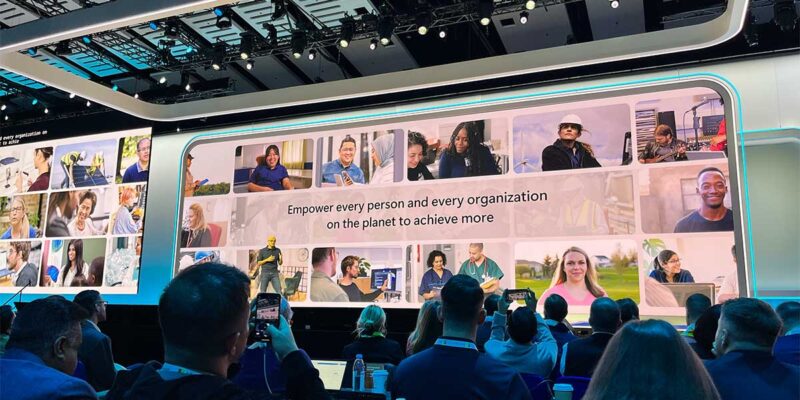
At Microsoft Ignite 2024, Copilot is the word on everyone’s lips. This became apparent to me as I sat down for the first talk of the show — the keynote — which kicked off bright and early Tuesday morning. The room was buzzing with excitement as Satya Nadella, CEO of Microsoft, took the stage to […]

Microsoft Copilot Roundup: August 2024
Welcome to this month’s Copilot for Microsoft 365 roundup! This month’s updates range from implementation in forms and quizzes to new prompt collections in sales and new languages added, so buckle up. I will include the full list of updates at the end of this article via slides in case you’re curious. Improvements in Language […]