

The Ever-Increasing Importance of High Quality Microphones


The first beamforming microphone array I ever saw was the Revoluto by Beyerdynamic, released back in 2006. It was a horizontal “corridor” microphone designed to pick up a speaker at the front of a room, even as they moved from side to side.
I’m not asserting it was the first microphone of this type; I am just relating that it was the first one I ever actually saw, and it opened my eyes to the power of microphone arrays enabled by DSP.
Ten years later, in 2016, the Shure MXA910 popularized the ceiling-mounted microphone arrays so prevalent today from companies like Shure and Sennheiser, as well as other form factors and alternative products using similar tech, like Parlé from Biamp.
These products greatly enhanced the aesthetics of drop-down ceiling mics and mitigated the infrastructure requirements for multiple ceiling- or table-mounted microphones. As the software advanced, features enabled commissioning engineers to tailor coverage patterns to mitigate unwanted noise from air registers and food wrappers during lunch-and-learns, further extending the software’s benefits.
The push toward achieving equity in hybrid meetings meant that remote participants should be able to hear everyone in the room, regardless of where they sat around the table, which added to its popularity and spread.
That brings us to the present day, where these products seem to be a de facto standard in most larger rooms.
Last week, I saw a post on LinkedIn showing a proposed new microphone product- the microphone muzzle.
The image was AI-generated, but the product development effort is not science fiction. The image showed a worker seated at their desk, wearing an apparatus not dissimilar to a fighter pilot’s oxygen mask, which includes an embedded microphone and is meant to mute the user’s voice in the office, allowing them to voice prompt AI without their coworkers hearing.
As much as I’d love to look as cool as Maverick on a daily basis, I’m uncertain of how well this product would do, having to strap and unstrap the head gear to switch between AI prompting and in person conversations.
It’s a solution that requires humans to adapt to machines, when really we should be designing machines that adapt to humans.
Whether the solution is the right one or not, it signals a larger issue as we move forward in a world of AI and voice.
Microphones will be more important than ever, not only in our hybrid meetings, but in our analog ones, and potentially even in our individual-focused work and tasks.
This issue came up in a panel discussion I was involved with, where the moderator asked what design changes we foresee given the pending shift to AI-enabled workflows and room designs. It raised its head again during another panel I did at InfoComm, where we discussed whether acoustics mattered as much as they did before, given AI’s ability to correct audio signals.
My answer, of course, was that designing for proper acoustics and good AV design should always be the general rule. AI should optimize a well-designed system, not compensate for a poorly designed one.
However, all of these questions are all related and ask the same thing.
How do we best capture high-fidelity audio in meetings and during individual work?
It now goes beyond meeting equity. With AI transcriptions, everyone needs to be heard and understood, even during in-person meetings. Microphones are for teams, not just MS Teams.
If there are five people in the meeting room, speaker attribution is key to understanding who said what. Platforms like Teams can store voice profiles to attribute speech to different participants in the room, but this requires them to be heard and understood clearly and accurately. Microphones establish identity.
With AI moving from note-taker to facilitator and active participant, high-quality audio capture is of extreme importance in guiding the group, adding key insights, and creating an action plan and deliverables at the end of the meeting. Microphones establish meaning.
This also requires more coordination between AV and design teams for great acoustics, additional private spaces, etc.
If the last 15 years were a period highly focused on the ever-increasing fidelity of video, I think the next few will show a shift towards the fidelity of audio, not only in spatial playback, but even more so in high-quality capture.
I’m hopeful we won’t all end up looking like Bane sitting at our hot desks, but I am confident that high-quality microphones will continue to increase in their importance in this new world.


More Stories Like This

Biamp Powers Change North Adelaide Sound System

Biamp officially announced that Change North Adelaide, a premier fitness and wellness destination in Adelaide, South Australia, has deployed a comprehensive Biamp audio system in an effort to deliver powerful, clear sound for high-energy training classes. It also aims to provide discreet, premium background music in its wellness and spa areas. Adelaide-based integrator Leedall installed […]
Shure Announces Next ‘Celebrating Women in Technology’ Virtual Panel with Recording Studio Pros
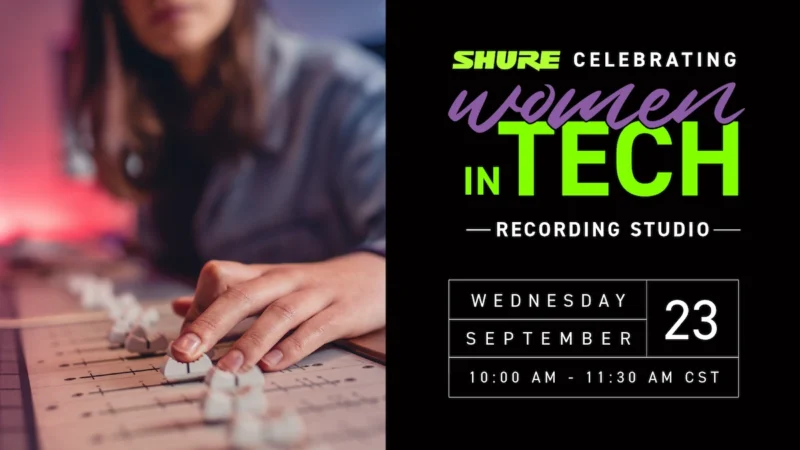
WHAT: The SIXTH in Shure’s “Celebrating Women in Technology” Panel Series features professionals from recording studios all over the world WHO: Shure President and CEO Chris Schyvinck will moderate with the following panelists: Emily Lazar: Emily is a Grammy Award-winning mastering engineer, founder of The Lodge, and a pioneer in stem mastering and immersive audio. […]
Barco Clickshare Hub Bundle Developed with Huddly and Shure Certified for Microsoft Teams

Barco announced that the new ClickShare Hub Pro room system bundle developed in partnership with Huddly and Shure has been Certified for Microsoft Teams. The bundle aims to help organizations deliver clearer audio and video in medium-sized spaces while keeping the Microsoft Teams Rooms one-touch join and ClickShare wireless content sharing experience. The new bundle […]