

You Got Your ePTZ in My PTZ — Recessed Reese’s


The Emerging Blended “Standard” for Stand-Alone Room Cameras
ISE wrapped up a little over a week ago, and I’m not going to bore you with a full recap — the rAVe crew already did a terrific job blanketing every hall and booth. What has stuck with me since getting home is a camera pattern that quietly kept showing up, one that says a lot about where conferencing cameras are headed.
We all know video bars are everywhere, and the availability of the now-standard Microsoft Device Ecosystem Platform software lowers the barrier to entry for more companies than ever. Those bars are built for small- to medium-sized rooms and almost universally use ePTZ — wide sensors and digital crops rather than motors and gears. That works just fine in those spaces.
But when you need to cover larger rooms, we still haven’t found anything that really beats a proper motorized PTZ camera with real optical zoom.
It now looks like we’re starting to congeal around a “best of both worlds” approach: a wide electronic pan-tilt-zoom camera in the base, plus a mechanical optical PTZ sitting on top, with enough brains in the housing to make both views look like they belong in the same show.
Think of those old “you got your peanut butter on my chocolate” TV commercials — two good things quietly turning into a new default recipe. (Reese’s cameras … that could also be recessed cameras. What’s not to love?)
How We Got Here — The Super-Short History Lesson
Conference rooms started with exactly what you’d expect: a single camera pointed at a table and somebody with a remote hoping to land roughly on the person speaking.
Then came the tracking era. Polycom’s EagleEye Director was essentially the first mainstream auto-tracking system in meeting rooms, listening and looking for the active speaker and driving an optical PTZ to that person. Cisco’s SpeakerTrack followed with its dual-PTZ design that bounced between talkers in a way that felt surprisingly natural for its time. Both were classic mechanical PTZ systems — the “smarts” told the motors where to go, but there was still only one real picture going to the far end.
Polycom then added an important but underappreciated step with the EagleEye Producer. It tucked an internal “room view” camera into the base of a single motorized camera. It continuously watched the whole room, counted participants and guided the attached EagleEye PTZ for group framing. That internal lens behaved like an embedded rangefinder — it informed framing and tracking, but the far end still saw the main optical camera’s output rather than a second published video feed.
All of that was phase two: tracking. Phase three was pure ePTZ — think Poly Studio X30 and X50 and their many descendants — where a single 4K wide shot gets sliced and diced digitally, no motors required. Great for many rooms and the first big wave of bars, but you eventually hit the physics wall when you try to zoom too far into that wide image.
Looking back at ISE 2026, it felt like we were finally seeing phase four — the moment when those two paths meet in stand-alone room cameras.
Multi-Camera Becomes Possible
Here’s what changed: the platforms grew up.
Microsoft Teams Rooms, Zoom Rooms and others can now handle multiple cameras in ways they simply could not a few years ago. They can ingest several simultaneous feeds, understand them as separate perspectives and let the room system or platform decide how to lay them out. That means the “helper” camera in the base no longer has to live its life as metadata. It can be a real, simultaneous source.
But to do that well, you can’t just bolt two random lenses into the same chassis and call it a day. You need enough electronics and intelligence in the box to make the optical PTZ and the digital ePTZ behave like they belong together — similar color, latency, geometry and, crucially, similar people size so you can cut between them without making everyone seasick.
Meet the Chocolate and Peanut Butter
AudioCodes was early to this party with the RXVCam70 — a 4K dual-lens PTZ camera designed for medium and large rooms. It pairs a close-up optical zoom lens with a panoramic lens in the same device. The AI under the hood handles auto-framing, speaker tracking and smart gallery-style layouts, using both lenses together: one for reach, one for context.
At ISE, Logitech put a big exclamation point on the architecture with its new Rally AI Camera family. The Rally AI Camera Pro combines a mechanical PTZ — sitting only a few inches off the wall — with a fixed wide-angle digital camera in the same body. The wide lens watches the entire space, the PTZ provides powerful zoom and close-ups and the AI decides how to blend and switch between them. Logitech also offers a variant that leans entirely on the wide digital view for spaces that don’t need the mechanical lens. And they provide mounting that can work in-wall — thus the recessed Reese’s.
Crestron, building on its 1 Beyond lineage, is very much on the same page. Its new cameras use a dual-motorized camera design in which a wide-angle reference lens with built-in visual AI constantly watches the room and directs two separate PTZ cameras. All of the visual AI is built into the camera — no external processor required — so the system can track, group-frame and dynamically compose layouts as a single stand-alone device.
Outside the usual suspects, you see similar thinking from AVer, Insta360 and others. Step back and look at the big picture and this is no longer just a novel product line — it’s a pattern.

What Makes This Different From the Old Dual-Camera Trick
On the surface, you could say, “We’ve had multiple lenses in one system before — what’s the big deal?” The difference now is intent and packaging.
In the EagleEye Producer era, the extra camera was there to whisper in the PTZ’s ear: “Two people just walked in, widen out a bit.” It didn’t expect to be seen. In the current generation, the base or reference camera is designed from the outset as a real video source, not just a silent helper.
In this emerging class:
- The ePTZ base can be a stand-alone wide shot, an always-on overview or the raw material for AI crops and smart galleries.
- The optical PTZ can provide the hero shot — presenter, whiteboard, lecturer or the far end of a long table.
- The electronics inside calibrate color, exposure, lens distortion, timing and even people scale so that you can cut between them or show them side by side without it feeling like you just switched to a different show.
In some designs, the camera exposes multiple streams — overview, close-up, presenter — and lets the platform mix and match. In others, it hides all that complexity and simply presents one composited stream quietly stitched together inside the housing.
Either way, the bottom lens has graduated from “rangefinder” to “co-star.”
The Secret Sauce — Not the Glass, but the Brains
None of this works if the only selling points are “4K sensor” and “12x optical zoom.” At this point, everyone has a spec sheet full of big numbers. The real differentiation in this emerging standard is what happens between the lenses:
- How well does the system equalize people size when switching between the wide and the PTZ view?
- How smooth are the cuts and moves — does it feel like a director or a cat chasing a laser pointer? Can you set it to prioritize one specific presenter?
- Can the device present different logical views to the platform — speaker view, room overview, front-row gallery — or is it stuck pretending to be a single, dumb UVC camera?
- How gracefully does it fail? Can it fall back to a wide ePTZ shot if tracking misbehaves, or does the meeting become a live demo of why IT doesn’t trust fancy cameras?
Those answers live entirely in firmware, silicon and software. The physical architecture — a reference or ePTZ camera in the base and a mechanical PTZ on top — is starting to look standardized. The experience will still vary wildly based on how each vendor writes the story between those two lenses.
My Prior Predictions
I still use Star Trek as the core reference for where we’re headed. In any example of video communications from a starship bridge, you never see a camera. The cameras are correctly categorized as sensors, and they use intelligence in the background to frame an appropriate shot at all times — from the captain in the chair to the science officer at a side station.
The sensors are smart. They know what’s going on and continuously process the appropriate shot for the far end without anyone shouting “pan left.” That form of smart camera array and digital processing is what I predicted as the future in a 2015 article on the subject. These new “best of both worlds” stand-alone cameras are baby steps along that same journey.
What to Watch for Next
So what should you do with this information as an integrator, consultant or buyer who just wanted “a camera for the room” and wound up reading about dual-lens AI hybrids?
A few thoughts:
Assume this architecture will spread
If one or two vendors were doing it, you could call it a trick. When it shows up from AudioCodes, Logitech, Crestron, AVer, Insta360 and more, it starts to look like table stakes for serious rooms. Even Cisco’s newer modular systems — pairing ePTZ-style multi-lens bars with external PTZ cameras over IP and HDMI from a single codec — are effectively camera arrays already, even if they aren’t marketed that way.
Start asking pointed questions
When a vendor shows you their new dual-lens wonder, ask: Is that base camera a true source or just a helper? Can I expose both views in Teams or Zoom if I want to? How do you keep people the same size when you switch?
Match the architecture to the room, not the brochure
Long tables, training rooms, classrooms and multipurpose spaces are obvious winners for this approach. Tiny huddle rooms may be fine with a simpler ePTZ-only bar. The fact that you can get dual lenses doesn’t mean you always should.
Remember that “standard” does not mean “identical”
The industry may be converging on a common physical layout — digital or analytics eye in the base, optical eye on top — but the magic is in how each vendor uses it. That’s where your evals, demos and shootouts still matter.
The bigger takeaway from ISE 2026 is that cameras are quietly turning into little studios — multiple views, internal switching, AI shot selection — all hidden behind a single USB or network connection. First we had cameras. Then we had tracking. Then we had ePTZ. Now we’re in the era of “both, please,” with platforms finally ready to drink from more than one fire hose.
If that sounds a bit more like a Starfleet sensor array than a traditional conference camera, that’s kind of the point.
If you’re speccing or buying room systems over the next few years, keep this on your mental checklist. When you see a camera with a big eye on top and a subtle little eye in the base, don’t assume it’s a gimmick. That may very well be the new normal.


More Stories Like This

Spark Announces Expansion for 2027 Event Following 2026 Debut

Spark 2026, powered by Samsung, made its official debut at ISE as a new event designed to connect the creative and production communities shaping the future of content and immersive experiences. Creators, brands, broadcasters, agencies, in-house teams and production innovators gathered to explore creative practices and the design and production of modern content across live, […]
Digital Signage Summit 2026 Celebrated 20th Anniversary with Industry Discussions
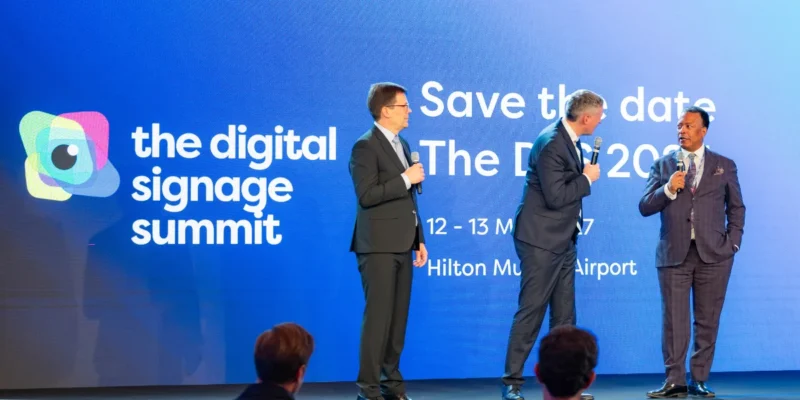
Integrated Systems Events (ISE) reflected on this year’s Digital Signage Summit (DSS), which examined the forces actively reshaping how digital signage and DOOH networks are built, managed and scaled. DSS 2026 marked its 20th year anniversary, highlighting how rapidly the industry is evolving, and why leadership dialogue is more important than ever. The event lasted […]

The Most Overlooked Product at ISE 2026

The crowds packed ISE this year. We escaped the main artery of the hall, turned a corner and found ourselves in a quiet aisle. There, tucked away on the edge of a massive stand in Hall 3, was the real story of the show. As the content tour leader for ISE’s VIP tours, my job […]