

The Most Overlooked Product at ISE 2026

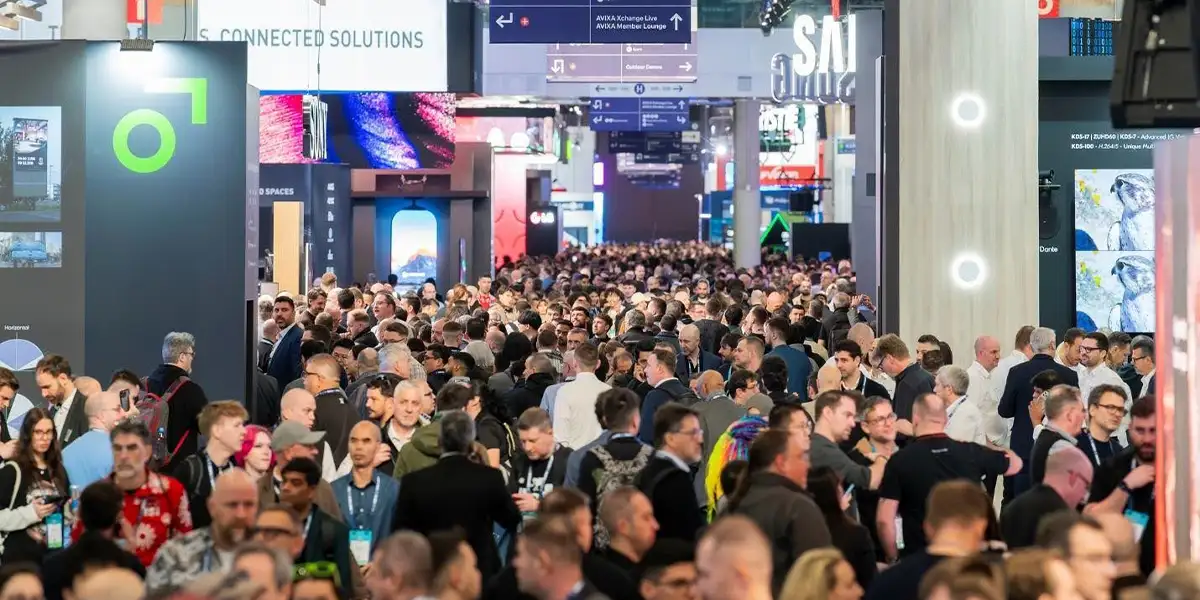
The crowds packed ISE this year. We escaped the main artery of the hall, turned a corner and found ourselves in a quiet aisle. There, tucked away on the edge of a massive stand in Hall 3, was the real story of the show.
As the content tour leader for ISE’s VIP tours, my job is to point out the hot products. That’s no easy feat because the “hottest” products are usually swamped. You have to wait your turn just to get a clear view.
Yet, ignored by much of the press and general foot traffic, this particular display was easy for my tours to visit and surround without disruption.
rAVe, with its blanket coverage, caught it on video, but other media outlets only managed a tepid rewrite of the press release.
Could the Raspberry Pi Smart Display Module have been the most overlooked product at ISE 2026?
In fairness, Sharp Corporation showed plenty of other “shock-and-awe” products — the 55-inch ePaper display comes to mind. But the smart salespeople were quietly ushering customers toward the “Modularity” wall to see this module, which Sharp co-developed.
This isn’t just a hobbyist board. It’s an adapter for the Compute Module 5 (CM5), the industrial-strength variant of the Raspberry Pi 5. The CM5 provides up to three times higher CPU performance and superior storage bandwidth compared to the previous generation. But the real magic is Intel SDM compliance. You slide the module directly into a compatible professional display, drawing power straight from the screen. It eliminates external boxes, messy cabling and wall warts, resulting in an ultra-clean, always-on installation.
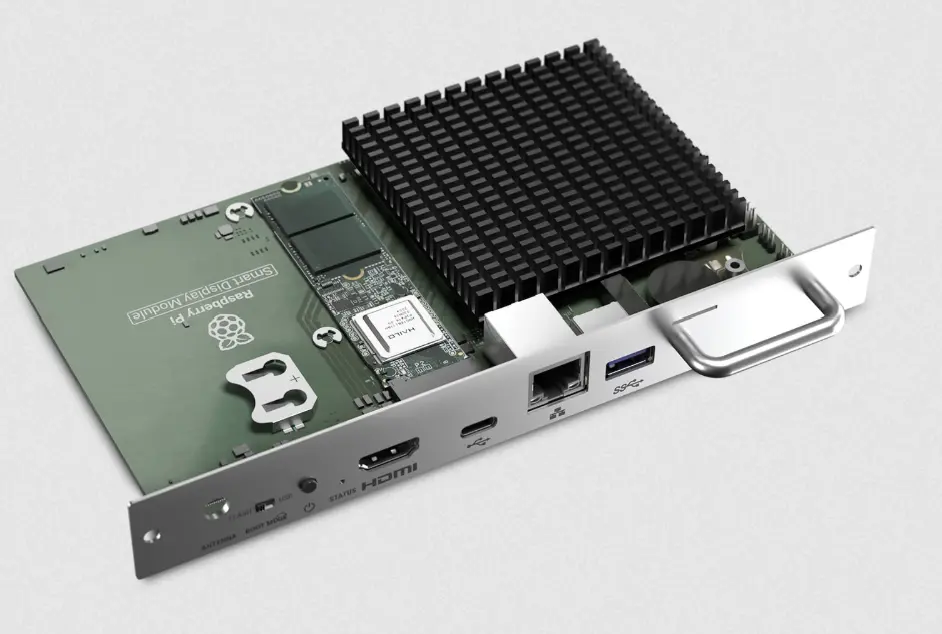
It even includes an M.2 slot for AI accelerators. Professionals are already eyeing it for complex multiscreen configurations because it supports a second independent HDMI stream.
Why This Matters to ProAV
Corporate display and digital signage are the heavyweights that draw the crowds at ISE. This module feeds directly into those trends by offering small size, affordability and an open-source backbone built around Python, Docker and third-party CMS platforms. The anticipated price for the adapter board is a steal — roughly $25, plus the cost of the CM5.
Critically, it future-proofs an installation for local edge AI. By adding an accelerator such as Hailo into that M.2 slot, users can run real-time video analytics and facial recognition within the screen itself, without relying on the cloud.
Raspberry Pi is proven — it has spent years aboard the International Space Station — which makes embedding one inside a display look almost conservative.
But most importantly, it brings the Raspberry Pi community into our sphere. That is what excites me. There are 60 million Pi units in the wild, with another 8 million expected this year. The community is roughly split between industrial applications and hobbyists, but the common thread is enthusiasm.
Let’s be clear: conforming to the Intel SDM specification is a massive win for basic digital signage. But if all you see is a low-cost media player for looping corporate propaganda in a lobby, you’re missing a big slice of this Pi.
The maker community never viewed a screen as a passive canvas. To them, it’s a two-way, data-driven interaction node. This new adapter gives integrators the enterprise-grade reliability needed to commercialize that mindset.
If you want to stop selling commoditized hardware and start selling “smart space orchestration,” here are seven ways this hardware changes the equation:
- Integrators usually push content out. The Pi community uses dashboards such as Grafana to pull data in. In a smart building, these displays become localized hubs showing real-time metrics such as room occupancy or air quality — tangible proof of ROI for an IoT ecosystem.
- Enterprise clients need hundreds of touch screens. Selling a proprietary $1,500 panel is a hard sell to a CFO. A fleet of SDM-equipped displays driven by Pi — tied directly into Microsoft 365 — is a highly scalable, professional alternative.
- By leveraging the Pi’s GPIO architecture, integrators can easily build retail displays where picking up a product or triggering a sensor instantly changes the content. Experiential AV just got democratized.
- This module can be used for backstage monitors, lyric and teleprompter walls or live data visualization at concerts, theaters and conferences. The second HDMI output can simultaneously feed a projector or stage screen while the Pi runs scheduling software, cues or even real-time AI transcription. It’s portable enough to work with a VESA-mounted display on a stand.
- We often forget that AV bleeds into logistics. A commercial display with an embedded Pi is perfect for ruggedized touchpanels or digital Kanban boards in a mechanical room where a full PC is overkill.
- With the CM5 and an AI accelerator, these displays become visual feedback loops. Think of a retail display running local demographic analysis or a security monitor highlighting unticketed individuals — all processed privately at the edge.
- The “Magic Mirror” is probably the most famous Pi project on earth. It’s time we brought that into high-end hospitality and executive suites. Creating displays hidden behind two-way glass until they show a personalized greeting moves you away from selling “a rectangle on a wall” and toward premium experiential design.
This Could Be a New Paradigm
By aligning with the Intel SDM standard, co-developing with Sharp and pairing the architecture with the Compute Module 5, Raspberry Pi has transformed what was once a clever embedded signage option into a genuinely scalable, enterprise-grade building block.
This isn’t just a cleaner way to run digital signage. It’s a quiet handoff of control back to integrators, developers and IT teams that want displays to behave like edge computers — capable of orchestration, analytics, automation and AI — without the visual clutter and fragility of bolted-on PCs.
If this product felt invisible on the ISE show floor, it’s because its real impact won’t be measured in booth traffic, but in how many “screens” stop being screens altogether.
The ProAV industry has traditionally viewed a screen as an output device. This module offers a reliable bridge between the boundless creativity of the Raspberry Pi maker community and the rigorous demands of corporate AV and enterprise IT.


More Stories Like This

Want to Simplify Digital Signage at Scale? See How Sony and Carousel Approach It
THIS IS A PROMOTED POST Digital screens are no longer vessels for rotating announcements. They’re critical communication systems. But that expanded role comes with a challenge. If displays now wear many hats: internal communications, operational information, wayfinding, safety messaging and more, how do you keep them from becoming overcomplicated? I.e., How do you keep them […]

Sharp Launches Q-SYS Verified Plugin for Large-Screen Displays

The audio-visual technology business within Sharp Imaging and Information Company of America, a division of Sharp Electronics Corporation, today announced the Sharp Displays control plugin, which aims to enable direct control and monitoring from within the Q-SYS Full Stack AV Platform. The company said the plugin has received the Q-SYS Verified badge and is now […]
EasySignage Certified as Powered by Raspberry Pi
EasySignage announced that it has earned official certification as “Powered by Raspberry Pi” from Raspberry Pi Ltd. The company said the certification confirms that EasySignage meets the quality and compatibility standards necessary to carry the “Powered by Raspberry Pi” mark, and it places EasySignage in the official Powered by Raspberry Pi product catalogue under the […]